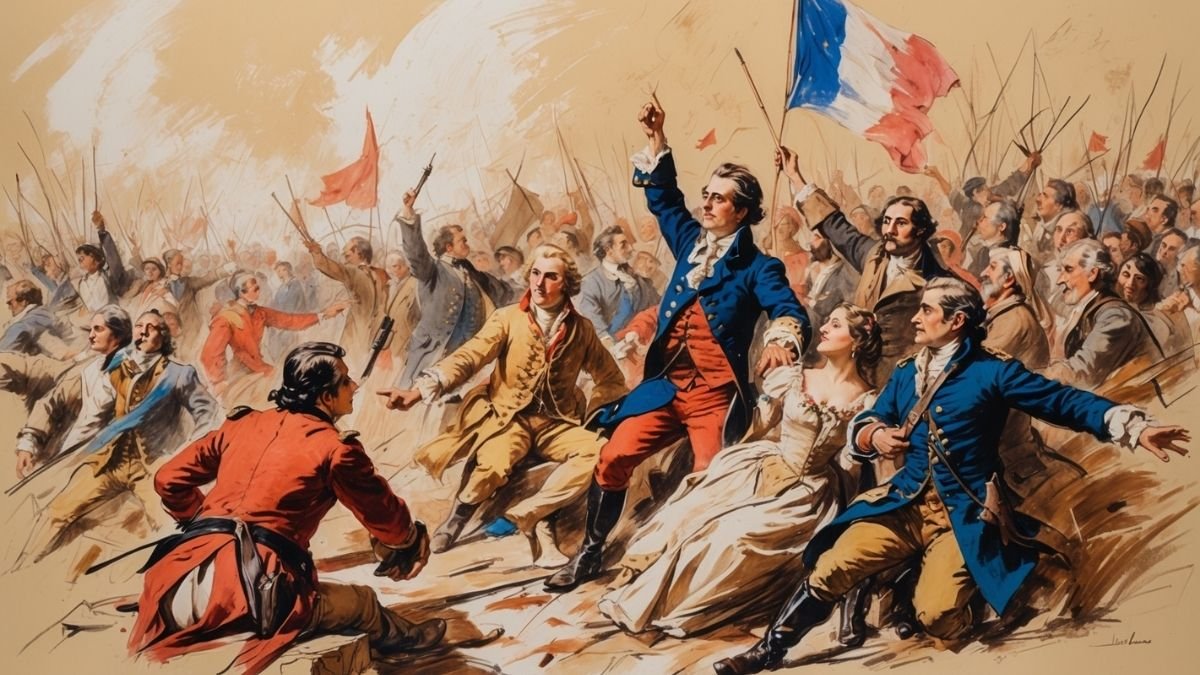
Excel in Listening: The History of the French Revolution
Welcome back to your advanced listening practice. Today we’re tackling a complex historical topic: The History of the French Revolution. When listening to a historical narrative, it’s crucial to follow the sequence of events. Listen for chronological cues—words like “first,” “then,” “following this,” “in 1789,” or “a decade later.” These phrases are your roadmap through the timeline.
A useful strategy is to create a simple timeline in your notes. As you hear key dates or events, jot them down in order. This will not only help you answer questions about “what happened when” but also help you understand cause and effect. Why did one event lead to another? Understanding this flow is key to mastering comprehension of historical lectures. Let’s dive in.
Listening Audio
[ppp_patron_only level=5]
[/ppp_patron_only]
Listening Transcript: Please do not read the transcript before you listen and answer the questions.
The History of the French Revolution
Good afternoon. The French Revolution, which officially began in 1789, stands as one of the most pivotal and tumultuous periods in modern European history. It was not a single event, but a decade-long maelstrom of social and political upheaval that completely reshaped France and had far-reaching consequences for the entire world. To understand how this cataclysmic event occurred, we must first examine the society that preceded it: the Ancien Régime.
Pre-revolutionary France was a kingdom of profound inequality, rigidly divided into three social classes, or Estates. The First Estate was the clergy, the Second Estate was the nobility, and the Third Estate encompassed everyone else—from peasants to the urban poor to the educated middle class, the bourgeoisie. The first two Estates, a tiny fraction of the population, enjoyed immense wealth and privilege, including exemption from most taxes. The Third Estate, which made up over 97% of the population, bore the entire tax burden while having virtually no political power. This deeply unjust social structure, combined with a severe financial crisis in the French government—made worse by extravagant royal spending and costly wars—created a powder keg of resentment. The ideas of the Enlightenment, with their emphasis on liberty, equality, and the rights of man, provided the intellectual spark.
The immediate trigger for the revolution came in 1789. King Louis XVI, facing bankruptcy, was forced to convene the Estates-General, a type of parliament that hadn’t met in 175 years. A dispute quickly arose over voting procedures. The Third Estate, realizing it would be consistently outvoted by the other two, took a radical step. They declared themselves the National Assembly, the true representatives of the French people, and took the famous Tennis Court Oath, vowing not to disband until a new constitution was written.
The revolution rapidly gained momentum in the streets of Paris. On July 14, 1789, fears that the king was preparing to crush the new assembly led a mob to storm the Bastille, a medieval fortress used as a prison and a symbol of royal tyranny. This act, while of little strategic importance, was a colossal symbolic victory for the revolutionaries and is still celebrated as France’s national day. In the months that followed, the National Assembly abolished feudalism and issued the Declaration of the Rights of Man and of the Citizen, a foundational document that proclaimed all citizens were to be equal before the law.
However, the initial phase of constitutional monarchy soon gave way to a more radical and violent chapter. In 1792, the monarchy was abolished, and France was declared a republic. King Louis XVI was tried for treason and executed by the newly invented guillotine in January 1793. His execution sent shockwaves across Europe, and France found itself at war with neighboring monarchies who feared the revolution would spread.
This external threat, combined with internal counter-revolutions, led to the darkest period of the revolution: the Reign of Terror, from 1793 to 1794. Dominated by the Committee of Public Safety and its most influential figure, Maximilien Robespierre, the revolution sought to purge itself of any “enemies.” A climate of extreme paranoia and suspicion descended. Vague accusations were enough to lead to a trial and, almost inevitably, a trip to the guillotine. Tens of thousands of people were executed during this period, a brutal irony given the revolution’s initial ideals of liberty. The Terror eventually consumed its own creators. In July 1794, Robespierre himself was arrested and guillotined, bringing the most radical phase of the revolution to an end.
What followed was a period of instability and moderation known as the Directory. The government was weak, corrupt, and ineffective, unable to solve France’s persistent economic problems or military challenges. This power vacuum created an opportunity for an ambitious and brilliant young general who had achieved remarkable victories for the French army: Napoleon Bonaparte. In 1799, in a swift military takeover known as a coup d’état, Napoleon overthrew the Directory and established himself as First Consul of France. While this event effectively ended the French Revolution, it also cemented many of its changes. Napoleon would go on to consolidate power, eventually declaring himself Emperor and embarking on a campaign to dominate Europe.
In conclusion, the legacy of the French Revolution is profoundly ambiguous. It began with the noblest of ideals—liberty, equality, fraternity—but descended into horrific violence and terror. It failed to establish a stable, lasting democracy, instead paving the way for a military dictatorship. Yet, it was undeniably a watershed moment. It destroyed the Ancien Régime, ended feudalism in France, and spread the powerful and transformative ideas of popular sovereignty and individual rights across the globe. The revolution demonstrated that an oppressed populace could rise up and fundamentally alter the structure of their society, a lesson that would inspire and terrify people for generations to come.
Listening Quiz
Keywords & Phrases
- Pivotal: (adjective) This means of crucial importance in relation to the development or success of something else. We described the revolution as a “pivotal” period because it was a turning point in European history.
- Tumultuous: (adjective) This word describes a state of confusion, disorder, or conflict. Calling the revolution a “tumultuous period” captures the chaos and violence of that time.
- Ancien Régime: (phrase) A French phrase that literally means “old rule.” As explained in the lecture, it refers specifically to the political and social system of monarchy and feudal privilege in France before the 1789 revolution.
- Bourgeoisie: (noun) Another French word, this refers to the middle class, especially those who were educated and involved in commerce or professional work. In the context of the revolution, the “bourgeoisie” were a key part of the Third Estate who drove many of the initial changes.
- Powder keg: (idiom) A barrel of gunpowder. We used this metaphorically— “a powder keg of resentment”—to describe the pre-revolutionary situation as extremely volatile and ready to explode into violence with just a small trigger.
- Tennis Court Oath: (phrase) This refers to the specific historical pledge taken by members of the French Third Estate in 1789. They were locked out of their usual meeting hall and gathered in an indoor tennis court, where they vowed not to separate until they had drafted a new constitution.
- Cataclysmic: (adjective) This means relating to a large-scale and violent event in the natural world, like an earthquake. We used it to describe the revolution as a “cataclysmic event” to emphasize its sudden, violent, and transformative nature.
- Guillotine: (noun) The infamous device used for beheading people during the French Revolution. Mentioning the “newly invented guillotine” highlights the cold, mechanical efficiency of the violence during the Reign of Terror.
- Coup d’état: (phrase) A French term meaning “blow of state.” As used in the lecture, it refers to the sudden, illegal, and often violent seizure of power from a government, which is exactly what Napoleon did in 1799.
- Watershed moment: (idiom) A watershed is the line of high land from which rivers flow in different directions. A “watershed moment” is a turning point, an event that marks a significant change in course. We called the revolution a “watershed moment” because after it happened, the course of history was permanently altered.










0 Comments