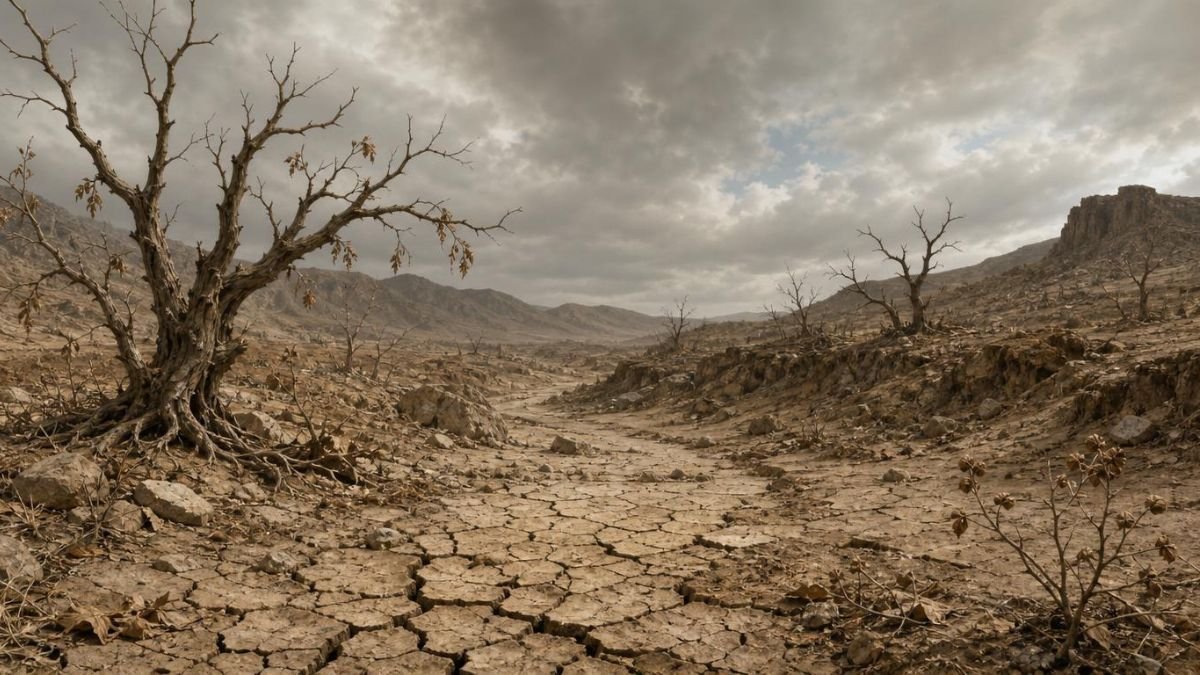
What's the difference between something that's resting, and something that's dried out completely?
It's a question worth sitting with, because the two can look alike from the outside, and the difference between them is everything. A seed in winter and a dead husk can seem the same to a careless glance. A person taking a needed pause and a person who has quietly gone hollow can wear the same tired face. And there's a precise, almost clinical word for that second state — for the total, thorough loss of every last drop of moisture. The word is desiccate. And I think it has more to teach us about being alive than its dry sound suggests.
To desiccate something is to dry it out completely — not just to dampen or to wilt, but to remove the moisture utterly, down to the last molecule. It's a strong word, and a total one. When scientists want to preserve something, they use a desiccant — a substance that greedily pulls every bit of water out of the air around it, leaving things bone-dry. Desiccation isn't ordinary dryness. It's the absence of water taken all the way to its conclusion. And here's what makes the word so haunting: water is life. Everything alive is mostly water. To desiccate something is, in a very real sense, to take the life out of it — to leave only the shape behind, the structure with the living substance drained away.
Picture it. A leaf in autumn that's gone brown and brittle, so dry it crumbles to dust in your fingers. A riverbed in a drought, cracked into a thousand curling plates, where water used to run. A flower pressed flat and colorless in an old book — still recognizably a flower, still holding its shape, but with all the living moisture gone, so that what remains is a kind of ghost of the thing it was. That's desiccation. The form survives. The life doesn't. And there's something quietly sad in that, because the shape being preserved is exactly what makes the absence of life so visible. You can see what it was. You can see that it's no longer that.
And of course, the word doesn't stay in the world of leaves and riverbeds. We reach for it, instinctively, to describe things that have dried out in a deeper way. We talk about desiccated prose — writing that's technically correct but has had all the life sucked out of it, all the juice, all the feeling, until it's just accurate and dead. We talk about a desiccated soul, a desiccated life — a person who's still going through all the right motions, still holding the shape of a life, but who has somehow lost the moisture of it. The passion. The wonder. The flow. Everything that made it feel alive rather than merely functional.
And I think this is a danger that creeps up on people so slowly they don't notice it happening. Nobody desiccates all at once. It's not dramatic. It's a slow evaporation. A little less curiosity this year than last. A little less delight. The things that used to move you moving you a little less. The passion you had for your work quietly drying at the edges until one day you realize you're just performing the shape of caring, going through the motions of a life whose living water has mostly left. Nobody chooses that. It just happens, drop by drop, when you go too long without whatever it is that keeps you moist and green and alive.
But here's the hope hiding inside this dry word, and it's a real one. Because there are things that can be desiccated and then — remarkably — brought back. There are seeds that can lie desiccated for years, looking utterly dead, holding no visible life at all, and then be given water and quietly, astonishingly, sprout. There's a tiny creature that can dry itself out almost completely, suspend itself in a state that looks like death, survive conditions that should destroy it, and then rehydrate and simply carry on living. Desiccation, in these cases, isn't death. It's a kind of terrible waiting. The life didn't leave. It went dormant, folded up small, holding on in the dryness for the return of water.
And I think that's true of us, too, more often than we fear. A person who feels desiccated — dried out, gone hollow, lost the flow — isn't necessarily dead inside. Sometimes they're a seed in a drought, still holding, waiting for water. And the question then becomes the most important one you can ask about your own dry seasons: what is your water? What rehydrates you? What brings the moisture back to a life that's gone brittle? For some it's rest. For some it's beauty, or love, or wonder, or making something, or being near people who are fully alive. But whatever it is, you have to know it — because desiccation is what happens when you go too long without it, and revival is what happens when you finally return to it.
And notice how the word itself sounds. Desiccate. Say it slowly and it's almost onomatopoeic — that hissing string of s and c sounds like something drying, cracking, the last rasp of moisture leaving. Some words carry their meaning in their music, and this is one of them. It doesn't sound lush or living. It sounds parched. The language dried the word out to match the thing it names, and that's part of why it lands with such a brittle, final weight when we use it about a life.
So maybe the lesson of this word is a kind of vigilance. To notice the early dryness, before it becomes total. To feel it when the moisture starts to leave — when things stop delighting you, when the color drains out of days that used to be vivid — and to reach for your water before you crumble. Because a life, like a leaf, needs its moisture. And the difference between resting and desiccating is often just whether you noticed the dryness in time to drink.
Here's the question I'll leave you with, in this driest of words. If a life can slowly desiccate without anyone choosing it — losing its moisture drop by drop until only the shape remains — then how green are you, honestly, right now? And if you've been drying out, what is the water you've been too busy to go back to?





0 Comments