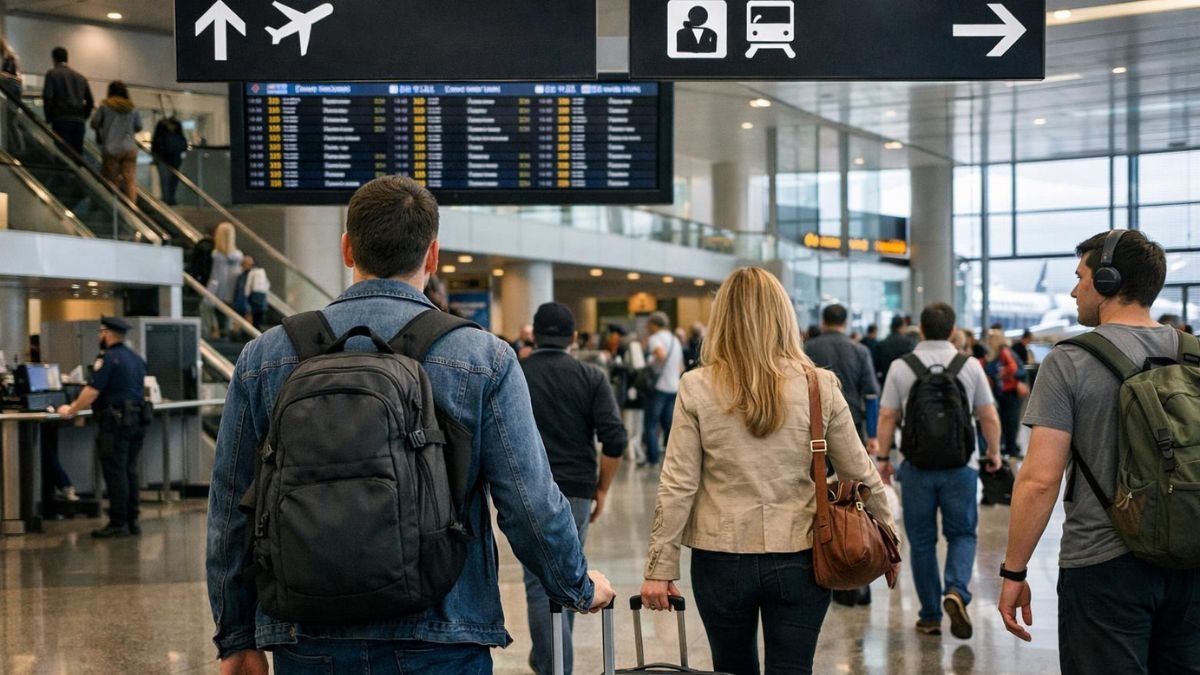
Quick question — what's your airport personality? Are you the type who arrives three hours early and sits peacefully at the gate? Or are you the person sprinting through the terminal with one shoe off, holding a half-eaten sandwich, wondering if Gate B47 is in this country or the next? Either way, navigating an airport in English is a skill you absolutely need, and I promise we're going to make it painless.
Airports involve a lot of specific vocabulary and a lot of situations where clear communication matters. You'll talk to airline staff, immigration officers, security personnel, and fellow passengers — and at each point, the language you need is slightly different. Let's walk through the entire airport experience together, from the moment you arrive to the moment you collect your bags on the other side.
LEVEL 1 — THE BASICS (A1/A2)
Let's follow the journey in order. First, you arrive at the airport. The big building is called the terminal. Some large airports have more than one terminal, so you might need to check which terminal your airline uses.
Your first stop is check-in. This is where you show your passport and ticket (or booking confirmation) and receive your boarding pass — that's the card or digital pass that lets you get on the plane. If you have large bags, you'll check them in here. Checked luggage goes in the hold of the plane (the storage area underneath). Smaller bags that you keep with you are called carry-on bags or hand luggage.
Some key phrases for check-in:
"I'd like to check in for my flight to London."
"Can I have a window seat, please?" / "An aisle seat, please."
"How many bags can I check in?"
"Is the flight on time?"
After check-in, you go through security. This is where they check your bags and sometimes scan you. You'll need to take off your belt, remove your laptop from your bag, and put everything on the conveyor belt (the moving belt that carries your items through the X-ray machine). Liquids must be in small containers — usually 100ml or less.
Once through security, you're in the departure lounge. Here you'll find shops, restaurants, and the gates. A gate is the specific door where you board your plane. Boarding means getting on the plane. You'll hear announcements like:
"Flight BA205 to Paris is now boarding at Gate 14."
"This is the final call for passengers on flight EK301 to Dubai."
Basic vocabulary you'll need: arrival (when the plane lands), departure (when the plane leaves), delayed (the flight is late), canceled (the flight isn't happening), and on time (everything is going as planned).
Grammar tip: imperatives are everywhere at the airport. 'Please have your passport ready.' 'Remove your belt.' 'Place your items in the tray.' These are direct instructions — no subject, just the verb. Understanding imperatives helps you follow airport instructions quickly and without confusion.
LEVEL 2 — ADDING COLOR AND DEPTH (B1/B2)
Now let's deal with the situations that make airports genuinely stressful — and give you the English to handle them like a pro.
Let's start with connections. A connecting flight (or connection) is a second flight you take to reach your final destination. If you have a layover, that's the time you spend waiting at the connecting airport. A stopover is a longer break — usually more than a few hours, sometimes overnight. And if you miss your connection? Well, that's when things get interesting.
"I've missed my connecting flight. Can you rebook me on the next available flight?"
"My flight's been delayed by three hours. Am I entitled to any compensation?"
"I'd like to speak to a supervisor, please."
The language of polite complaint is essential here. 'I'd like to…' is your foundation, but you can add firmness: 'I'd really appreciate it if you could look into this.' 'I understand this isn't your fault, but I do need a solution.' 'I've been waiting for over an hour, and I haven't received any information.' Notice how these sentences are firm but respectful — that balance is key.
Let's talk about immigration and customs, which you go through when you arrive in a new country. Immigration (or passport control) is where an officer checks your passport and visa. They might ask:
"What's the purpose of your visit?" — "I'm here on vacation / for business / to visit family."
"How long are you planning to stay?" — "Two weeks."
"Where will you be staying?" — "At the Hilton / with friends."
Customs is where they check if you're bringing anything that needs to be declared — items like large amounts of money, certain foods, or goods you plan to sell. 'Nothing to declare' means you're not carrying any restricted items. 'Goods to declare' means you are.
Grammar spotlight: the present continuous with future meaning is incredibly common in travel contexts. 'I'm flying to New York.' 'I'm staying for a week.' 'We're connecting through Dubai.' These are plans and arrangements — and using the present continuous for them is very natural.
Phrasal verbs for airports: to check in (register for your flight), to take off (when the plane leaves the ground), to touch down (when it lands), to pick up your bags (collect them from the carousel), to drop someone off (drive them to the airport), to see someone off (say goodbye at the airport).
LEVEL 3 — FLUENCY AND NUANCE (C1/C2)
At the advanced level, you're not just navigating the airport — you're navigating the system. This means knowing your rights, communicating effectively in difficult situations, and understanding the subtle language of airline announcements that most passengers miss.
Let's decode airline speak. When they say 'We're experiencing a slight delay,' that often means the delay is not slight at all. 'We're waiting for a slot' means air traffic control hasn't given permission to take off. 'The aircraft is being prepared for your arrival' is a polite way of saying the previous passengers only just got off and the cleaning crew is still working. 'We ask for your patience' is airline code for 'We have no idea when this is going to be resolved.' Understanding these euphemisms gives you a real advantage.
Advanced vocabulary: an involuntary bumping is when the airline removes you from a flight because it's been oversold — and yes, you have rights in that situation. Turbulence is the shaking caused by disturbed air currents. A redeye is an overnight flight (named because you arrive with red, tired eyes). A codeshare is when one airline sells seats on another airline's flight. And duty-free refers to shops in the airport where goods are sold without import taxes.
Now let's talk about formal complaints and knowing your rights — because this is where advanced English really pays off:
"Under EU regulation 261/2004, I believe I'm entitled to compensation for the significant delay. Could you provide me with the relevant claim form?"
"I'd like to file a formal complaint regarding the handling of my lost luggage. I've been given no clear timeline for recovery and minimal communication from your team."
"I understand operational disruptions occur, but the lack of proactive communication over the past six hours has been entirely unacceptable."
Notice the language here: 'I believe I'm entitled to,' 'I'd like to file a formal complaint,' 'the lack of proactive communication.' This is assertive, professional, and devastatingly polite. It's the kind of language that gets results because it signals that you know what you're talking about and you won't be brushed off with a generic response.
Grammar at this level: reported speech becomes important when you're documenting what happened. 'The agent told me the flight was on time, but it was subsequently delayed by four hours.' 'I was assured that my luggage would be delivered within 24 hours, which did not happen.' Reported speech allows you to present facts clearly, which is essential when writing complaints or escalating issues.
Writing tip: if you need to write a complaint letter to an airline, structure matters. Start with the facts (date, flight number, what happened). Then describe the impact. Then state what you want (refund, compensation, explanation). And finish with a clear, polite deadline: 'I would appreciate a response within 14 business days.' This structure is professional, effective, and universally understood.
Idioms and expressions: 'It went off without a hitch' means everything went smoothly. 'A rocky landing' can be literal (bumpy touchdown) or figurative (a difficult conclusion). 'Up in the air' means uncertain — 'Our plans are still up in the air.' 'To be grounded' means a plane can't fly, but figuratively it means to be kept from doing something. 'Excess baggage' literally means too many bags, but figuratively it refers to emotional burdens someone carries — which, honestly, is how most of us feel after a long-haul flight.
YOUR CHALLENGE
Imagine your flight was canceled and your luggage lost — all on the same trip.
Task 1: Role-play a conversation with the airline desk agent. Record yourself asking for rebooking and filing a lost luggage report.
Task 2: Write a formal complaint email (150–200 words) to the airline requesting compensation.
Try to include: at least one reported speech structure, two phrasal verbs, and one conditional sentence.








0 Comments