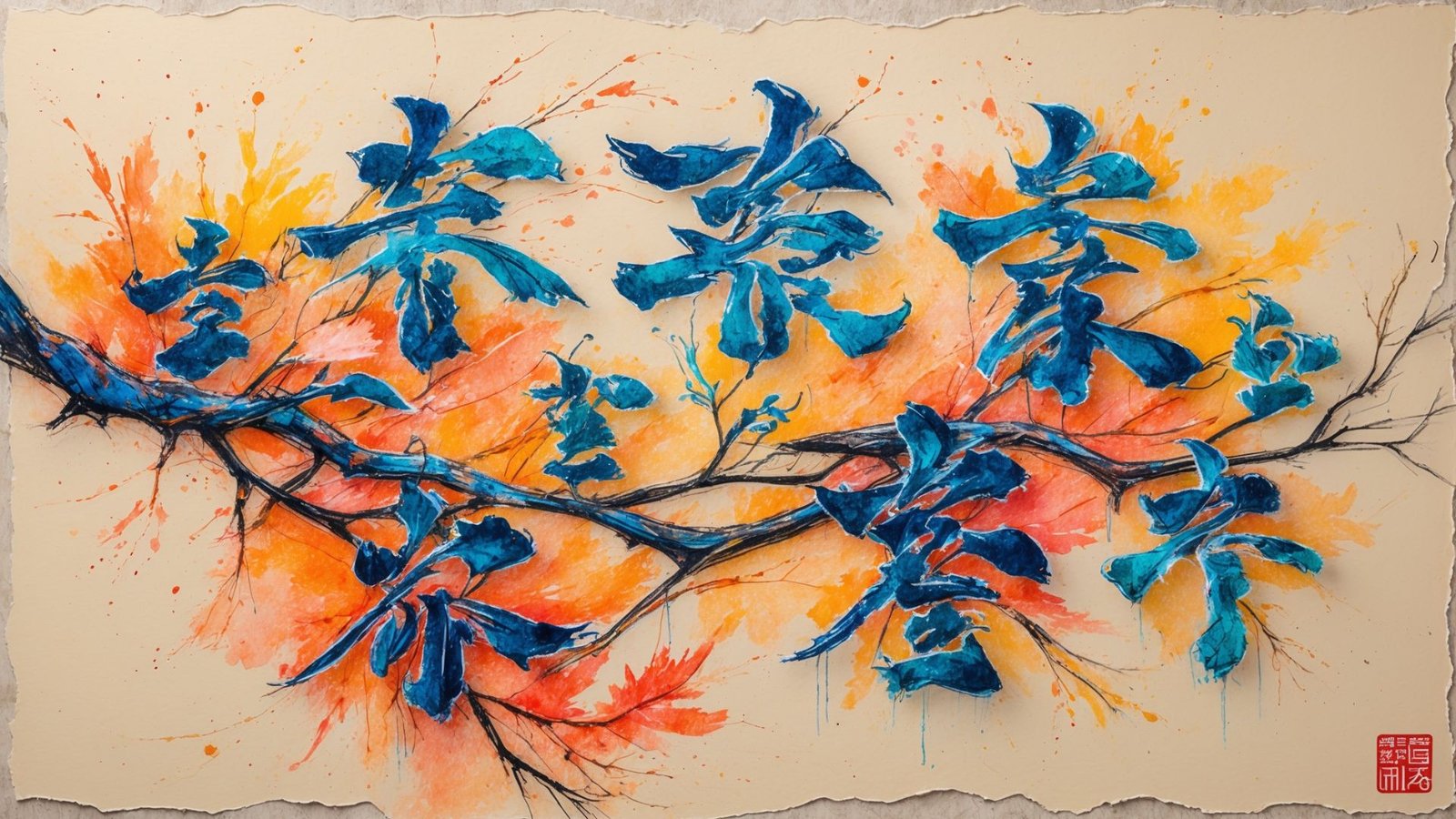
Welcome to a different kind of writing practice! Today, we’re exploring the beauty of poetry through one of its most elegant and accessible forms: the haiku. Writing a haiku isn’t about complex arguments or long paragraphs; it’s about capturing a single, fleeting moment in just a few words. It’s an exercise in precision, observation, and finding the beauty in simplicity.
This is a skill that can help all writers. Learning to choose your words carefully makes your academic and professional writing stronger, too. The best way to approach this lesson is to be playful and observant. Look around you. Listen. What do you see and feel? We’re going to translate those feelings into a tiny, three-line poem.
The Challenge and the Plan
Our challenge today is simple but profound: Compose a haiku about the changing seasons.
A haiku is a traditional Japanese form of poetry. Its power comes from its brevity and its structure. It doesn’t tell a long story; instead, it paints a single, vivid picture or captures a feeling in a snapshot.
To write a great haiku, we can’t just throw words on a page. We need a plan that respects the form’s tradition and structure. Here it is:
- Step 1: Understand the Golden Rule (The 5-7-5 Structure). We’ll break down the single most important rule of haiku: the syllable count.
- Step 2: Choose a Moment. We won’t try to describe a whole season. Instead, we’ll pick one tiny, specific moment of change (e.g., the first snowflake, the last leaf falling).
- Step 3: Brainstorm Sensory Images. We’ll think about what we can see, hear, feel, smell, or taste in that moment.
- Step 4: Draft Line by Line. We’ll build our haiku one line at a time, carefully counting the syllables and choosing the most impactful words.
- Step 5: Polish and Reflect. We’ll read our haiku aloud to check its rhythm and feeling.
Let’s begin.
The Walkthrough: Composing Our Haiku Step-by-Step
Step 1: The Golden Rule (5-7-5)
A haiku is a three-line poem with a specific syllable structure.
- Line 1: 5 syllables
- Line 2: 7 syllables
- Line 3: 5 syllables
That’s it. 17 syllables in total. The challenge is to convey a clear image or feeling within this tight constraint. Let’s try clapping out the syllables in a sentence: “I love to write poems.” (I-love-to-write-po-ems = 6 syllables. Doesn’t fit Line 1). How about: “I like to write poems.” (I-like-to-write-poems = 5 syllables. Perfect!). Syllable counting is the key.
Step 2: Choose a Moment
“Changing seasons” is too big. Let’s choose a very specific moment. How about the very end of summer and the first hint of autumn?
Step 3: Brainstorm Sensory Images
What do we experience in that moment?
- Sight: Green leaves, bright sun, a single red or yellow leaf, long shadows in the afternoon.
- Feeling: Hot sun on the skin, but a sudden, cool breeze. A little chill in the air.
- Sound: The buzz of late summer insects, the rustle of dry leaves.
These are our raw materials. We’re not going to use them all. We just need a few to create our snapshot. Let’s focus on the feeling of the cool breeze on a warm day and the sight of the first colorful leaf.
Step 4: Draft Line by Line
Let’s build our haiku.
Line 1 (5 syllables): We want to set the scene. It’s still summer.
- Attempt 1: The leaves are still green. (The-leaves-are-still-green = 5 syllables. This works!)
- Attempt 2: Summer sun shines bright. (Sum-mer-sun-shines-bright = 5 syllables. Also works!)
Let’s go with the first one. It feels a little more tranquil.
The leaves are still green
Line 2 (7 syllables): Now, we introduce the change. The cool breeze.
- Attempt 1: But a sudden cool breeze blows through. (But-a-sud-den-cool-breeze-blows-through = 7 syllables. Perfect.)
- Attempt 2: A cool wind whispers a secret. (A-cool-wind-whis-pers-a-se-cret = 7 syllables. Ooh, I like this one. “Whispers” is a great, evocative verb.)
Let’s use the second one. It’s more poetic.
The leaves are still green
A cool wind whispers a secret
Line 3 (5 syllables): This line should deliver the final image or feeling—the “turn.” It reveals what the secret is. The secret is autumn.
- Attempt 1: Autumn is coming. (Au-tumn-is-com-ing = 5 syllables. This works, but it’s a bit too direct. It tells us instead of showing us.)
- Attempt 2: One leaf turns to gold. (One-leaf-turns-to-gold = 5 syllables. This is much better! It’s a specific, beautiful image that shows us autumn is arriving.)
Step 5: Polish and Reflect
Let’s put our final version together and read it aloud.
(Sample Writing: Polished Haiku)
The leaves are still green, A cool wind whispers a secret: One leaf turns to gold.
This works perfectly. It follows the 5-7-5 rule, it captures a specific moment, and it uses simple, clear imagery to create a feeling.
Here’s another one for a different seasonal change (winter to spring):
White snow starts to melt, A small green shoot pushes through— The sun stays longer.
Wrap-up and Your Next Challenge
As you can see, writing a haiku is a wonderful exercise in mindfulness and word choice. The key takeaways are:
- Follow the 5-7-5 rule. It’s the one unbreakable rule of the form.
- Focus on a single, specific moment. Don’t try to tell a whole story.
- Use sensory images. Show, don’t tell. What do you see, hear, or feel?
Poetry is for everyone, and practicing it can make all of your writing more vivid and impactful. The only way to get a feel for it is to try it yourself.
Your Optional Writing Challenge:
Ready to capture your own moment? Compose a haiku about the feeling of waking up in the morning.
Think about it. Is the room dark or light? Is it quiet or can you hear birds? Do you feel tired or energized? Pick one specific feeling or image and capture it in just 17 syllables. Give it a go!










0 Comments