Introduction
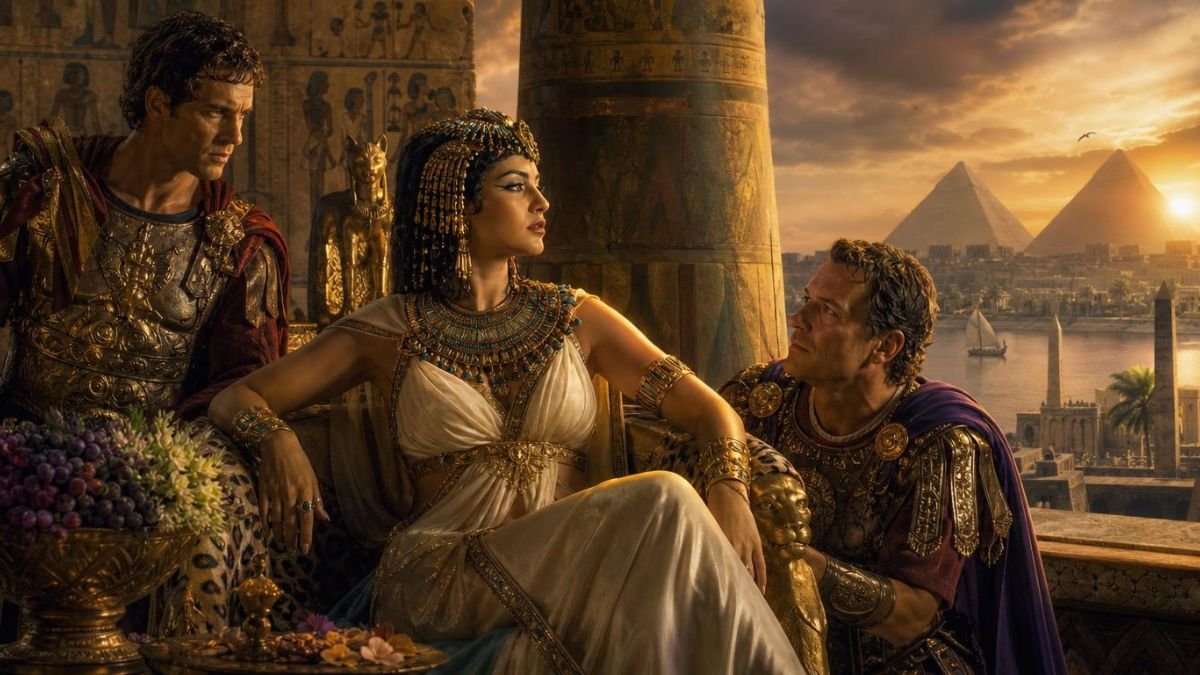
She is one of the most famous women who ever lived. She has been painted, sculpted, filmed, and fictionalized so many times that the real person has almost disappeared beneath the layers of imagination stacked on top of her. But here is the thing about Cleopatra VII, the last pharaoh of ancient Egypt: the real woman is actually more interesting than any of the versions Hollywood ever gave us. More strategic. More linguistically gifted. More politically ferocious. More human. And her story is a window not just into one remarkable life but into one of the most turbulent, consequential periods in the ancient world — a time when the Mediterranean was being rearranged by force, and the survival of entire civilizations depended on the decisions of a handful of very extraordinary people.
Cleopatra's reign lasted from around 51 BCE until her death in 30 BCE. In those two decades, she navigated civil wars, Roman imperialism, family betrayal, and two of the most powerful men of the ancient world — Julius Caesar and Mark Antony. She was the first ruler of the Ptolemaic dynasty to bother learning the Egyptian language, after nearly three centuries of Greek-speaking pharaohs who ruled a country whose language they never learned. She also reportedly spoke eight or nine additional languages. She was a scholar, a naval commander, and a diplomat of extraordinary sophistication. She was not a tragic romantic heroine. She was a head of state.
Now, why are we going to read closely about her? Because Cleopatra's story is told in a specific kind of language — the language of historical narrative — and that language has its own techniques, its own rhetorical moves, its own way of building argument and meaning. Learning to read it carefully is exactly how you cross from being someone who reads in English to being someone who thinks in English. That gap — between consuming words and inhabiting ideas — is the plateau that so many intermediate and upper-intermediate learners hit. Close reading is the practice that breaks through it. So let's meet the queen, and let's do it right.
The Article
Is it possible to be one of the most famous people in history and still be almost entirely misunderstood? That's Cleopatra's reign in a sentence — a story so thoroughly co-opted by dramatists, propagandists, and filmmakers across two millennia that the actual woman at its center has become almost invisible. But when you look past the asp and the eyeliner and the famous barge floating down the Nile, what you find is something far more interesting: a political genius operating under almost impossible pressure, and winning — for a long time — with nothing but her mind and her nerve.
Cleopatra VII came to power in 51 BCE at approximately eighteen years of age, co-ruling Egypt initially with her father Ptolemy XII and then, after his death, with her younger brother Ptolemy XIII. The Ptolemaic dynasty, which had ruled Egypt since the death of Alexander the Great, was a Greek-speaking Macedonian family. For nearly three centuries, the Ptolemies had governed one of the ancient world's richest kingdoms without ever learning its people's language. Cleopatra changed that. She immersed herself in Egyptian language, religion, and culture, presenting herself not as a Greek ruler condescending to manage a foreign territory, but as the living embodiment of the goddess Isis — the divine mother, the magical healer, the queen of the heavens. This was not sentiment. This was strategy. By wrapping herself in the religious and cultural identity of her Egyptian subjects, she built a loyalty that her predecessors had never been able to command.
The early years of her reign were treacherous. Her brother — and nominal co-ruler — Ptolemy XIII, backed by powerful advisors, drove her into exile in 48 BCE. She raised an army in the Syrian desert. She was twenty-one years old. The opportunity to regain her throne arrived in the form of Julius Caesar, who had pursued his enemy Pompey to Egypt and found himself drawn into the country's internal power struggle. The famous story of Cleopatra having herself smuggled to Caesar rolled in a carpet is almost certainly embellished — ancient sources speak of her being wrapped in a sack or a roll of bedding — but the core truth it encodes is accurate: Cleopatra got herself in front of the most powerful man in the world by her own daring and initiative. The alliance that followed was political before it was romantic, and it served both of them. Caesar needed Egypt's grain and gold. Cleopatra needed Rome's military muscle. They were two exceptional intelligences recognizing each other across a conference table, and the rest followed from that.
What followed Caesar's assassination in 44 BCE was a period of extreme geopolitical instability, during which Cleopatra maintained Egyptian independence through extraordinary diplomatic agility. Her alliance with Mark Antony, which developed into a genuine and apparently profound personal bond, was once again strategically coherent from the start. Antony was attempting to consolidate power in the eastern Mediterranean. Cleopatra's resources — grain, ships, gold, the administrative apparatus of the wealthiest remaining independent kingdom in the region — were indispensable to his ambitions. In return, she secured territorial expansions for Egypt and, crucially, a partner willing to recognize her and her children as legitimate dynastic heirs to a combined Greco-Egyptian empire. This was the Donations of Alexandria in 34 BCE — Antony's formal recognition of Cleopatra and their children as rulers of a vast eastern dominion. Octavian, Caesar's heir and Antony's rival, branded it treason. And that framing stuck.
The propaganda war that Octavian waged against Cleopatra is one of the most consequential in history. He portrayed her not as a head of state but as a foreign temptress who had bewitched a Roman general and dragged Rome toward the East with her dangerous, Oriental wiles. This was not merely a political attack — it was a cultural one. The Romans had deep anxieties about Eastern luxury, excess, and female power. Octavian's portrayal of Cleopatra tapped directly into those anxieties. The image of Cleopatra that we have inherited — the seductress, the exotic queen, the woman destroyed by passion — is substantially his invention. We have been living inside his propaganda ever since, which is one of the most interesting and disturbing things about her legacy.
The final act of Cleopatra's story unfolded with devastating speed. After Antony's forces were defeated at the Battle of Actium in 31 BCE, and as Octavian's army advanced on Alexandria, both Antony and Cleopatra took their own lives. She was thirty-nine years old. Her method — the famous asp, or possibly poison — has been debated by historians ever since. What is not debated is the reason: she refused to be paraded through Rome in Octavian's triumph. She died on her own terms, in her own palace, as a queen. Even at the end, she controlled what she could control.
Cleopatra's reign lasted just over two decades in the literal, political sense. But the civilizational consequences of its end were enormous. With her death, Egypt became a Roman province, and the last independent Hellenistic kingdom dissolved into the machinery of an empire. The ancient world, as it had existed for centuries, effectively ended with her. She was, in a very real sense, the last of the ancients — and the first person to understand what it would mean when they were gone.
So here is the question that her story leaves hanging in the air, two thousand years later: when history is written by the winners, how much of what we believe about the people who lost is actually true? And how differently might we read the story of power, intelligence, and survival if we could strip away the layers of myth that the victors painted on?
Close Reading Analysis
Paragraph 1: "Is it possible to be one of the most famous people in history and still be almost entirely misunderstood?"
First question: this paragraph opens with a rhetorical question and follows it immediately with a statement that answers it ("That's Cleopatra's reign in a sentence"). What effect does this rapid question-answer movement have, and why is it different from opening with the statement alone?
Second question: the phrase "the actual woman at its center has become almost invisible" — what does this phrasing imply about the relationship between fame and identity?
Opening with a question that is then immediately answered by the writer is a technique sometimes called a self-answering question or an epanaphora setup. Unlike a standard rhetorical question left hanging for the reader to answer alone, this one is resolved in the very next sentence, which creates a satisfying click — like the setup and punchline of a joke, or a thesis followed immediately by its evidence. The effect is that you feel the question was asked not to create suspense but to frame the problem precisely. This is important in academic and analytical writing: questions used this way signal "here is the contradiction I am going to resolve."
The phrase "almost invisible" is also doing quiet but significant work. Visibility is usually associated with fame — famous people are seen. To say that fame has made someone invisible is a paradox. It implies that layers of representation (paintings, films, myths, propagandist retellings) actually obscure rather than illuminate the real person. This is a sophisticated critical concept — the idea that excessive cultural attention can function as a kind of erasure. Recognizing paradoxes like this in non-fiction writing is a key skill at the advanced level, because they are often the clue to the writer's central argument.
Paragraph 2: "Cleopatra VII came to power in 51 BCE..."
Question: compare these two possible sentences: "She presented herself as connected to Egyptian religion" vs. "presenting herself not as a Greek ruler condescending to manage a foreign territory, but as the living embodiment of the goddess Isis." What are the key differences, and why is the second version significantly more powerful?
This comparison exercise cuts to the heart of what separates adequate writing from excellent writing. The first version is accurate but inert. It tells you a fact without creating any image or feeling. The second version does several things simultaneously: it uses negation first ("not as a Greek ruler condescending...") to clear away a lesser image, then delivers the real one with full force ("the living embodiment of the goddess Isis"). The word "embodiment" means she did not just claim a relationship with Isis — she claimed to be the physical, material presence of the goddess in the world. And the word "condescending" — meaning treating someone as inferior while interacting with them — is a sharp political characterization: it implies the failure mode of the entire previous dynasty. This is efficient writing: one word carries a judgment about three centuries of dynastic incompetence.
Paragraph 3: "The early years of her reign were treacherous..."
Question: the sentence "She was twenty-one years old" is placed immediately after describing Cleopatra raising an army in the Syrian desert. Why is this placement — rather than earlier or later — particularly effective?
This is a technique called the delayed detail. The information that she was twenty-one is not placed in an introductory description or a biographical summary. It is placed immediately after the most impressive deed so far — raising a personal army in exile. The effect is a double-take: you absorb the act, and then you absorb the age, and the collision between those two pieces of information creates the impact. If the age had been mentioned at the beginning of the paragraph, it would simply be a fact. Placed here, it becomes a judgment: this is astonishing. Skilled writers manage the sequencing of information deliberately to control when and how impact lands. This is something to practice consciously in your own writing — where does the detail land, and what does it land next to?
Paragraph 4: "What followed Caesar's assassination in 44 BCE..."
Question: the paragraph describes the relationship with Antony as "two exceptional intelligences recognizing each other across a conference table." What does this metaphor do to the conventional romantic narrative of Cleopatra and Caesar, and what is the argument embedded in the metaphor?
The conference table metaphor is doing explicit revisionist work. It takes the most famous "romantic" moment — the first meeting — and recodes it in the language of professional politics. Conference tables are where negotiations happen, where deals are made, where power talks to power. By using this image, the writer is arguing that the relationship was, at its foundation, a meeting of political and intellectual equals before it was a romantic one. The qualifier "apparently profound personal bond" in the Antony paragraph is also carefully chosen: "apparently" signals that the writer is working from external evidence rather than claiming certainty, while "profound" resists the cynical reading that it was purely transactional. This is what balanced historical writing looks like: neither sentimental nor coldly reductive, but genuinely attentive to complexity.
Paragraph 5: "The propaganda war that Octavian waged against Cleopatra..."
Question: the paragraph ends with "We have been living inside his propaganda ever since, which is one of the most interesting and disturbing things about her legacy." What does the phrase "living inside" imply, and why is "disturbing" a strong and appropriate word choice here?
"Living inside" is an immersive metaphor. It does not say "believing" the propaganda, which would be passive and external. "Living inside" suggests that the propaganda has become our habitual environment — we don't even notice it because we are surrounded by it on all sides. This is a claim about the nature of cultural inheritance: we do not simply receive ideas about historical figures; we inhabit them, move through them, build on them without questioning their foundations. The word "disturbing" is appropriate because the implication is genuinely troubling: two thousand years of scholarship, art, and cultural conversation about one of history's most significant women has been substantially shaped by the political interest of her enemy. That is not a small or comfortable claim. Using the word "disturbing" honestly acknowledges this without overstatement.
Paragraph 6: "The final act of Cleopatra's story unfolded with devastating speed..."
Question: the phrase "She died on her own terms, in her own palace, as a queen." Note the three parallel phrases all beginning with "in her own" / "on her own" / "as a." What is the cumulative effect of this parallel structure?
This is a tricolon — a rhetorical structure of three parallel elements — and it is one of the most ancient and powerful tools in the writer's kit. The repetition of "her own" in the first two phrases ("on her own terms, in her own palace") creates a drumbeat of possession and agency, pushing back against the narrative of her defeat. She owned her death as she had owned her reign. The third element breaks the "her own" pattern and shifts to a title — "as a queen" — which functions as a final declarative identity statement. After all the complexity, the alliances, the losses, the reduced options, she remained a queen. The tricolon makes that claim feel earned because the repetition builds toward it. This is something you can deploy powerfully in your own writing when you want to make a cumulative point about someone's character or significance.
Closing Question Paragraph:
Question: the article's closing question — "how differently might we read the story of power, intelligence, and survival if we could strip away the layers of myth that the victors painted on?" — uses the image of painting over someone. What does this extend from the first paragraph, and how does the closing circle back to the opening?
This is a structural technique called a circular or frame structure: the article opens with the image of Cleopatra becoming invisible beneath layers of imagination, and it closes with the image of those layers as paint applied by victors. The circle is complete: we began with the problem (the real person obscured by accumulated representation) and we end with its cause (the winners actively painted those layers on). The framing metaphor — invisibility, layering, painting over — has been quietly consistent throughout. This is the mark of a well-constructed piece of writing: the imagery is not random but part of a coherent visual logic that the whole article inhabits. Noticing this structure, and building it consciously in your own work, is one of the clearest ways to move from competent to genuinely sophisticated writing.
Speaking and Writing Challenges
Writing Challenge
Choose a historical figure who has been significantly simplified, romanticized, or distorted in popular culture — it can be anyone from any culture or period. Write a 350–450 word analytical paragraph in which you: (1) describe the popular image of this person, (2) identify at least one specific way in which that image is inaccurate or incomplete, and (3) argue for what a more honest understanding of this person would give us. Use at least one strong parallel structure (tricolon or paired negation) as modeled in the article.
Speaking Challenge
Think of a time when you were misunderstood — when the image others had of you was substantially different from who you actually are. Prepare a two-minute spoken reflection in which you describe the gap between the external image and the internal reality, and explore why that gap existed. Use at least one metaphor to describe the experience of being misrepresented. The goal is to practice the kind of nuanced self-expression that separates conversational English from truly fluent, precise English — the ability to draw fine distinctions, use figurative language comfortably, and sustain a coherent argument across multiple sentences.







0 Comments