Introduction
One of the most important tasks for the management of any organization employing more than a few people is to determine its organizational structure, and to change this when and where necessary. That’s the heart of what we are going to talk about today in our Chapter 3 Company Structure from our Audio Business Course from English Plus Podcast.
Our learning objectives for this chapter:
- Consider the different ways of organizing work
- Discuss potential conflicts between different department in a company
- Compare the differences between large and small companies
Podcast Episode
Lead-In Discussion
- Which department — production, finance, accounting, marketing, sales, human resources, etc. — of an organization do you think is the most interesting to work in and why?
- What reasons can you think of for why departments get into conflict with each other?
- Is it better to have one immediate boss or to work for more than one manager?
- Do you prefer to work alone or in a team?
- Is it more motivating to be responsible to someone for your work, or responsible for people who report to you?
You can discuss these questions on your own, with your friends or family or you can share your ideas with us in the forum.
Wikinomics
The main idea of wikinomics is to collaborate with people outside the traditional corporate structure, letting people around the world cooperate to improve an operation or solve a problem, and paying them for their ideas, of course. This might be similar to outsourcing, but it extends further than the scope of outsourcing. When you outsource a project, you assign it to a certain person outside your company, but with wikinomics, you’re assigning the task to anyone who can come up with a good idea or a solution to one of your problems.
The word wiki comes from the Hawaiian quick and nomics comes from economics, so it literally means quick economics.
Discussion Questions
- How is the world of organized work changing?
- In what ways could your organization, company or business school use the wikinomics principle?
- What do you think are the disadvantages of the wikinomics principle?
You can discuss these questions on your own, with your friends or family or you can share your ideas with us in the forum.
Company Structure
Vocabulary Exercise
[qsm quiz=62]
The Chain of Command
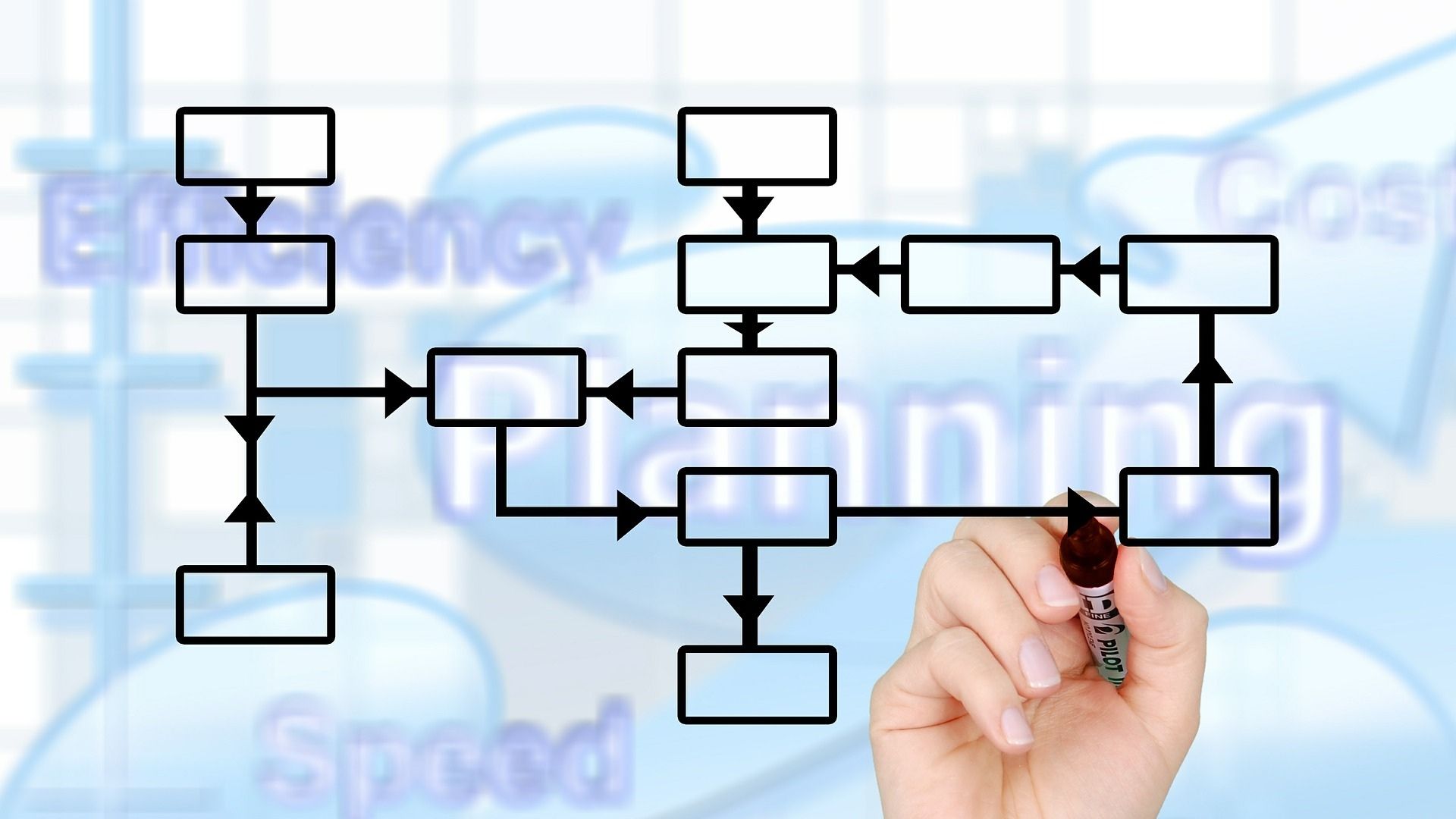
Traditionally, organizations have had a hierarchical or pyramidal structure, with one person or a group of people at the top, and an increasing number of people below then at each successive level. This is sometimes called line structure.
Functional Structure
As the activities of most organizations are too complicated to be organized in a single hierarchy. Most large manufacturing companies, for example, have a functional structure, including, among other, specialized production, finance, marketing, sales and human resources departments. This means, for example, that the production and marketing departments cannot take financial decisions without consulting the finance department.
Flattening Hierarchies and Delegating Responsibility
The modern tendency is to reduce the chain of command, take out layers of management, and make the organization much flatter. Typically the owners of small firms want to keep as much control over their business as possible, whereas managers in larger businesses who want to motivate their staff often delegate decision making and responsibilities to other people.
Matrix Management
Another way to get round hierarchies is to use matrix management, in which people report to more than one superior. For example, a product manager with an idea could deal directly with the managers responsible for a certain market segment and for a geographical region, as well as managers in the finance, sales and production departments.
Teams
A further possibility is to have wholly autonomous, temporary groups or teams that are responsible for an entire project, and are split up as soon as it is successfully completed.
Comprehension Check
[qsm quiz=63]
Verbs and Nouns
[qsm quiz=64]
Incompatible Goals
[qsm quiz=65]
Big and Small Companies
You will be answering questions and discussing the questions and points below based on what you heard in the episode about big and small companies from the accounts of Krishna, Carlo and Olga.
Listening Comprehension
[qsm quiz=66]
Discussion
- How far do you share Krishna and Olga’s points of view, and agree with Carlo’s advice?
- What other benefits of working in a large company can you think of?
- What other reasons might make someone prefer to work in a small company?
Big or Small Company’s Advantages?
[qsm quiz=68]
Assignment
Write notes for a short presentation on your company or a company you would like to work for. You should mention”
- what it does: it designs/ makes/ provides/ distributes/ sells/ offer/ organizes/ invests in, etc.
- where it is located: it has offices/ branches/ subsidiaries/ factories/ stores, etc. in …
- how it is structured and whether this is a reason for its success: It consists of/ includes/ is divided into/ is organized in, etc.
- why you want to work for this company.
Deliver the assignment in a presentation form. You can use any presentation software available to you (PowerPoint, Keynote, PowerPoint Online, Google Slides, etc.)
Use the Google Form below to submit your assignment. Grading priority goes to Patrons, but I may have time to grade other assignments as well, and even if I don’t have the time for that, it will be a great exercise for you to put everything you have learned in this chapter into practice. (Please note that you will need to input your email in the form if you would like me to reply)








Hello Danny, thank you for the interesting podcast about company structure. Is it possible to make the podcasts without the music in the background? In my opinion it is very difficult to concentrate to the words you say. Thank you for your answer. Best regards from Munic.
Thank you very much for letting me know that the music is distracting. That’s definitely something I want to avoid. You got it. Starting from Monday, there will only be music background for the intro and outro, and where necessary only, but I will not add music background to the whole episode.