Article Brief
Full Audio Article
A line on a map is a funny thing. It’s an abstraction, a political fiction, an agreement between people—often people who are long dead—that this side is one thing and that side is another.
But in many parts of the world, that line is no joke. It’s a scar.
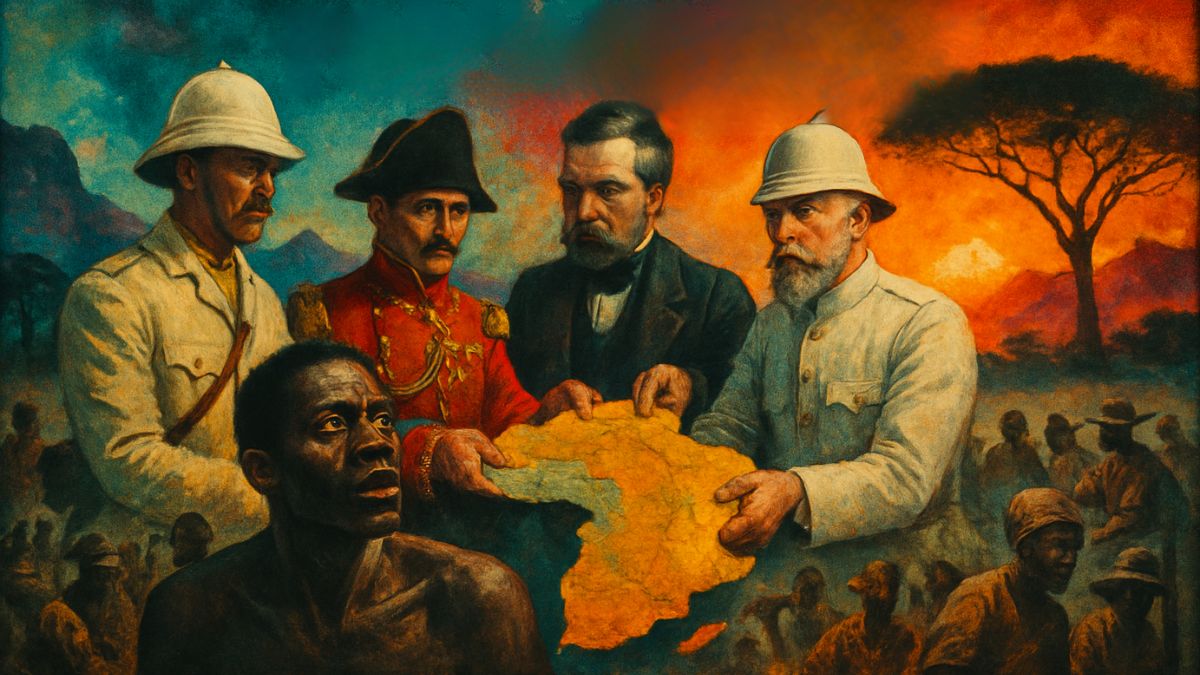
We all know the stories. We know about the gentlemen in top hats who gathered in Berlin in 1884 for the “Scramble for Africa,” carving up a continent of over 10,000 distinct political and ethnic units into about 50 states, often with the stroke of a ruler on a map. We know about the Sykes-Picot Agreement of 1916, where two diplomats (one British, one French) secretly sketched out their spheres of influence across the Middle East, manufacturing new countries from the remnants of the Ottoman Empire.
These lines were arbitrary, drawn with almost zero regard for the human, ethnic, linguistic, economic, or geographic realities on the ground. They sliced through communities, bundled hostile groups together, and severed ancient trade routes.
The legacy of these borders has been pernicious. It’s a story of conflict, of civil wars, of stateless peoples, of stunted economic development, and of artificial identities struggling to become real. It’s a story we are still living every single day.
And… what if that’s only half the story?
What if the 21st century is defined not by the primacy of these borders, but by the ingenious, resilient, and cooperative ways we are overcoming them? What if the real, emergent story is not about the division, but about the synthesis?
This isn’t about pretending the conflicts don’t exist. They absolutely do. But focusing only on the problem is like staring at the wound, fascinated by the scar tissue, while ignoring the complex healing process that is already well underway.
The future is being built, not by erasing these lines, but by making them increasingly, wonderfully irrelevant. It’s happening in economics, in politics, and in culture. And it’s a much more hopeful, and frankly, more interesting story to tell.
The Scars of the Scramble: A Quick Acknowledgment of the Problem
Before we get to the solution, we have to respect the problem. The reason 21st-century solutions are so vital is because the 19th-century problem was so profound.
When a Line Divides a People: The Human Cost
Imagine you are a member of the Ewe people. For centuries, your community has lived in a cohesive region. Then, the “scramble” happens, and a line is drawn between the British and German (later French) colonies. Today, that line is the border between Ghana and Togo. Your family, your markets, your sacred groves—all split. To visit your cousins, you need a passport.
This story is repeated across the globe. The Maasai in Kenya and Tanzania. The Kurds in Turkey, Syria, Iraq, and Iran. The Pashtun across the “Durand Line” separating Afghanistan and Pakistan. These borders didn’t just create new states; they attempted to destroy old nations.
When a Line Kills an Economy: The Financial Cost
The traditional map of Africa was not one of states, but of routes. Vast, ancient trade networks moved salt, gold, textiles, and ideas across the Sahara, along the coasts, and deep into the interior.
Colonial borders were designed to shatter this. They were not built for regional trade; they were built to be funnels. All roads, all railways, were designed to lead from the resource-rich interior to a single port, where the wealth could be extracted and shipped to Europe. This reconfiguration actively underdeveloped regional economies, forcing neighbors to trade with their colonial metropole rather than with each other. The result? A century of economic stagnation and dependency.
The Economic Handshake: Making Borders Porous Through Trade
This is where the new story begins. If the old borders were designed to extract wealth, the new solutions are designed to create it by reconnecting what was severed. The most powerful tool for this? The economy.
The Rise of the Cross-Border Zone
The first and most direct solution is the cross-border economic zone. The concept is simple: two or more countries agree that in a specific shared border region, the rules will be different. They lower or eliminate tariffs (taxes on imports), streamline bureaucratic customs (the dreaded “gridlock”), and often co-invest in shared infrastructure like bridges, roads, and power plants.
It’s a way of saying, “Our national border will legally remain here, but for the practical purposes of daily life and trade, we will act as one.”
The Öresund Region between Denmark and Sweden is a “gold standard” example. The construction of the Öresund Bridge in 2000 didn’t just connect Copenhagen (Denmark) and Malmö (Sweden); it created a single, synthesized metropolitan region. People live in one country and commute to work in the other. It’s a functional “soft border.”
The African Model: Corridors of Power
While Europe has its zones, Africa is thinking even bigger: “development corridors.” These are not just zones; they are massive infrastructure projects that act as economic arteries, running across multiple borders.
The LAPSSET Corridor (Lamu Port-South Sudan-Ethiopia-Transport) is one of the most ambitious. It’s a colossal project to connect Kenya, Ethiopia, and South Sudan with a new port, a pipeline, railways, and highways. It’s a direct, 21st-century rebuke to the colonial “funnel” model. Instead of “interior to port,” it’s designed to connect the interiors of multiple countries, sparking trade between them.
Similarly, the Abidjan-Lagos Corridor is a superhighway project set to link five West African countries (Côte d’Ivoire, Ghana, Togo, Benin, and Nigeria), a region of over 40 million people. The goal is to make it faster to move goods from one capital to the next than it is to ship them to Paris.
These corridors are not just concrete and steel. They are physical declarations that the future lies in regional integration, not national isolation.
The Political Superstructure: Building Bridges, Not Walls
These economic handshakes don’t happen in a vacuum. They require a high-level political framework. For decades, the political bodies in post-colonial regions were… fragile. They were often modeled on the very European states that had colonized them, and they were (understandably) obsessed with protecting their new, fragile sovereignty and the “sanctity” of their borders, even the artificial ones.
That, too, is changing.
The African Union’s Grand Vision: Agenda 2063
The Organization of African Unity (OAU), formed in 1963, had one primary rule: thou shalt not touch the colonial borders. Everyone knew they were a disaster, but the fear was that trying to “fix” them would unleash a continental cascade of war.
In 2002, the OAU was reborn as the African Union (AU), and its philosophy is fundamentally different. It’s no longer just about protecting old sovereignty; it’s about pooling sovereignty to achieve collective power.
The AU’s flagship project, “Agenda 2063,” is a 50-year plan for “an integrated, prosperous and peaceful Africa.” The two biggest pieces of this?
- The African Continental Free Trade Area (AFCFTA): This is, simply put, the largest free-trade area in the world by the number of countries participating. It came into effect in 2021, and its goal is to progressively eliminate tariffs on 90% of goods and make it easier for services and capital to move across the continent. It is a direct, continent-wide effort to reverse the economic damage of the Berlin Conference.
- The African Passport: This is the symbolic and practical cherry on top. The AU has launched a common passport that, in theory, will one day allow any African citizen visa-free travel to any other African country.
This is a slow, deeply bureaucratic process. But the vision is revolutionary. It frames the continent not as 54 separate states, but as one economic and political bloc.
From Antagonists to Partners: The ASEAN Model
A similar story played out in Southeast Asia. The region is a complex web of former French, British, Dutch, and Spanish colonies, as well as uncolonized states like Thailand. The 1960s and 70s were rife with conflict, mistrust, and war.
The Association of Southeast Asian Nations (ASEAN) was formed in 1967 by just five countries. Today, it has ten. For decades, it was mostly just a talking shop. But in recent years, it has evolved into a powerful economic community.
Like the AU, ASEAN has focused on economics as the antidote to political division. By creating the ASEAN Economic Community (AEC), they are working to create a single market and production base. The result is that a region once defined by its “antagonistic” relationships is now one of the most dynamic economic zones on the planet. Its members have realized they are stronger together—a synthesis—than they could ever be apart.
The Cultural Connection: Healing the Line from the Ground Up
Politics is slow. Economics is complex. But culture? Culture is immediate.
While governments in capital cities debate treaties, the people living on the borders have often just ignored them. They’ve maintained their ties, languages, and family connections in defiance of the map. The 21st century is seeing a resurgence and celebration of this.
Festivals Without Borders
One of the most powerful ways to “soften” a border is to throw a party on it.
Cross-border cultural festivals are powerful tools of reconnection. The Lake of Stars Festival in Malawi, for example, is intentionally located on the shores of Lake Malawi, which itself is bordered by Malawi, Mozambique, and Tanzania. It draws tens of thousands of people from all over Southern Africa, creating a temporary, vibrant “nation” of music lovers where passports are secondary to rhythm.
In West Africa, festivals celebrating the shared heritage of the Ewe people (in Ghana and Togo) or the Senoufo people (in Côte d’Ivoire, Mali, and Burkina Faso) are vital. They are a declaration that cultural identity is deeper and older than national identity.
The Power of the Shared Story
You also can’t underestimate the power of shared media. The rise of “Nollywood” (Nigeria’s film industry) means that people from Lagos to Nairobi to Accra are watching the same films, sharing the same jokes, and debating the same social dramas.
The “Afrobeats” music phenomenon, fusing West African rhythms with global pop, isn’t just a Nigerian or Ghanaian export; it’s a continental sound. When an artist from Nigeria (like Burna Boy) collaborates with an artist from South Africa (like Master KG), they are doing cultural “integration” work faster than any politician.
This shared media landscape creates a modern, synthesized identity where a young person in Kigali might feel more in common with a young person in Cotonou than either of them does with the 19th-century European who drew their border.
The 21st-Century Map: A New Kind of Geography
So what does the new map look like? The old, hard lines of the “Scramble” aren’t being erased. You still need to show your passport.
But they are being transcended.
The “Soft” Border vs. The “Hard” Line
The 21st-century map is one of “soft” and “hard” borders. The old map was just hard lines. The new map is layered. It shows the hard political lines, but superimposed on them are the soft and porous lines of economic corridors, free-trade areas, cultural festivals, and digital communities.
The future of these regions is not in the ascension of one nation over another, but in the synthesis of all of them. It’s the realization that while you may be “Kenyan” and your neighbor “Tanzanian,” you are both “Maasai,” and you are both “East African.” You can be all of them at once.
From Scramble to Synthesis
The colonial map-makers drew lines of division. They used pencils and rulers to create conflict and extract wealth.
The 21st-century is about drawing new lines—lines of connection. These new “lines” are highways, fiber-optic cables, trade agreements, and festival grounds.
This new map is being drawn not by diplomats in a European capital, but by truck drivers on the Lagos-Abidjan highway, by musicians at the Lake of Stars, and by political leaders in Addis Ababa who have decided that a united continent is the only viable path forward. The scramble was an act of political fiction. The synthesis is an act of economic and cultural necessity. It’s slower, it’s harder, but it’s real, and it is building a future that is finally, finally moving beyond the shadow of that arbitrary line.
MagTalk Discussion
Focus on Language: Vocabulary and Speaking
Alright, that was a pretty dense journey through history, economics, and culture. To navigate it, we had to use some very specific, high-level vocabulary. Let’s break down ten of the most important words we just used. These aren’t just academic terms; they are powerful words you can use to make your own arguments more precise and sophisticated.
Let’s start with the word that defined the whole problem: arbitrary. In the article, I talked about the “arbitrary lines” on the map. “Arbitrary” means something is based on a random choice, a whim, or a personal feeling, rather than on any logical reason or system. The colonial borders were arbitrary because they weren’t based on geography or who lived where; they were based on “I’ll take this bit, you take that bit.” You can use this all the time. Maybe your boss has an “arbitrary” rule about not wearing green shirts. There’s no reason for it; they just decided it. Or you’re frustrated by the “arbitrary” nature of a new law. It means the rule feels random and unfair.
That leads to the effect of those lines, which I called pernicious. This is a fantastic word. It doesn’t just mean “bad”; it means harmful, but in a gradual, subtle, and often hidden way. The “pernicious legacy” of colonialism isn’t just the obvious stuff, like the initial conflict. It’s the slow, creeping damage it did to local economies and social trust that lasted for generations. Think of it like a slow-acting poison. You can talk about “the pernicious effects of social media” on our attention spans, or a “pernicious rumor” that slowly destroys someone’s reputation. It’s a very elegant word for a very nasty kind of harm.
To fix these pernicious problems, we talked about high-level groups like the African Union. And that brought us to the word bureaucratic. I said the process is “slow, deeply bureaucratic.” “Bureaucracy” is the system of rules, procedures, and paperwork that large organizations use to function. So, “bureaucratic” is the adjective. It often has a negative feeling, implying something is too complicated, too slow, and full of “red tape” and “gridlock.” You know this feeling. Renewing your driver’s license is a bureaucratic process. Trying to get a refund from a huge corporation is a bureaucratic nightmare. It’s the word for when the system gets in the way of the goal.
The solution to the hard, bureaucratic borders is to make them porous. A “porous” border is one that is easy to cross. It’s not a solid wall. Think of a sponge. A sponge is porous; water flows right through it. The article argues the future is “porous” borders, where people and goods can move easily, even if the line is still on the map. You can use this for other things, too. A company with “porous” communication is one where ideas flow easily between departments. But it can be negative, too: a “porous” defense in sports is one the other team runs right through.
This idea of a new future, this “coming together” of different things, I called a synthesis. A synthesis is the combination of different ideas, elements, or styles to create a new whole. The article suggests the new map isn’t just the old tribal identities and it isn’t just the new national ones; it’s a synthesis of both. Afrobeats music is a synthesis of traditional African rhythms and modern pop. A good essay is a synthesis of your own ideas and the research you’ve done. It’s a “blending” to create something new and more complex.
Next is a great, simple-looking word: primacy. I said the 21st century is defined not by the “primacy of these borders.” “Primacy” just means the state of being first, or most important. It’s about what has “number one” status. For 100 years, the border had primacy. Now, the article argues, cooperation is gaining primacy. In your life, you might argue about the “primacy of family” over work. Or in a debate, you’d say, “The primacy of our argument rests on this one fact.” It’s what’s most important.
When we talked about culture, I used the word resurgence. A resurgence is a renewal, a revival, or a “coming back to life” of something that was dormant or suppressed. We’re seeing a “resurgence of cultural identity,” meaning those old, pre-colonial identities are becoming strong and celebrated again. You might see a “resurgence” of a ’90s fashion trend. Or after being sick, you might feel a “resurgence” of your energy. It’s a powerful, positive word for a comeback.
I used the word antagonists to describe how countries in Southeast Asia used to see each other. An antagonist is an opponent, an enemy, or someone who actively opposes someone else. In a story, the “antagonist” is the villain, the person who opposes the “protagonist” (the hero). The article says ASEAN helped turn regional antagonists into partners. In your life, you don’t have to be so dramatic, but you could say, “I’m not trying to be an antagonist, I just disagree with the plan.”
To describe the solutions people are building, I used ingenious. This just means clever, original, and inventive. An “ingenious solution” is a really, really smart one. The cross-border zones are ingenious because they don’t erase the border (which is politically hard) but just make it irrelevant (which is economically smart). You can use this for anything: an “ingenious” plan, an “ingenious” new gadget, or an “ingenious” way to fix a broken chair.
Finally, all of this is about the ability to transcend these borders. “Transcend” means to go beyond the limits of something, to rise above. The new projects are designed to transcend the old divisions. They don’t fight the border; they just go over it. Culturally, shared music helps people transcend their national differences. In your life, you might try to “transcend” your old fears. It’s a very philosophical and powerful verb.
So there you have it. Ten words that help you talk about problems and, more importantly, the ingenious solutions that transcend them.
Now, let’s talk about Speaking.
Today’s skill is directly inspired by the article’s entire structure. The prompt I was given said: “This piece acknowledges the conflicts… but pivots quickly to the solutions.”
This is a powerful, high-level communication strategy. We can call it the “Acknowledge and Pivot.”
We all know people who get “stuck” on the problem. They just want to complain. They’ll talk for an hour about how pernicious and arbitrary the problem is, how bureaucratic the system is, and how it’s all a mess. This is called “problem-stating.” It’s easy, it’s common, and it’s a complete dead end.
The “Acknowledge and Pivot” is the mark of a leader, a problem-solver, and a good communicator.
Here’s how it works:
- Acknowledge: You must first validate the problem. You show the other person you are listening. You use strong, empathetic language. “You are 100% right. That is a pernicious problem.” “I completely agree, the bureaucratic gridlock is frustrating.”
- Pivot: Then, you use a “bridge” word (“and,” “so,” “which means”) and you pivot the conversation to the future. You ask a “How” or “What” question.
Let’s look at the article’s topic:
- Problem-Stater: “These colonial borders have ruined everything for a century! It’s all conflict and chaos.”
- Pivot-Artist: “You’re right, the legacy of those arbitrary borders is undeniably tragic. (Acknowledge). And what’s fascinating is looking at the ingenious ways people are trying to transcend them right now. (Pivot). What do you think is the most effective solution: the economic or the cultural?”
See? You didn’t ignore the problem, but you also refused to get stuck in it. You grabbed the wheel and turned the car toward “solutions.”
Here’s your Speaking Challenge:
This week, I want you to find a conversation that is stuck in a “problem loop.” This could be with friends talking about politics, or coworkers complaining about a project, or even a family member frustrated with a household issue.
Your mission is to be the “Pivot-Artist.”
Listen, and then validate the problem. “I hear you. That sounds…”
Then, make the pivot. “So, what’s one small thing we could do to move forward?” “Given that’s the reality, what’s our next step?” “What does a solution even look like?”
Your goal is not to solve the problem, but just to change the direction of the conversation, from backward-looking (the problem) to forward-looking (the solution). It’s a small change, but it’s how you transcend a dead-end argument.
Grammar and Writing
We’ve been talking about big ideas: political unions, economic corridors, and bypassing old, bureaucratic systems. These things don’t just happen. They start with a piece of writing. A proposal. A memo. A persuasive argument.
The people who can write these documents are the ones who build those new solutions. So, let’s practice.
Here is your Writing Challenge:
You are a policy advisor for a local community leader. Your community (let’s call it “River Valley”) lives on the border of two friendly, but notoriously slow and bureaucratic, countries. A major cross-border highway (the “Unity Corridor”) was approved by the national governments five years ago, but it is completely stalled in gridlock—committees, funding debates, etc.
Your community, which was split in two by the arbitrary border, is suffering. Families are separated, and the local economy is stifled.
Your task is to write a 600-word persuasive proposal to the “Joint Regional Committee,” which is a small body of local leaders (like yourself) from both sides of the border.
Your Goal: Persuade them to bypass the national gridlock and use local authority to start building a “Special Local Economic Zone” (SLEZ) immediately. You’re not trying to build the whole highway, but to create the local conditions (e.g., a shared market, a joint tourism board, a streamlined pass for locals) that will prove the concept and force the national governments to catch up.
Your tone must be respectful of the national government, but fiercely urgent about the local need.
Now, how do you win this argument? You need the grammar of persuasion.
Lesson: The Grammar of Persuasion and Proactive Proposals
This kind of writing needs to be confident, respectful, and relentlessly forward-looking. Here are the tools to make it work.
1. The Stylistic Framework: “Problem-Agitate-Solve”
This is a classic persuasive structure.
- Problem: State the shared reality. “We were all energized by the promise of the Unity Corridor.”
- Agitate: Show why the status quo is unacceptable. “But five years of bureaucratic gridlock have left that promise unfulfilled. While national committees debate, our local economy stagnates. Our families remain divided by a line that serves no one.” This agitation makes the reader feel the need for a solution.
- Solve: Present your ingenious idea as the clear, logical, and active next step. “The time for waiting is over. We propose the immediate formation of a local ‘River Valley Taskforce’ to establish a ‘Special Local Economic Zone’…”
2. Grammar Tool: Modal Verbs of Urgency
Modal verbs (like can, could, should, must) are not all created equal. Your choice of modal verb sets the entire tone.
- Weak (passive): “A local zone could be considered.” (This is weak. Don’t use it.)
- Better (polite suggestion): “We should consider a local zone.” (This is good, but a little preachy.)
- Strong (necessity): “We must act locally.” (This is powerful. Use it to stress the “Agitate” part.)
- Confident (ability): “We can build this zone ourselves.” (This shows agency.)
- Determined (will): “We will create a model of local cooperation.” (This is a promise.)
Pro Tip: Use a synthesis of these. “Our national governments may be stuck, but we can move forward. We must take this first step, and we will succeed.”
3. Grammar Tool: The “Active Gerund Phrase” as a Subject
This sounds complicated, but it’s a secret weapon. A “gerund” is just a verb ending in “-ing” that acts as a noun. Instead of starting your sentences with “It is…” or “There is…”, start them with the action itself. It makes your proposals dynamic and proactive.
- Weak: “It is important to act locally.”
- Strong: “Acting locally transcends national delays and delivers immediate results.”
- Weak: “The goal is a new zone.”
- Strong: “Creating a new, porous economic zone is the key to our shared future.”
- Weak: “The delay is the problem.”
- Strong: “Waiting for national approval is no longer a viable option.”
By making the action the subject of your sentence, you sound like a person of action, not a person who just talks about action.
4. Stylistic Tip: The “While They… We Will…” Construction
This is a powerful rhetorical device. It contrasts the inaction of the “other” (the national government) with the proactive stance of “us” (the local committee). It creates a sense of urgency and empowerment.
- “While the national committees debate feasibility studies, we will build a new local market.”
- “While they argue about budgets, we will create a joint tourism pass that brings immediate revenue to our citizens.”
- “While they remain mired in gridlock, we will move forward.”
This structure (called parallelism or antithesis) is incredibly persuasive. It’s respectful (you’re not attacking them), but it’s also a powerful pivot to your own agency.
Putting It All Together (A Sample Outline for the Challenge):
- Salutation: (Formal, to the “Joint Regional Committee.”)
- The “Problem”: (Acknowledge the shared dream of the Unity Corridor.)
- The “Agitation”: (Politely describe the pernicious bureaucratic gridlock. Emphasize the local stagnation and division. “Our communities cannot wait.”)
- The “Pivot” & “Solve”: (Introduce your proposal. Use the “Active Gerund”.) “Bypassing this gridlock is our only option. We propose the immediate formation of a ‘Special Local Economic Zone’…”
- The Details (The “We Will” section): (Use the “While they… We will…” construction.) “While the national governments finalize the highway, we will create a single, streamlined customs pass for all citizens of the River Valley… We will establish a joint market…”
- The “Why” (The Vision): (Frame this not as rebellion, but as helping.) “This is not an act of defiance; it is an act of leadership. Creating this local zone proves the concept. We will not just be waiting for the future; we will be building it.”
- Conclusion: (A call to action.) “Let us be the ingenious ones. Let us transcend this delay.”
Now, give it a try. Good luck.
Let’s Think Critically
The Debate
Let’s Discuss
The article presents a hopeful, optimistic vision of a future where 21st-century cooperation transcends 19th-century
lines. But is it that simple? Let’s dig deeper and challenge some of these assumptions.
The “Pivot” Problem: The article intentionally pivots quickly from the “problem” (colonial borders) to the “solution” (cooperation). Is this a useful, forward-looking approach, or does it irresponsibly minimize the profound, ongoing trauma and violence that these borders still cause every single day?
(Hint: Can you build a new house on a foundation that is still on fire?)
The “Elite Zone”: We celebrated Special Economic Zones. But who really benefits?
(Hint: Do these zones just create new borders—like a ‘Green Zone’—where multinational corporations and local elites get rich, while the rest of the country is left behind in poverty, creating more inequality?)
The “New Bureaucracy”: The article praises big bodies like the African Union and ASEAN. But aren’t these just new high-level, bureaucratic nightmares?
(Hint: How is a farmer at a border crossing helped by a politician in a fancy suit at a summit 1,000 miles away? Do these bodies just become “talk shops” for leaders who aren’t accountable to the people?)
The “Festival” Solution: A cultural festival is a beautiful, powerful symbol. But can a weekend of music really heal a century of conflict over land, resources, and ethnic identity?
(Hint: Or is it a “feel-good” distraction that changes nothing about the hard political reality the moment the music stops?)
The “Luxury” of Soft Borders: The article points to the EU (like the Denmark/Sweden bridge) as a “gold standard.” But is this a fair comparison?
(Hint: Is a “soft border” a luxury that only rich, stable, and peaceful countries can afford? What happens when a region is dealing with real security threats like smuggling, terrorism, or insurgency?)
Who Owns the “Corridor”? We talked about massive “development corridors.” Who is funding these?
(Hint: If a foreign power—say, China or a Western-led consortium—funds the highway, do they own it? Is this just a new, 21st-century “Scramble,” swapping political colonialism for debt-trap colonialism?)
The Nationalist Resurgence: The article’s premise is that we are “beyond borders.” But are we?
(Hint: From Brexit to “America First” to border walls going up around the world, aren’t we actually in a period of nationalist resurgence where the “hard border” is making a comeback?)
The Sykes-Picot Reality: The article mentions Sykes-Picot. Given the ongoing, brutal conflicts in the Middle East, is the “solution” really regional cooperation?
(Hint: Or is the only solution to admit that Sykes-Picot was a total failure and to redraw the borders (e.g., creating a Kurdish state) to match the ethnic and sectarian realities on the ground?)
The “Stateless” People: What about groups who want a border? The article’s “transcend borders” narrative is nice, but what about groups like the Kurds, the Palestinians, or the Sahrawi, who are actively fighting for their own state, with its own lines on a map?
(Hint: Does this “beyond borders” narrative ignore their legitimate aspirations for sovereignty?)
The Climate Change Border: The article missed the biggest map-drawer of the 21st century: climate change.
(Hint: What happens to “cooperation” when climate change creates millions of refugees? What happens when rivers (which are borders) dry up? Is this the new source of conflict that will make all these old lines irrelevant in a much more terrifying way?)
Local vs. National: The writing challenge suggested local leaders “bypass” the national government. When is this an ingenious act of local leadership, and when is it a dangerous act of separatism or rebellion that could start a civil war?
The “Necessary” Border: We’ve assumed all borders are bad. Is that true?
(Hint: Don’t borders also protect things? Can’t a border protect a unique ecosystem, a fragile economy, or a local culture from a more dominant neighbor? What do we lose by making everything porous?)
Digital Borders: We only talked about physical lines. What about the new artificial borders: the “Great Firewall,” social media “filter bubbles,” or digital “geoblocking” that splits the world?
(Hint: Are these the new, pernicious lines of division that are harder to see and even harder to transcend?)
Personal Identity: How much of your identity is tied to your passport? How would you feel if the borders of your country were suddenly “softened” and people from a neighboring country (perhaps a former antagonist) could freely live and work in your town?
Power Imbalance: The article talks about “equitable partnerships.” But if one country in the partnership is a tiny, poor nation and the other is a massive economic powerhouse, can the partnership ever be truly equitable?
(Hint: Or is it just a “polite” way for the big country to get what it wants?)
Your “Arbitrary” Line: What’s an “arbitrary line” in your own life?
(Hint: Think about a social clique, a “bad” neighborhood people warn against, or a mental line you’ve drawn. How do the principles of “softening,” “cooperation,” and “shared culture” apply to that?)
Critical Analysis
So, I’ve just laid out a very hopeful, optimistic vision. The article’s core idea is that 21st-century cooperation is a powerful antidote to 19th-century colonial division. It all sounds wonderful.
But if I put on my “critic” hat, I have to challenge my own thesis. The article glosses over several massive, inconvenient realities that complicate this rosy picture.
First, let’s talk about the “Elite” Problem. The article celebrates these big, top-down solutions: Special Economic Zones, the African Continental Free Trade Area, Development Corridors. We have to ask the uncomfortable question: who are these for?
These agreements are often “elite pacts.” They are fantastic at making it easier for corporations to move capital and goods across borders. But they are often terrible at helping actual people. These “soft” borders often only apply to a specific class of “approved” business people, while the informal trader, the small-scale farmer, or the person just trying to visit their family still faces the same bureaucratic nightmare. These zones can, and often do, increase inequality, creating a new “border” between the privileged insiders who benefit from the zone and the rest of the population.
Second, the article completely sidesteps the elephant in the room: Security. The article is built on a “post-conflict” premise. But why are borders hard in the first place? In many of these regions, it’s not just “bureaucracy”; it’s active insurgency, smuggling, ethnic conflict, and terrorism. The “soft border” dream of the EU (which I used as an example) is only possible because it’s underwritten by a massive, integrated legal and security apparatus (like NATO and Europol). You cannot just “decide” to have a porous border in a region where there are active, non-state groups exploiting that very porosity. The article’s failure to seriously engage with the legitimate, hard security concerns that necessitate hard borders is a major, idealistic blind spot.
Third, the “Global Headwind” of Nationalism. The article’s thesis feels a bit… 2010. It’s based on an assumption that “globalization” and “regional integration” are the inevitable future. But the 2020s are telling a very different story. We are in a global resurgence of nationalism, the “hard border,” and the primacy of the nation-state. From Brexit to “America First” to new walls and fences going up everywhere, the actual trend is arguably in the opposite direction of the article’s. These cooperative efforts are not sailing with the wind; they are fighting a hurricane-force headwind.
Finally, what about the “New Scramble”? The article celebrated “Development Corridors” as a local, 21st-century solution. But… who is funding many of them? China, via the Belt and Road Initiative. Is this really a new synthesis of cooperation? Or is it a 21st-century economic scramble, creating new lines of debt and dependency? These new infrastructure projects can look a lot like the old colonial “funnels”—extracting resources to a single port, just one that now leads to Beijing rather than London or Paris.
So, while the local and cultural efforts are genuinely hopeful, the big “top-down” solutions are far messier, more compromised, and less optimistic than the article would have you believe. The “synthesis” is real, but it’s happening despite these global power games, not because of them.







0 Comments