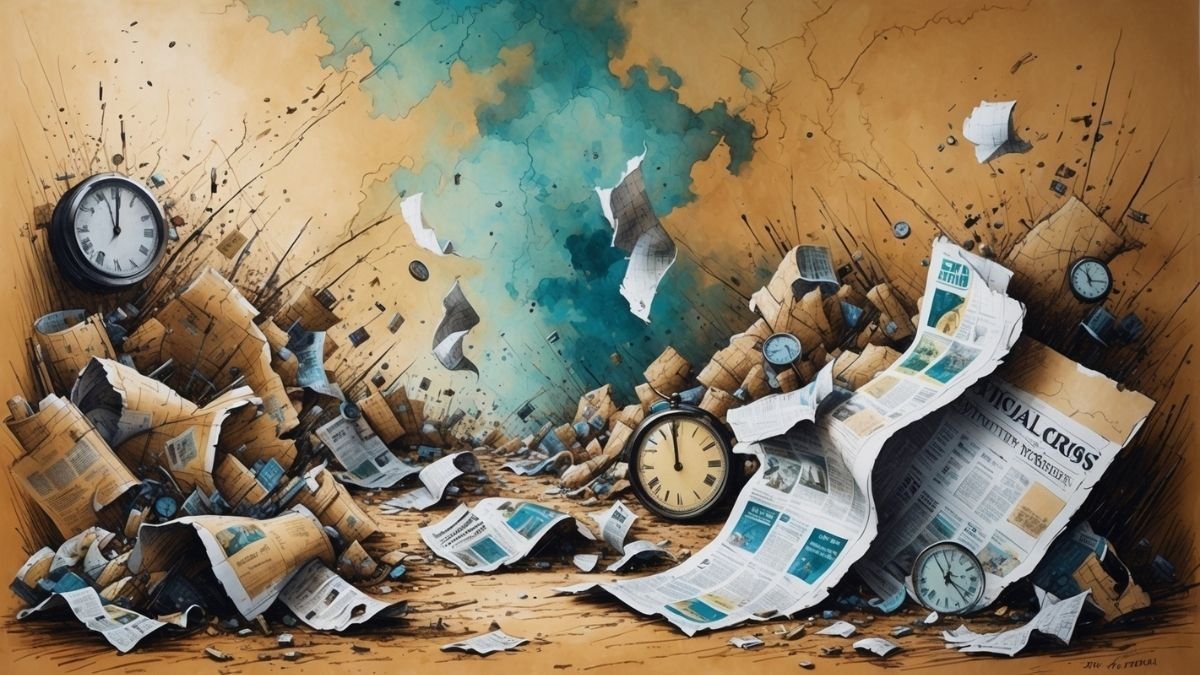
How to Approach This Lesson
Hello and welcome! This lesson is designed to sharpen your advanced grammar skills. The best way to get started is by reading the main text about financial crises. As you read, focus on the overall message and any new vocabulary. Don’t get bogged down in the grammar just yet. Once you have a good grasp of the content, we’ll go back and analyze some of the key grammatical structures together. We’ll explore what they mean, why they’re used, and how you can use them to boost your own English proficiency. Let’s get started.
The Domino Effect: Unpacking Global Financial Crises and Their Enduring Repercussions
The global economy, a marvel of interconnectedness, is not without its Achilles’ heel: the ever-present specter of financial crisis. Hardly had the world recovered from one economic shock than another began to brew on a distant horizon. These are not isolated tempests in a teacup; they are seismic events whose repercussions ripple across continents, sparing few. So profound are their effects that they can redefine geopolitical landscapes, exacerbate social inequalities, and fundamentally alter the trajectory of nations for decades to come. Understanding these crises is not merely an academic exercise; it is a necessity for navigating our volatile world.
At the heart of most modern financial crises lies a cocktail of deregulation, excessive risk-taking, and the creation of complex financial instruments that few truly understood. Take the 2008 global financial crisis, for example. Fueled by a housing bubble in the United States, the crisis was amplified by the widespread sale of mortgage-backed securities of dubious quality. Investors, lured by the promise of high returns, purchased these assets, failing to appreciate the underlying risk. Had they been more discerning, or had regulatory oversight been more robust, the ensuing catastrophe might have been averted. When the bubble burst, the value of these securities plummeted, leaving financial institutions with trillions of dollars in toxic assets.
The immediate aftermath is often a credit crunch. With their balance sheets decimated, banks become intensely risk-averse, drastically curtailing lending to businesses and individuals alike. This credit freeze is the economic equivalent of a cardiac arrest. Not only does it halt investment and expansion by large corporations, but it also squeezes small and medium-sized enterprises, which are the lifeblood of many economies. The result is a cascade of business failures, soaring unemployment, and a sharp contraction in economic output, otherwise known as a recession.
Moreover, the social fabric is invariably stretched to its breaking point. Governments, facing collapsing tax revenues and surging welfare costs, are forced into austerity measures. These spending cuts, often impacting education, healthcare, and social safety nets, fall disproportionately on the most vulnerable segments of the population. The resulting public anger and disillusionment can lead to widespread protests and political instability, the consequences of which can be as damaging as the initial economic shock itself. We see this pattern repeated time and again: an economic crisis begetting a social and political one.
The long-term repercussions are equally daunting. A nation struggling to recover from a financial crisis often experiences a “lost decade” of stagnant growth and high unemployment. The psychological scars, too, are deep. A generation entering the workforce during a severe recession may face diminished career prospects and wage stagnation, a phenomenon known as economic scarring. Furthermore, the trust in financial institutions and government regulators, once shattered, is painstakingly difficult to rebuild. This erosion of trust can have a chilling effect on investment and economic dynamism for years to come.
In response, international bodies and national governments have sought to implement stricter regulations. The Basel III accords, for instance, demand that banks hold more capital in reserve to weather financial storms. However, a debate rages on: to what extent can we regulate risk without stifling the innovation and dynamism that fuel economic growth? There is no easy answer. The global financial system, by its very nature, is a dynamic and evolving entity. What is certain is that a vigilant, proactive, and globally coordinated approach to financial regulation is not a luxury, but a prerequisite for sustainable global prosperity.
Grammatical Structures Deep Dive
[ppp_patron_only level=5]
Alright, you’ve made it through the text. Now for the interesting part: let’s dissect some of the advanced grammar that gives the writing its punch.
1. Fronted Adverbials with Inversion
This is a stylistic choice that adds emphasis and a formal tone. You saw a couple of prime examples.
- “Hardly had the world recovered from one economic shock than another began to brew…”: This is a very literary way of saying “The world had only just recovered… when another one started.” By putting “Hardly” at the front, we must invert the subject (“the world”) and the auxiliary verb (“had”). The structure is Hardly + had + subject + past participle … than …
- “So profound are their effects that…”: Instead of “Their effects are so profound that…”, placing “So profound” at the beginning makes the statement much more dramatic and impactful. The verb ‘are’ comes before the subject ‘their effects’.
Quick Tip: This type of inversion is common with negative or limiting adverbials like ‘Never’, ‘Rarely’, ‘No sooner’, and ‘Only then’.
2. Past Unreal Conditionals (Third Conditional)
We use these to speculate about past events and their different outcomes. The text used a classic example.
- “Had they been more discerning, or had regulatory oversight been more robust, the ensuing catastrophe might have been averted.”: This is a double-barreled third conditional that avoids using ‘if’. It’s a very concise and formal way to say, “If they had been more discerning, or if regulatory oversight had been more robust…”. The structure Had + subject + past participle replaces If + subject + had + past participle. It’s perfect for analytical writing.
Common Mistake: Mixing up the verb forms. Remember, the ‘had’ clause needs the past participle (been, seen, done), and the result clause uses a modal verb (would, might, could) + have + past participle (have been averted).
3. Cleft Sentences for Focus
Cleft sentences are used to focus on a particular piece of information in a sentence. They “cleave” (or split) a single sentence into two parts.
- “What is certain is that a vigilant, proactive… approach… is not a luxury…”: The writer could have just said, “A vigilant… approach is certain.” But that’s flat. The cleft structure What + … + is + that… isolates and emphasizes the certainty of the point. It tells the reader, “Listen up, this is the main takeaway.”
4. Apposition
This is when you place a noun or noun phrase next to another to explain or identify it. It’s a great way to add detail without using extra clauses.
- “…a cascade of business failures, soaring unemployment, and a sharp contraction in economic output, otherwise known as a recession.“: The phrase “otherwise known as a recession” is in apposition to the list that comes before it. It renames and clarifies the concept.
- “…The psychological scars, too, are deep.”: Here ‘too’ is used as an appositive to add emphasis on the fact that psychological scars are also an important factor.
Summing It Up
Let’s do a quick recap of the structures we’ve covered:
- Fronted Adverbials with Inversion: For adding drama and emphasis (e.g., “Hardly had I…”).
- Past Unreal Conditionals: For speculating about the past in a formal way (e.g., “Had she known…”).
- Cleft Sentences: For zeroing in on the most important piece of information (e.g., “It was the… that…”).
- Apposition: For adding extra, clarifying information concisely.
Your mission, should you choose to accept it, is to become a grammar detective! Look for these forms in your reading. The more you see them used correctly, the easier it will be to deploy them in your own writing and speaking, making your English more sophisticated and impressive. Keep up the great work!
[/ppp_patron_only]









0 Comments