
Introduction
More than 1 billion people live in India, a country in southern Asia. Only China has more people. The people of India speak more than 100 different languages.
Audio Episode
[ai_playlist id=”16072″]
Interactive Transcript
INDIA
More than 1 billion people live in India, a country in southern Asia. Only China has more people. The people of India speak more than 100 different languages.
CITIES AND VILLAGES
Kolkata (also spelled Calcutta) is India’s largest city. Mumbai (also called Bombay) is the country’s most populated urban area. They rank among the world’s largest cities, too. New Delhi is the capital of India.
More than 16 million people live in or near the port city of Mumbai. Mumbai is a center of trade and the center of India’s movie business. India makes about 800 movies a year, more than any other country in the world.
In spite of its large cities, India is primarily a country of villages. Most of India’s people make their living by farming. Many of them are extremely poor.
More and more people are moving from rural areas of India to cities. They hope to find better-paying jobs in the cities. India’s cities have become very crowded as a result.
A SUBCONTINENT
India is shaped like a triangle. It juts out from the bottom of Asia into the Indian Ocean. India is sometimes called a subcontinent. Is this because India is big? Not really. Six countries—including Russia, Canada, and the United States—are bigger.
India is a subcontinent because it is cut off from the rest of Asia. Mountains, jungles, and the Indian Ocean form barriers that make India a world apart—a subcontinent.
India’s neighbors Pakistan and Bangladesh also form part of the Indian subcontinent. These lands were once part of India.
A LAND OF CONTRASTS
The Indian subcontinent offers striking contrasts. The Himalayas, the world’s highest mountains, extend across northern India. Towns lie on the lower slopes, but few people live high in the mountains.
South of the mountains stretch broad plains. Two great rivers, the Ganges and the Brahmaputra, flow through the plains. Tea grows on plantations to the east. The huge Thar Desert lies to the west.
A vast plateau lies south of the plains. Much of this region is rocky. The climate of the plateau is extremely hot. Every summer, winds called monsoons drop heavy rain on India.
JUNGLES AND WILDLIFE
The English language borrowed the word jungle from Hindi, the language spoken by most Indians. India’s jungles are home to many fascinating animals. Tigers, panthers, lions, cheetahs, snow leopards, monkeys, and elephants are all found in India. So is the poisonous cobra snake. India has many national parks and wildlife preserves where its animals can be seen.
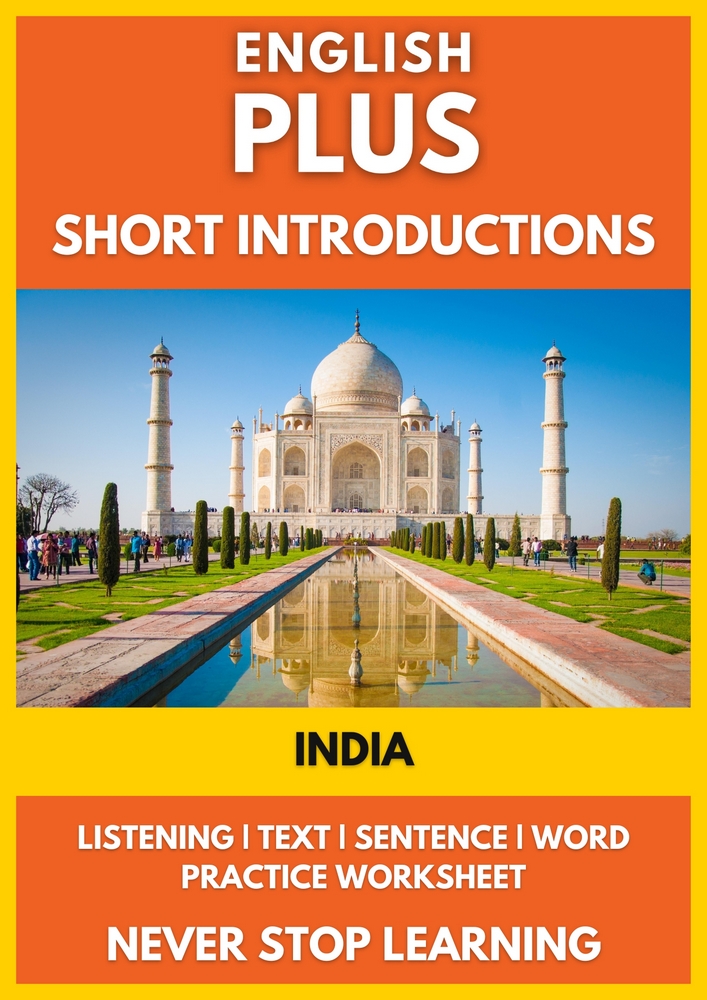
TAJ MAHAL
The Taj Mahal in Agra, India, is considered one of the most beautiful buildings in the world. An emperor built it after the death of his young wife. She died in 1631. Her tomb is inside.
The Taj Mahal is covered in white marble and set in a garden with pools of water. The garden represents paradise. The building is decorated with beautiful carvings and colored stones. Its color appears to change throughout the day as the sun moves across the sky.
RELIGION IN INDIA
Hinduism and Buddhism, two of the world’s major religions, were born in India. So were the Jain and Sikh religions. Most of India’s people are Hindus. Muslims—followers of Islam—are second in number.
Hindus worship in the many beautiful temples they have built in India. They also worship at home. Hindus worship all life. They do not kill animals, and they do not eat meat.
Muslims also have built many beautiful buildings, including the Taj Mahal. Hindus and Muslims have not always gotten along. Muslim invaders brought Islam to India. For centuries, Muslims ruled a largely Hindu country.
A BRITISH COLONY
During the 1700s, Britain gained control of India. Many Indians began speaking English. British sports, such as cricket and badminton, became popular. But many British efforts to change Indian customs and traditions were far less popular.
MAHATMA GANDHI
Mohandas K. Gandhi was a Hindu who led India to independence from Britain. Gandhi’s followers called him Mahatma, which means “great soul.”
Gandhi taught people to work for independence without using violence. Thanks to his efforts, India gained its independence in 1947. Gandhi’s policy of nonviolence influenced many other people. In the United States, Martin Luther King, Jr., used Gandhi’s idea of nonviolent protests to gain civil rights for black Americans.
AFTER INDEPENDENCE
When India gained its independence, it split apart. The parts of India that were primarily Muslim became the country of Pakistan. Pakistan was made up of two parts, one to the east of India and the other to the west. In 1971, East Pakistan became a separate country called Bangladesh.
Practice Worksheet (Downloadable PDF)





0 Comments