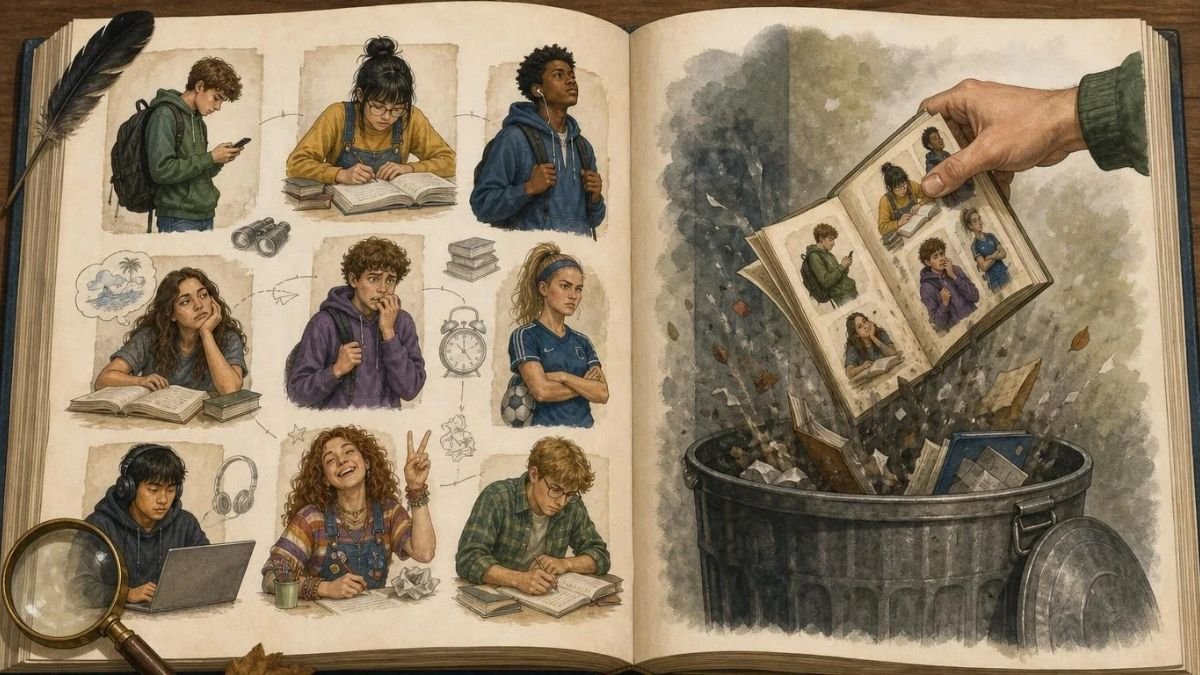
Can you remember the smell of a brand-new notebook on the first day of school?
If you can, I suspect you can also remember how long that feeling lasted. For most of us, the magic of September survives, generously, until about the second week of October. By then the notebook has a coffee stain, the new pens have mysteriously disappeared, and the bright resolution to "be organized this year" has joined all the previous years' resolutions in a quiet graveyard at the bottom of a backpack.
So here's the question I'd like to explore in this episode, whether you're a teacher, a parent, or someone who still has nightmares about forgetting your homework. Is it possible to create a reasonable amount of enthusiasm and motivation that lasts the whole school year? Not a September sugar rush. Something that survives the long, gray middle of the year, the exams, the illnesses, the power cuts and the mornings when nobody wants to get out of bed, including the adults.
To answer that, I'll start by doing something that every teacher does in the first week, even if they won't admit it. I'm going to sort the students into types. The Stationery Enthusiast. The Hibernator. The Negotiator. The Invisible One. And, because fairness matters, I'll also sort the parents and teachers, and I'll put myself in there too.
And then, halfway through, I'm going to argue with my own field guide. Because I'm not sure types are the answer. I'm not even sure they're harmless.
Here's how we'll do it. First, I'll tell you a story about an English teacher in Beirut who has been doing this for twenty-eight years and can identify every type of student by their shoes, and about the new boy who arrives one September and refuses to fit. Then we'll talk it through together, with some humor, some research, and some practical ideas. And at the end, I'll leave you with some questions to take home, or to the next parents' meeting.
Let's go to class. Please don't forget your pencil case.
The Story
Joumana Salameh could tell what kind of student a child was going to be by their shoes.
She had been teaching English at the same school in Beirut for twenty-eight years, and on the first morning of every school year she stood at the door of Room 14 and watched the feet come in. It was, she told the younger teachers in the staff room, far more reliable than any file from the counselor's office.
New sneakers, so white they hurt the eyes, with the laces tied in double knots: the Stationery Enthusiast. That child would arrive with a pencil case the size of a suitcase and color-coded tabs in every notebook, and would be devastated by October when real life got its fingerprints all over the system.
Shoes with the backs trodden down flat like slippers: the Hibernator. Still living on summer time. Would yawn until November.
Expensive shoes, scuffed on purpose: the Comedian. Or possibly the Rebel. Occasionally both, in which case you prayed.
Neat, polished school shoes, laces exactly even: the Perfectionist. Would cry over a ninety-six. Would need to be told, repeatedly, gently, that a ninety-six was not a catastrophe.
And the shoes she almost didn't notice, because they came in close to the wall and went straight to the back row: the Invisible One.
She had a type for every pair. She had written none of it down, but she carried it in her head like a field guide, the way her grandfather had carried the names of every bird in the valley where he grew up. And it worked. Mostly. It had worked for twenty-eight years. Knowing the type meant knowing what to do. The Enthusiast needed to be slowed down before they burned out. The Hibernator needed warming up. The Comedian needed a stage, but a small one, preferably a job. The Perfectionist needed permission to fail. The Invisible One needed, well, to be seen, though she had to admit that in a class of thirty-four, some years she didn't manage it until spring.
This year, on the third day of September, the feet came in as usual. Lara, double-knotted, beaming, carrying three new notebooks in three different pastel colors. Hadi, backs of his shoes flattened, already telling a joke in the corridor that was making two boys laugh so hard they had to hold the wall. Yasmina, polished shoes, sitting down in the front row and immediately arranging her pens in a straight line.
And then the new boy.
His shoes were neither new nor old. Plain black sneakers, clean, slightly too big, as though they'd been bought for someone else, or bought to last. He stopped in the doorway, and Joumana waited for him to choose a seat, because the choice of seat was the second chapter in her field guide.
He didn't choose one. He stood there and looked around the room. Not at the other children. At the room. At the windows. At the door he had just come through. At the second door at the back that led to the fire stairs. And only then did he walk to the desk in the far corner, the one nobody wanted because it faced the wall at an awkward angle, and turn the chair around so that it faced the door.
"Name?" she asked, pen hovering over the register.
He looked at her for a moment. "Omar."
"Welcome, Omar. Would you turn your chair around, please? We face the board in this room."
He didn't answer. He didn't turn the chair. He didn't look defiant, exactly. He looked as though he hadn't heard the question, or had heard it from very far away.
A ripple went around the class, the particular ripple of thirty-three children discovering, with interest, that a new boy is going to be trouble.
Joumana decided not to fight about a chair on the first morning. "We'll discuss it later," she said, which is what teachers say when they have lost a battle and intend to reframe it as a strategy.
She filed him, in her head, under a type she didn't use very often. The Defiant One.
The Defiant One needed firmness. Clear rules, calmly stated, consistently enforced. You didn't let the Defiant One set the terms in the first week, or you would spend the whole year negotiating.
So on the second day, she asked him again to turn his chair. He didn't. On the third day, she moved his desk herself before class, so it faced the board. When he came in, he looked at it for a long moment, then picked up the chair, turned it around again, and sat down with his back to the board and his face to the door, and did the whole lesson like that, copying from the board by twisting round in his seat every thirty seconds, which looked so uncomfortable that Hadi started a quiet running commentary about it, and the back row began to laugh.
"Hadi," said Joumana.
"I'm just saying, Miss, he's going to need a neck operation by Christmas."
The class laughed louder. Omar did not look up.
By the second week, she had written his name in the small notebook she kept for the conversations she would need to have with the principal. He never did his homework. He never spoke unless spoken to. He never, ever turned his chair. When she stood beside his desk and asked him quietly to try, just for one lesson, he said, "No, Miss," politely and completely, as if she had asked him to fly.
She called his home. A woman answered, tired, polite, and said that she was his aunt, and that his mother would call back, and his mother didn't.
On the Thursday of the third week, the weather broke.
It had been a long, hot September, the kind that makes the classroom smell of dust and pencil shavings and too many children, and all afternoon the sky over the city had been turning a strange yellow-gray. Joumana was writing the past perfect tense on the board. Hadi was pretending to understand it. Lara had already filled half a page of notes in three colors. Yasmina had her hand up with a question about an exception to the rule that Joumana hadn't yet explained and would now have to.
And then the first thunder came.
It wasn't the rolling kind. It was the other kind, the single, enormous crack that seems to happen directly above your head, so loud that the windows hummed in their frames.
Several children jumped. Someone squealed and then laughed at themselves. Lara dropped her pink pen.
And Omar was on the floor.
He had gone under his desk so fast that Joumana hadn't seen him move. He was curled against the wall with his arms over his head and his knees drawn up to his chest, perfectly still, the way she had seen people lie on the ground in the news, and his whole body was shaking.
For a second nobody understood. Then Hadi laughed, one short, uncertain laugh, the laugh of a boy who thinks this might still be a joke.
"Hadi," said Joumana. And something in her voice, which she had not used in twenty-eight years of teaching, stopped the laugh in his throat.
The second crack of thunder came. Omar pressed himself harder into the corner.
Joumana walked to the back of the classroom. Her knees, which were fifty-two years old, complained as she lowered herself onto the floor beside his desk, in her good skirt, among the pencil shavings.
She didn't touch him. She didn't say anything about the chair.
"It's thunder," she said quietly. "It's only thunder. It's the weather. I'm here."
He didn't answer. But after a while, she saw his hands loosen a little on the back of his head.
The class was completely silent now. Thirty-three children watching their English teacher sitting on the floor in the back corner of Room 14, beside the boy who wouldn't turn his chair around, while the rain began to drum on the windows.
It was a long time before he spoke.
"We came up from the south," he said, to the floor. "Last year. When the war came. We stayed in a school. In a classroom. For two months." A pause. "When it's loud, you watch the door. So you can get out."
Joumana closed her eyes for a moment.
The Defiant One. She had written it in her notebook. She had called his home to complain about the chair.
She thought of all the other shoes she had read so confidently over twenty-eight years. The double knots. The flattened backs. The polished leather. She wondered, for the first time, how many of them she had read wrong.
The rain eased. The thunder moved off toward the mountains, grumbling.
"Omar," she said. "What do you need? To be able to learn in this room. What do you need?"
He looked at her properly for the first time.
"A seat facing the door," he said.
The next morning, before school, Joumana came in early and moved her own desk. She put it at the back of the room, beside the fire door. Then she moved Omar's desk next to it, facing the front, so that from where he sat he could see both the board and, with a small turn of his head, both doors.
When the class came in, they looked at the new arrangement with enormous interest. Hadi opened his mouth to say something. Then he looked at Omar, and closed it again.
Omar sat down, and faced the board.
Between My Lines
Let's begin with a national holiday that nobody officially celebrates, but that is observed in every household with children: the week before school starts.
You can tell it's arrived by the signs. The school supply list arrives, a document of such length and specificity that it could double as a NASA procurement order. Twelve notebooks, but not just any notebooks, ninety-six pages, squared for mathematics, lined for languages, with a very particular shade of plastic cover for each subject. Glue sticks, plural, because apparently one glue stick per child is considered reckless. A calculator model that has been discontinued. A dictionary nobody will open. And, in this part of the world in recent years, a fee schedule quoted in fresh dollars that makes parents stare into the middle distance like soldiers remembering a battle.
Then there's the first-day photograph. The child in the new uniform, standing in front of the door, holding a sign with their grade written on it, smiling the brave smile of a prisoner being released back into custody. This photo will be posted by the parent with a caption like "Where did the summer go?" and liked by approximately every relative on the planet, including several who don't know which child it is.
And then there's the class WhatsApp group, which reactivates at the end of August with the force of a dormant volcano. But we'll come back to that.
For now, I promised you a field guide. So let me introduce you to the students. I'm doing this with enormous affection, because I've taught all of them, and I've been several of them.
First, the Stationery Enthusiast. You'll recognize this student by the pencil case, which requires its own backpack. Every subject is color-coded. The notebooks have tabs. There is a highlighter for every emotion. The Stationery Enthusiast arrives in September with the energy of an Olympic athlete, and there is only one problem: they are running a marathon at sprint speed. By mid-October, the color-coding system has collapsed under the weight of actual work, and the Enthusiast experiences something close to grief. The trick here isn't to dampen the enthusiasm. It's to help them pace it. Help them build a system that's still standing in February. Teach them that a slightly messy notebook that's still being used in March is worth more than a perfect one abandoned in October.
Second, the Hibernator. This student is technically present in September but is still operating on summer time, which in many homes means going to bed at two in the morning and waking up at noon. The Hibernator yawns through the first month, answers questions a full four seconds late, and has the eyes of a small creature emerging from a cave. It's tempting to call the Hibernator lazy. I'll come back later to why that may be unfair, especially for teenagers. For now, the practical advice is simple: the transition starts before school does. Moving bedtimes gradually earlier in the last week or two of the summer is a great deal kinder than a brutal shock on the first Monday.
Third, the Negotiator. This is the future lawyer, diplomat or car salesman who treats every instruction as the opening bid in a trade agreement. "If I do half the homework, can I skip the other half?" "What if I read the chapter but don't write the summary?" "Technically, you said 'write a paragraph,' and this is a paragraph." The Negotiator is exhausting, and also, if you think about it, displaying exactly the kind of reasoning skills we claim to want in young people. The trick is to give the Negotiator real choices within clear limits, so their energy goes into choosing rather than bargaining. "You can do these exercises or those exercises, but you're doing one set." Deprive the Negotiator of the fight, and you often discover a very capable student underneath.
Fourth, the Class Comedian. Every class has one, and every teacher has, at some point, wanted to both strangle them and give them their own television show. The Comedian can derail a lesson with one perfectly timed remark. But the Comedian is also often the student with the most social intelligence in the room, and humor is sometimes a shield for something else: not understanding the material, or wanting to be noticed, or having something heavy at home to distract from. The Comedian usually needs a stage, but a controlled one. Give them a role. Let them read the dialogue out loud. Let them present. Channel the performance, and you often turn a disruptor into a leader.
Fifth, the Anxious Perfectionist. This student's shoes are polished, their homework is immaculate, and a ninety-four feels to them like a personal tragedy. The Perfectionist is the easiest student to overlook, because they cause no trouble. They're also, quietly, one of the most at risk of burning out. What they need most is permission to make mistakes, and to see adults make mistakes too, without the world ending. And please, if you're a parent, when they bring home a ninety-four, don't ask about the missing six.
Sixth, the "What's the Point?" Philosopher. This is a newer species, or at least a more articulate one. The Philosopher wants to know why they should learn to write an essay when an app can write one in ten seconds, why they should learn history when everything is online, why they should learn anything at all when the future is uncertain. And here's the uncomfortable thing: these are good questions. The worst possible response is "because I said so" or "because it's on the exam." The Philosopher deserves a real answer, and if we don't have one, that's a problem with us, not with them.
Seventh, the Fresh Starter. This is the student who has decided, over the summer, that this year will be different. New haircut, new attitude, new resolution. They want to shed their old reputation, the class clown or the one who always forgot homework, and become someone else. The Fresh Starter is incredibly fragile in the first few weeks, because nothing can crush a new start faster than an adult who says, "Oh, you're the one who was in my brother's class, I've heard about you." Let them start fresh. It's one of the most generous things a teacher can do.
And finally, the Invisible One. Back row, near the wall. Never raises a hand. Never causes trouble. Submits their work on time, or doesn't, without anyone noticing either way. In a class of thirty-five, the Invisible One can go weeks without being called by name. They're not a problem, so they're not a priority. And that, I think, is one of the quiet tragedies of classroom life.
Now, since fair is fair, let me turn the field guide on the adults.
The parents. First, the WhatsApp Group Parent. This is the parent who, at eleven-thirty at night, posts in the class group: "Sorry to disturb, did anyone understand what the teacher meant by question four?" followed by twenty-three replies, three voice notes, a photograph of the wrong page, and at least one parent who has misread the entire assignment and started a panic about a test that doesn't exist. The class WhatsApp group is where calm goes to die. It's a remarkable social experiment in which forty adults, all of whom have finished school, collectively fail to understand a worksheet designed for nine-year-olds.
Then there's the Co-Author. This is the parent who helps with the science project. By "helps," I mean builds the entire volcano, from the papier-mâché to the baking soda, while the child watches television. Every science fair has several of these projects, beautifully engineered, standing next to a lopsided but honest cardboard creation made by a child who actually did it. We all know which one deserves the prize. We also know which one usually gets it.
Then there's the Economist, who runs the household on a system of incentives so elaborate that it would impress a central bank. A good grade earns a new phone. Finishing homework earns an hour of video games. Reading a book earns cash. I'll come back to the Economist, because there's research about this that might surprise you.
And there's the "At Your Age" Parent, whose motivational strategy consists of describing, in detail, how much harder things were in their own school days. At your age, I walked to school through snow, uphill, in both directions, during a war, without electricity, and I was grateful. It's possibly true. It's also, as a motivational technique, about as effective as reading a child the phone book.
And the teachers, because I'm one of them. There's the Day-One Idealist, arriving in September with a new seating plan, a laminated behavior chart, three motivational posters and the absolute conviction that this year, everything will be different. And there's the October Survivor, who is the same teacher five weeks later, eating lunch standing up, with the laminated chart hanging from one corner of the wall.
And now I owe you a confession, because I've been making fun of everyone else, and it's time to make fun of myself.
I've been a teacher for a long time. And I've done most of what I've just described. I've been the Day-One Idealist and the October Survivor, often in the same year. I've had favorites, the bright, eager ones who made me feel like a good teacher. I've been short with the Comedian when I was tired. I've let the Invisible One stay invisible, because there was a crisis in the front row and only one of me. And, most relevant to this episode, I've sorted students into types. Quickly, confidently, often in the first week, sometimes in the first ten minutes. I've done exactly what Joumana did with her shoes. And I've been wrong. I'd like to tell you I've been wrong rarely. I suspect the honest answer is that I don't know how often, because the students I got wrong mostly didn't come and tell me.
Which brings me to the uncomfortable part of this episode. Because I've just spent quite a while giving you a field guide to student types. And now I'd like to argue with it.
Here's a story about types that went wrong on a very large scale. You've probably heard of learning styles: the idea that some people are visual learners, some are auditory learners, and some are kinesthetic learners, who learn best by doing and moving. And the idea that teaching will be more effective if it's matched to each student's style. It's one of the most widely believed ideas in education. Surveys of teachers in several countries have found that large majorities agree with it. It appears in teacher training, in parenting books, and on countless posters.
The trouble is that the evidence doesn't support it. In 2008, a team of psychologists led by Harold Pashler reviewed the research and looked for the specific kind of evidence that would be needed to show that matching teaching to learning styles actually improves learning. They found very little of it that met that standard, and several well-designed studies that contradicted it. People certainly have preferences. Some of us like diagrams, some of us like to talk things through. But there's little good evidence that teaching to those preferences helps people learn better. Much of the time, the best way to teach something depends on the thing being taught, not the person learning it. You learn to swim by swimming, not by watching a video, whatever your style.
Why does this matter for a back-to-school episode? Because it shows how seductive types are. A type is a shortcut. It makes a confusing room of thirty-five unique human beings feel manageable. It gives us something to do. And it can quietly become a cage. The child who's been told they're a "kinesthetic learner" may decide they can't learn from reading. The child who's been labeled "the lazy one" or "the troublemaker" may decide that's who they are.
And there's research on that, too. In the 1960s, the psychologist Robert Rosenthal and a school principal, Lenore Jacobson, told teachers that certain students had been identified by a test as likely to "bloom" intellectually during the year. In reality, those students had been chosen at random. By the end of the year, some of those randomly chosen students, particularly younger ones, had shown larger gains. The study, published as Pygmalion in the Classroom in 1968, became one of the most famous in educational psychology: teacher expectations, it suggested, could become self-fulfilling prophecies.
Now, I want to be careful here, because we're trying to think critically, and this is exactly the sort of famous finding that gets inflated over time. The original study was heavily criticized for its methods, and later research has generally found that teacher expectation effects are real but usually quite small. However, some reviews have suggested they can be larger for students who are already struggling or from groups that face stigma. So the honest summary is not that a teacher's belief can magically turn a struggling student into a genius. It's that what we expect of children can nudge them, and the nudges fall hardest on the children with the least protection.
So should we throw away the field guide entirely? I don't think so, and let me make the case for types, because it's a real one.
A teacher with thirty-five students, five classes a day and a salary that, in this country, has been decimated by the economic collapse, cannot start from scratch with every single child every single morning. Human beings need patterns to function. Experienced teachers really do recognize recurring behaviors, and that recognition is part of their expertise. It lets them respond quickly. And for parents, knowing that other children behave like theirs can be a huge relief. It's comforting to discover that your Negotiator isn't a budding criminal mastermind, just a fairly normal twelve-year-old. And a bit of humor about the types, frankly, keeps teachers and parents sane.
So the answer, I think, isn't to stop noticing patterns. It's to change what we do with them. A type should be a question, not a verdict. Not "he's the Defiant One," but "he's behaving defiantly; I wonder why." Not "she's lazy," but "she's exhausted; what's happening at home?" Not "he's the Comedian," but "what's the joke protecting?" The type is where your curiosity should start, not where it should stop.
Now, let's talk about the thing we actually came here for: motivation that lasts longer than the notebook smell.
Remember the Economist parent, with the phone for good grades and the cash for books? In 1973, the psychologists Mark Lepper, David Greene and Richard Nisbett ran a now-famous experiment with preschool children who already liked drawing with markers. Some of the children were told that if they drew, they would get a special "Good Player" award with a gold seal and a ribbon. Others weren't told about any award. Later, when the researchers watched the children during free play, the ones who had drawn in order to get the promised award spent less time drawing on their own than the others did. The reward, it seemed, had turned something they enjoyed into something they did for a prize, and when the prize went away, so did some of the interest. Psychologists call this the overjustification effect.
Again, in fairness, the research on rewards is more complicated than "rewards are bad." For tasks that aren't interesting to begin with, rewards can help get things started, and praise that gives information about what someone did well can actually support motivation. There was a long academic debate in the 1990s about exactly how damaging rewards are, and the answer depends a lot on the type of reward and the task. But the broad warning holds, and it matters for parents: if you pay a child to read, you may be teaching them that reading is a job. And jobs are things people stop doing when the pay stops.
So what does make motivation last? One influential framework in psychology, self-determination theory, developed by Edward Deci and Richard Ryan, suggests that people tend to be more deeply motivated when three needs are met. Autonomy: some real sense of choice and control. Competence: the feeling that you're getting better at something, that effort leads somewhere. And relatedness: a sense of connection to the people around you. Look at the student types again with those three in mind, and they start to make a different kind of sense. The Negotiator is fighting for autonomy. The Perfectionist is terrified about competence. The Comedian and the Invisible One are, in very different ways, dealing with relatedness.
You might also have heard that the answer is teaching children a "growth mindset," the belief that abilities can grow with effort. It's a lovely idea, and I believe in the spirit of it. But, as with so many popular ideas in education, the evidence suggests the effects of short mindset interventions on grades are fairly modest overall, sometimes meaningful for students who are struggling, and small for most. Like everything else in this episode, it's a tool, not a master key.
And let me say something in defense of the Hibernator, especially the teenage one. Adolescents' body clocks naturally shift later during puberty; many teenagers genuinely struggle to fall asleep early and to be alert first thing in the morning. It's partly biology, not just phones and bad habits. In 2014, the American Academy of Pediatrics recommended that middle and high schools start no earlier than eight-thirty in the morning for exactly this reason. Many schools still start much earlier. So the next time a fifteen-year-old seems barely alive in a first-period class, remember that some of what looks like laziness is a body being asked to operate in a time zone it hasn't moved to yet.
So what can teachers and parents actually do to keep enthusiasm going past October? Here are a few things that, in my experience, help more than posters.
Think in embers, not fireworks. The first week of school is often designed like a fireworks show: exciting, loud, over quickly. What lasts is the ember: small, steady routines that make school predictable and safe, and small wins that let children feel their competence growing. Plan for October in September. Assume the magic will fade, and have something ready for when it does: a project that begins in week six, a class tradition that starts in the second month.
Give real choices. Not fake choices, like "do you want to do your homework now or do your homework now?" Real ones, within limits. Which book to read. Which problem set to try. How to present a project. Autonomy doesn't mean chaos. It means the child owns a piece of the decision.
Praise the specific, not the general. "You're so smart" is pleasant and useless. "The way you checked your answer by working it backwards was clever" tells a child exactly what they did well, and lets them do it again.
Ask better questions at home. "How was school?" gets you "fine," the single most useless word in the parent-child vocabulary. Try "What made you laugh today?" or "What was the hardest thing?" or "Who did you sit with at lunch?" And then, crucially, listen to the answer without immediately fixing it.
Leave the WhatsApp group on mute. Not forever, but for a while. A great deal of back-to-school anxiety in children is actually borrowed from adults. If you want a calm child, try being a calm parent, even if that means discovering what question four meant a day later than everyone else.
And let them fail a little. Not catastrophically, but enough. A forgotten piece of homework in October, with a small, survivable consequence, teaches more than a parent who drives across the city to deliver it.
These things help. They really do. But I don't think they are the heart of the matter, and I'd like to tell you why.
For children in Lebanon, the school year that began in the autumn of 2024 was, according to Save the Children, the sixth consecutive year of serious disruption to their education. Before it, there was the economic collapse, the pandemic, the port explosion, and a long teachers' strike. And then, that September, the war escalated, more than a million people were displaced, and around half of the country's public schools were turned into shelters for displaced families. The start of the public school year was postponed to November. Education officials said that roughly forty percent of the country's pupils had been forced from their homes. In some of those schools, classrooms became bedrooms. There were thin mattresses where the desks had been, and laundry hanging near the blackboard.
So think about what that means for the children walking into a classroom this September, anywhere in this country. Some of them spent weeks living in a school, not learning in one. For some of them, a classroom isn't a place of learning. It's a place you sleep when you've lost your home. Some of them have learned to watch the door. Some of them have learned that a loud noise means you get under something, fast, and think afterward.
Now look at the field guide again.
The Hibernator who can't wake up may not be on summer time. They may not have slept properly in months. The Comedian may be making everyone laugh because silence is where the memories live. The Negotiator may be fighting for a small piece of control in a life where they've had none. The Perfectionist may be trying to make one thing in their world perfect because everything else has fallen apart. The Invisible One may be invisible because being seen, somewhere along the way, became dangerous. And the Defiant One, the boy who won't turn his chair, may simply be a child who needs to see the door.
Every type, I've come to believe, is a costume. Sometimes the costume is just a personality, a quirk, a phase. Children are wonderfully strange, and not every behavior hides a wound. But sometimes the costume is armor. And you can't know which from the shoes.
Here is what I think the research on resilience actually tells us, and it's much simpler, and much harder, than any technique. Researchers at Harvard's Center on the Developing Child, looking across studies of children who faced serious hardship, found that the single most common factor for those who developed resilience was having at least one stable, committed relationship with a supportive adult. A parent. A caregiver. A grandparent. A neighbor. A teacher.
One. Not a program. Not a poster. Not a reward chart. One adult who stays, and notices, and asks.
We talk a great deal in this country about how resilient our children are, as if resilience were something they were born with, a national trait, like a talent for languages or for hospitality. It isn't. Resilience, according to that research, is built. It's built in relationships. It's built by adults who show up, again and again, over years. When we praise our children for being resilient without asking who is helping them carry what they carry, we're admiring the building and forgetting the foundation.
And that, I think, is the answer to the question this episode started with. Enthusiasm that lasts the whole school year can't be installed in September like new software. It can't be bought with a phone or a reward chart, or motivational posters, or a perfect first day. It grows, slowly, in a child who feels safe enough to try, and seen enough to believe that trying matters to someone.
The most powerful question a teacher or a parent can ask a child isn't "Why won't you do what I say?" It's the one Joumana finally asked, sitting on the floor in her good skirt among the pencil shavings, twenty-eight years into a career, after getting it wrong for three weeks.
What do you need?
And then, and this is the hard part, you have to be willing to move your own desk.
One more thing, because it would be dishonest to leave it out. The adults need someone too. Teachers in this country have spent years working for salaries that lost most of their value, in schools without reliable electricity, teaching children who carry more than any curriculum can hold. Parents are exhausted, frightened and stretched. You can't pour from an empty cup, as the saying goes, and a great many of our cups have been empty for a long time. So if you're a teacher or a parent listening to this, and you feel you're failing at being that one adult, you're probably not failing. You're probably tired. And you may need your own one adult as well. That's not weakness. That's how it works, for all of us, at every age.
So let's leave it there, and I really do mean leave it with you, because you know your children and your students far better than I do.
Here are the questions that I keep turning over.
Which type were you, when you were in school? Was that really who you were, or was it a costume? Did anyone ever see past it? And what difference did it make?
Are types useful? When does noticing a pattern help a teacher or a parent respond well, and when does it turn into a label that a child can't escape? How would you tell the difference in the moment?
Should we reward children for learning? When does a reward help a child get started, and when does it quietly teach them that learning is a job they'd stop doing if the pay stopped?
What does a child in your life need this year that they might not be able to ask for? How might you find out, without turning the question into an interrogation?
And the hardest one: who was your one adult? The teacher, relative or neighbor who stayed, and noticed, and asked? Have you ever told them? And whose one adult might you be, right now, without even knowing it?
I don't have tidy answers to these, and I'm suspicious of anyone who does. Talk about them with your friends, especially the ones who teach. Talk about them with your family, including the children, who may have more to say than you expect. And if you'd like, bring your thoughts to us. You'll find me and the rest of this community on Patreon at dannyballan.com, and at our website, englishpluspodcast.com.
And this September, before you read the shoes, look up. Ask the question. And be ready to move your desk.





0 Comments