Introduction
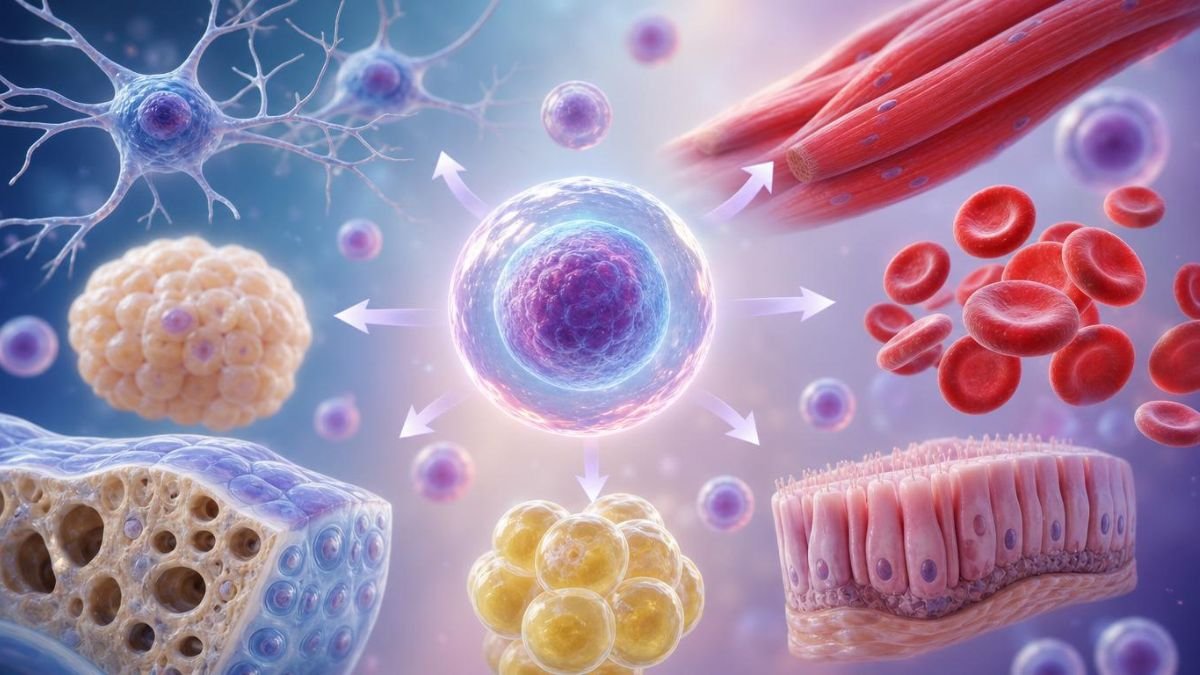
Somewhere inside you, right now, there are cells that have not yet decided what to be. Not in a philosophical sense — in a literally biological one. These cells, called stem cells, retain a remarkable degree of what biologists call potency — the ability to develop into multiple different cell types, to divide and renew themselves, to respond to the body's signals about what is needed and become it. They are the body's maintenance crew, its repair system, and in the early stages of development, the architects of the entire biological structure that eventually becomes a complete human being.
Stem cells have been at the center of some of the most exciting and most contentious scientific developments of the last three decades. They hold genuine promise for treating conditions ranging from Parkinson's disease to spinal cord injuries to diabetes to certain cancers. They have been the subject of intense ethical debate — particularly around embryonic stem cells — that has shaped both scientific policy and public opinion. And the science itself is moving fast enough that what seemed like distant possibility a decade ago has become clinical practice today, while other applications that seemed imminent have proved more difficult than expected.
Why read about this carefully today? Because science at the frontier — science that is simultaneously advancing rapidly, being contested politically, and carrying enormous human stakes — is some of the most complex and consequential writing you will encounter in English. It requires you to distinguish between what is established, what is promising, and what is speculative. It requires you to read ethical arguments alongside empirical ones. And it requires the kind of vocabulary precision and analytical depth that close reading builds. Today we do all of that, with cells that carry more possibility in them than almost anything else in the living world.
The Article
What if the most powerful medicine of the future is not a drug but a cell — a living, responsive, adaptive entity that could travel to a site of injury or disease in your body and become whatever is needed to restore function? That is not science fiction. That is the promise — still partly unfulfilled, but advancing — at the center of stem cell science. The body's stem cells are its building blocks in the most literal sense: undifferentiated units that can, under the right circumstances, become specialized cells of many different types. Understanding them is one of the great scientific projects of our time.
The word "stem" in stem cells refers to the idea of a stem as an origin point — the place from which branches diverge. A stem cell is a cell that has not yet committed to becoming a specific cell type. This state of non-commitment is called pluripotency in its broadest form — the ability to develop into any of the cell types of the body — or multipotency, meaning the ability to develop into a limited range of related cell types. Embryonic stem cells, derived from the inner cell mass of a blastocyst (the early-stage embryo, approximately five days after fertilization), are pluripotent: given the right signals, they can become neurons, cardiomyocytes, hepatocytes, or almost any other specialized cell. Adult stem cells, found in various tissues throughout the developed body, are typically multipotent: a hematopoietic stem cell in the bone marrow can become various blood cells but will not generally become a liver cell.
The discovery that most dramatically changed the field was Shinya Yamanaka's demonstration in 2006 that ordinary adult cells — skin cells, in the original experiment — could be reprogrammed back to a pluripotent state by the introduction of a small number of transcription factors. The resulting cells, called induced pluripotent stem cells (iPSCs), have the properties of embryonic stem cells but are derived from adult tissue. Yamanaka was awarded the Nobel Prize in Physiology or Medicine in 2012 for this discovery. Its importance is hard to overstate: it meant that the ethical controversies surrounding embryonic stem cell research — which center on the destruction of embryos — could potentially be bypassed entirely. A patient's own skin cells could, in principle, be reprogrammed into pluripotent stem cells, differentiated into the specific cell type needed, and returned to the patient's own body with minimal risk of rejection.
The clinical applications that have moved furthest from promise toward practice include hematopoietic stem cell transplantation — bone marrow transplants, in the popular vernacular — which has been used to treat blood cancers and immune disorders for decades and represents the most established form of stem cell therapy. CAR-T cell therapy, in which a patient's immune cells are extracted, genetically modified to recognize cancer cells, and reinfused, is a more recent development that has produced remarkable results in certain blood cancers. Clinical trials using iPSC-derived cells to treat macular degeneration — a leading cause of blindness — have produced early results that are cautiously encouraging. Parkinson's disease, Type 1 diabetes, spinal cord injuries, and heart failure are all conditions where stem cell therapies are in various stages of clinical investigation.
The ethical complexity of stem cell research is real, and understanding it requires distinguishing between different types of stem cells and different research uses. The most contested area has been embryonic stem cell research, because deriving embryonic stem cells requires the destruction of a blastocyst. For those who believe that human life — or morally significant human life — begins at fertilization, this is ethically impermissible regardless of the scientific benefits that might result. For those who believe that the moral status of a five-day blastocyst (which has no nervous system, no organ differentiation, and no sentience) is meaningfully different from that of a developed person, the ethical calculus points differently. This is a genuine moral disagreement rooted in fundamentally different premises about when human personhood begins, and it is not resolved by appealing to scientific evidence alone — it is a philosophical and often theological question to which science offers no direct answer.
The development of iPSC technology has not eliminated these ethical debates, partly because some researchers believe embryonic stem cells still have properties that iPSCs do not fully replicate, and partly because the ethical frameworks of those who object to embryonic stem cell research are often not solely about the specific technique but about the broader project of treating early human life as raw material for therapeutic purposes. The ethical debate over stem cells is also inseparable from broader cultural anxieties about the direction of biotechnology: about whether science is moving faster than our moral frameworks can accommodate, about who will have access to these therapies and at what cost, and about the relationship between human identity and the biological substrate that carries it.
What stem cell science offers, at its most hopeful, is a genuinely different relationship between human beings and biological limitation. The diseases and injuries that have historically been permanent — the severed spinal cord, the destroyed cardiomyocytes after a heart attack, the neurons lost to Parkinson's or Alzheimer's — are limitations that stem cell therapies might eventually address by replacing what has been lost with cells that function as if they were never missing. The body's building blocks, mobilized and directed by scientific understanding, might someday perform the repair that the body cannot accomplish on its own.
The question worth sitting with is not just whether this science will succeed — though that question matters enormously for millions of people who live with the conditions it might treat. It is what our answer to this science says about our values: about what we owe to each other, about what counts as a human being and when, about who gets access to medical breakthroughs and on what terms, and about the kind of relationship between human beings and biological fate that we want to build into the future.
If you could grow replacement cells from your own tissue to repair any damage or disease in your body, would you — without hesitation? And if the answer is not entirely "yes, obviously," what is the reservation trying to tell you?
Close Reading Analysis
Paragraph 1: "What if the most powerful medicine of the future is not a drug but a cell..."
Question: the opening question contrasts "a drug" with "a cell" and then describes a cell as "a living, responsive, adaptive entity." What does this three-part description add to the simple word "cell," and what does the three-part structure accomplish?
"A drug" is inanimate, manufactured, chemically fixed — it has a single mechanism of action and does not adapt to context. "A living, responsive, adaptive entity" is a three-part appositive that progressively expands the conception of what a therapeutic cell is. "Living" distinguishes it from drugs in the most fundamental way: it has biological agency. "Responsive" indicates it responds to environmental signals rather than operating mechanically. "Adaptive" means it can change what it is doing based on what it encounters. The three-part structure is not redundant — each term adds a dimension: existence (living), interaction (responsive), change (adaptive). The progression from simple to complex is also a kind of argument: this is not just a different kind of drug. It is a fundamentally different category of therapeutic agent.
Paragraph 2: pluripotency and multipotency:
Question: the paragraph introduces two technical terms — "pluripotency" and "multipotency" — and explains both using specific examples. Notice that the examples given (neuron, cardiomyocyte, hepatocyte) are themselves technical terms left undefined. What decision is the writer making about the reader, and is it the right decision?
The writer is choosing not to define "neuron," "cardiomyocyte," and "hepatocyte" — relying on the reader either knowing these terms or inferring from context that they are different types of specialized cells. This is a calibration decision about reader level: the article is aimed at C1 English learners, who are likely to know "neuron" (brain cell) from general education and can infer from the pattern that "-cyte" suffix words are cell types. The decision to leave these terms undefined is defensible for C1, though it creates a small accessibility cost. The key terms that are defined — pluripotency and multipotency — are defined because they are the conceptual architecture of the paragraph. The example cell types are the illustrations, not the argument, so their technical names can be left to the reader's prior knowledge without sacrificing comprehension.
Paragraph 3: Yamanaka and iPSCs:
Question: the paragraph says Yamanaka's discovery had an importance that is "hard to overstate." This phrase is used commonly but often imprecisely. What is the writer actually claiming here, and what evidence in the paragraph supports the claim?
"Hard to overstate" means that whatever exaggeration you apply to the statement will likely still fall short of the truth — the importance is so large that it is difficult to claim too much. This is a strong evaluative phrase, and it needs to be earned. The paragraph earns it in two ways: by explaining the discovery (adult cells can be reprogrammed to pluripotency), by noting the Nobel Prize recognition (expert confirmation of significance), and by spelling out the specific ethical consequence (embryonic stem cell controversies potentially bypassed). Each of these elements adds weight to the evaluative phrase. In your own writing, evaluative claims like "hard to overstate" or "extraordinary" or "landmark" need to be preceded or followed by the specific evidence that earns them. Evaluative language without supporting evidence is empty assertion.
Paragraph 5: ethical complexity:
Question: the paragraph presents both sides of the embryonic stem cell debate and ends with "it is a philosophical and often theological question to which science offers no direct answer." What is the writer doing by explicitly marking this as beyond science's domain, and what does this tell you about the relationship between scientific and ethical reasoning?
Explicitly marking the personhood question as outside science's domain is an act of disciplinary humility — acknowledging that a particular question belongs to a domain where scientific method cannot produce an answer. Science can tell you when a blastocyst develops a nervous system. Science cannot tell you at what point a developing human entity acquires morally significant status. That question depends on philosophical premises about personhood, on religious beliefs about ensoulment, and on value judgments that are not derivable from empirical data. Recognizing the boundaries of scientific authority — knowing which questions science can and cannot answer — is a critical thinking skill of enormous importance, both for scientists and for everyone who reads and acts on scientific claims.
Closing question:
"If you could grow replacement cells from your own tissue to repair any damage or disease in your body, would you — without hesitation? And if the answer is not entirely 'yes, obviously,' what is the reservation trying to tell you?"
The question presupposes a degree of complexity that most people would not immediately recognize in what seems like an obviously positive technology. The dash "without hesitation" is doing the work of marking hesitation as expected and significant — not as irrational or religious but as a signal worth taking seriously. The follow-up question ("what is the reservation trying to tell you?") treats any reluctance as information rather than irrationality. This is philosophically generous: it treats hesitation as a form of moral reasoning rather than simply squeamishness. The question is an invitation to ethical self-examination that respects the reader's autonomy while opening a genuinely important conversation.
Speaking & Writing Challenges
Writing Challenge
Choose any area of rapidly advancing science or technology — gene editing, artificial intelligence, space colonization, brain-computer interfaces, or anything else that fascinates you — and write a 400–500 word analytical paragraph that: (1) explains the scientific development in accessible language for a general audience, (2) identifies its most promising application honestly (without overclaiming), (3) raises the most serious ethical objection to it fairly (without dismissing), and (4) marks clearly which questions belong to science and which belong to ethics and philosophy. Use at least one technical term with a definition, one strong evaluative phrase that is earned by evidence, and one sentence that honestly marks the limits of what scientific evidence can determine.
Speaking Challenge
Prepare a two-minute explanation of stem cell therapy for someone who has just been told by a doctor that they might benefit from a stem cell treatment. Your challenge: explain what stem cells are, what the treatment involves, and why the science is genuinely promising — while also being honest about what is still experimental and what the ethical debates around stem cells involve. The goal is to practice the register of informed, honest, and humane scientific communication — speaking accurately without either false reassurance or unnecessary alarm.









0 Comments