- A World So Connected It Was Practically Asking for Trouble
- The Bronze Age Was Not a Primitive World
- The Interdependence That Made Everyone Wealthy — and Vulnerable
- What Actually Collapsed?
- The Systemic Lesson That History Keeps Teaching
- Why We Keep Building These Systems Anyway
- What Comes After the Fall?
- Reading the Tablets We're Writing Right Now
- LET'S GET CRITICAL
- FANTASTIC GUEST — URTENU OF UGARIT
- EDUSTORY — THE LAST SHIPMENT
- AUTHOR'S COMMENTARY
- LET'S DISCUSS
- WHAT NOW? — FRAMEWORK & 7-DAY ACTION PLAN
- LANGUAGE FOCUS: VOCABULARY & SPEAKING
- LANGUAGE FOCUS: GRAMMAR & WRITING
A World So Connected It Was Practically Asking for Trouble
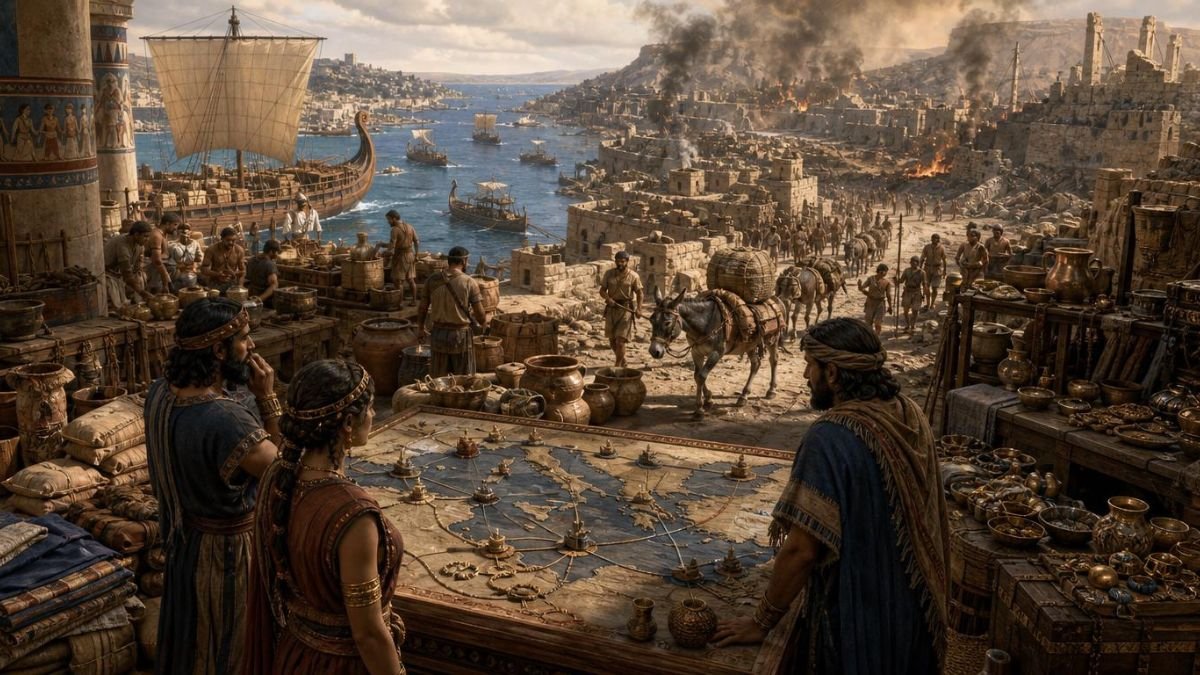
Let's start with a scene. It's around 1200 BCE. A merchant in the port city of Ugarit, on the coast of what is now Syria, is watching ships arrive from Egypt, Cyprus, Canaan, the Hittite Empire, and Mycenaean Greece. His warehouse contains copper ingots from Cyprus, tin from somewhere in Anatolia or Afghanistan, ivory from Egypt, and grain from across the Levant. His scribes are keeping meticulous records in multiple languages. He is, in every meaningful sense, a global trader.
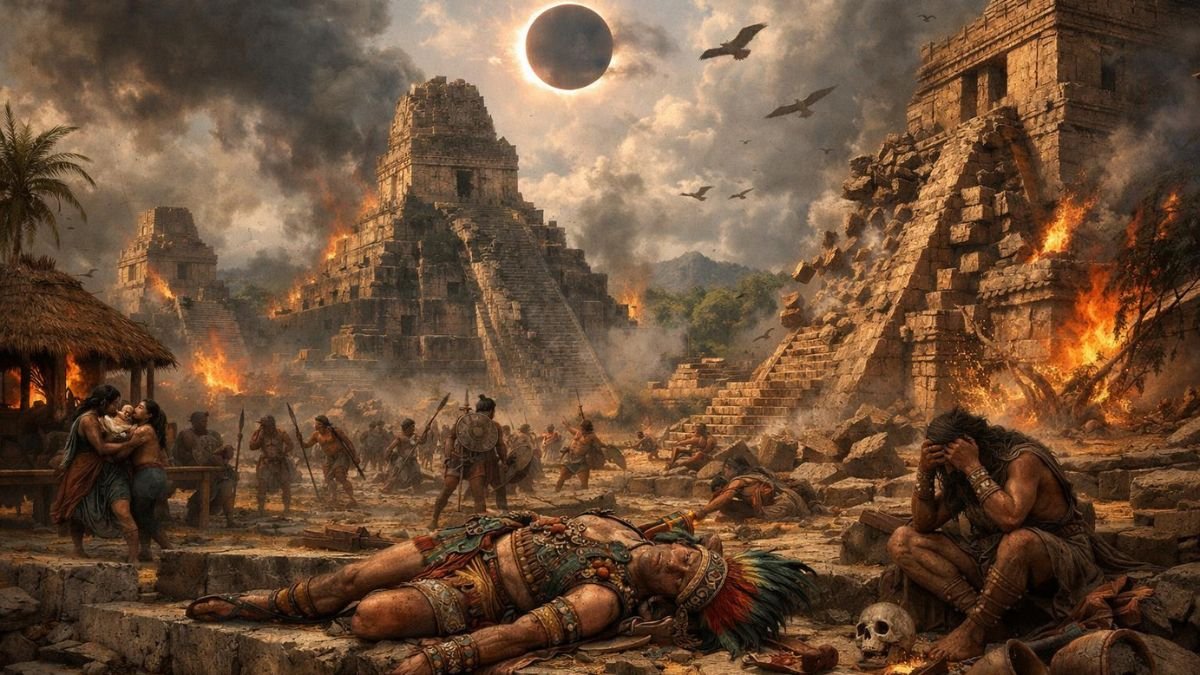
Now fast-forward a few decades. Ugarit is burned to the ground. The city is never rebuilt. The merchant is gone. The ships stop coming. And across an entire region stretching from Greece to Egypt to Mesopotamia, the most sophisticated network of interconnected economies the Bronze Age had ever produced simply... stops.
This is the Bronze Age Collapse, and it is one of the most dramatic, consequential, and frankly baffling events in all of human history. And here is the part that should make you sit up a little straighter: in almost every important way that matters, the world those civilizations built looks uncomfortably like the one we live in today.
The Bronze Age Was Not a Primitive World
This is the first thing people tend to get wrong. When most of us picture 1200 BCE, we imagine simple people in simple societies doing simple things. That picture is almost entirely false.
The Late Bronze Age, roughly 1550 to 1200 BCE, produced a network of palace economies stretching from Mycenaean Greece in the west to Egypt, Canaan, the Hittite Empire in Anatolia, Assyria, Babylon, and Cyprus. These weren't isolated city-states doing occasional trade. They were deeply, structurally interdependent. Their economies were built on the assumption that goods would keep flowing.
Bronze Itself Was a Supply Chain
Consider the central commodity of the era: bronze. Bronze is an alloy of copper and tin. Copper was available in Cyprus and a few other places. Tin was scarce, and its main sources appear to have been in Central Asia and possibly Afghanistan — thousands of miles away. To make bronze, you needed both. Neither palace alone had sufficient quantities of both. This meant that the entire military-industrial complex of the Late Bronze Age was dependent on long-distance trade.
The famous Uluburun shipwreck, discovered off the southern coast of Turkey in 1982, gives us a staggering picture of this trade. A single ship, dating to around 1300 BCE, was carrying ten tons of copper ingots from Cyprus, one ton of tin ingots, glass ingots from Egypt, ebony logs from sub-Saharan Africa, resin from Greece, and luxury goods from at least seven different cultures. This was not a curiosity. This was a routine cargo.
The Interdependence That Made Everyone Wealthy — and Vulnerable
Here is what the Late Bronze Age traders, kings, and palace administrators got very right: specialization creates wealth. The Egyptians were extraordinary at grain production and papyrus. The Canaanites were brilliant traders and middlemen. The Cypriots had copper. The Hittites had iron (though it remained rare and ceremonial for most of this period) and military power. The Mycenaean Greeks had timber and manufactured goods. Each civilization leaned into what it was good at and depended on its neighbors for everything else.
If this sounds familiar, it should. It is the economic logic that drives the modern world. Apple designs products in California, manufactures chips in Taiwan, assembles devices in China, and sells them everywhere. No single country or company controls the entire supply chain, and nobody seems to think that's a problem — until a pandemic shutters factories, a ship gets stuck in the Suez Canal, or a geopolitical dispute cuts off semiconductor exports.
The Late Bronze Age economies were running the same logic at full speed. And the efficiencies were real. Cities grew. Art flourished. Literature appeared. International correspondence between kings reads like diplomatic emails, full of gift-giving, negotiations, and complaints about delayed shipments. Yes, kings in 1200 BCE were writing letters complaining about delayed shipments.
When One Piece Moves, Everything Moves
The vulnerability that comes with deep interdependence is not a bug — it's a feature that eventually becomes a crisis. In a tightly coupled system, disruptions don't stay local. They travel.
Modern supply chain experts call this the "bullwhip effect": a small disruption at one end of a supply chain amplifies as it travels downstream, growing larger and more disruptive with each step. A factory that misses a single shipment causes a distributor to over-order; the over-order causes a manufacturer to ramp up production; the ramp-up causes a raw materials shortage; the shortage cascades back into the factory. What started as a minor hiccup becomes a full-scale supply crisis.
The Late Bronze Age had its own version of this. When disruption hit — and we will get to what caused it shortly — the tightly woven network turned its greatest strength into its most catastrophic weakness.
What Actually Collapsed?
Here is where history gets complicated, and where historians still argue passionately. The Bronze Age Collapse wasn't a single event with a single cause. It was a cascade, a perfect storm of interlocking disasters that hit an already stressed system.
The Sea Peoples — History's Most Convenient Villains
For a long time, the standard explanation was "the Sea Peoples did it." The Sea Peoples appear in Egyptian records as a confederation of maritime raiders who swept down the eastern Mediterranean around 1200 BCE, destroying cities and destabilizing kingdoms. Ramesses III famously fought them off at the Battle of the Delta around 1175 BCE and recorded the victory in lavish detail at Medinet Habu.
The problem is that "the Sea Peoples destroyed the Bronze Age" is almost certainly too simple. Modern scholars like Eric Cline, whose book 1177 B.C.: The Year Civilization Collapsed is essential reading on this topic, argue persuasively that the Sea Peoples were more likely a symptom than a cause — displaced populations fleeing the same disasters that were destabilizing everyone else, rather than the origin point of the collapse.
Earthquakes, Drought, and the Limits of Agricultural Systems
Recent archaeological and paleoclimatological research points to a severe and prolonged drought hitting the Eastern Mediterranean region around 1200 BCE. Pollen samples, sediment cores, and isotopic data from human remains all point toward a long period of reduced rainfall and agricultural failure. Palace economies that depended on grain surpluses suddenly found themselves without surpluses. Famine followed.
At roughly the same time, a series of major earthquakes struck the region. Multiple cities show evidence of violent seismic destruction at roughly the same period. Add to this the possibility of internal rebellions — populations stressed by famine and disrupted trade — and you begin to see not a single villain but a cascading series of failures that reinforced each other.
The Systemic Lesson That History Keeps Teaching
What the Bronze Age Collapse illustrates, with brutal clarity, is what complex systems scientists call a "synchronous failure" — when multiple stresses hit an interconnected system at the same time, the system's usual resilience mechanisms are overwhelmed. In normal times, a drought in one region is manageable because grain can be imported from another. An earthquake in one city is survivable because trade reroutes. A military threat from one direction is containable. But when drought, earthquake, disrupted trade, famine, and raiding all arrive together, the system has no room to absorb any of it.
The Lehman Brothers collapse in 2008 looked a lot like this. The COVID-19 pandemic in 2020 looked a lot like this. The semiconductor shortage that crippled car manufacturers, consumer electronics, and medical device producers in 2021 looked exactly like this. You pull one thread — a single factory in Taiwan, a single chip type, a single shipping lane — and suddenly you can't buy a new car or a PlayStation.
Why We Keep Building These Systems Anyway
At this point, you might reasonably ask: if interconnected systems are so fragile, why do we keep building them? The answer is that they are extraordinarily, seductively productive. The Late Bronze Age was genuinely one of the wealthiest periods in ancient history. Modern global trade has lifted hundreds of millions of people out of poverty. The efficiencies are real. The gains are real.
The trap is that the gains are visible and immediate, while the fragility is invisible and deferred. When a supply chain works, nobody talks about supply chains. When it fails, everyone suddenly becomes an expert.
The Cost of Just-In-Time
Modern supply chain management has, over the past few decades, optimized relentlessly for efficiency through a concept called "just-in-time" manufacturing. The idea is simple: keep inventory as low as possible. Don't stockpile components you don't need right now. Order what you need when you need it. This eliminates waste and reduces costs.
It also eliminates buffers. When a disruption hits a just-in-time system, there's no slack to absorb it. The Late Bronze Age palaces ran similar systems. Tablets from Ugarit, Pylos, and other palace centers show meticulous inventory management, goods flowing in and out with impressive precision. Those same archives, written on clay tablets baked hard by the fires that destroyed the palaces, show no evidence of meaningful strategic reserves.
What Comes After the Fall?
The centuries following the Bronze Age Collapse are sometimes called the Greek Dark Ages — a period of population decline, reduced literacy, simpler material culture, and broken trade networks. It took roughly 400 years for the Eastern Mediterranean world to recover anything like the complexity and connectivity it had lost.
This is perhaps the most sobering lesson. Collapse isn't a brief disruption from which you recover in a quarter or two. Collapse can mean centuries of genuine regression. The knowledge, the trade networks, the literacy, the administrative systems — much of it was simply lost and had to be rebuilt from scratch.
Modern economies are, of course, far more resilient than Late Bronze Age palace economies. But "more resilient" is not the same as "immune." The question the Bronze Age Collapse forces us to ask — with genuine urgency — is not whether disruption will come, but whether we have built enough redundancy, enough slack, enough diversity into our systems to absorb it when it does.
Reading the Tablets We're Writing Right Now
Every tablet found at Pylos, Ugarit, and Mycenae is an accidental time capsule — records kept by people who had no idea they were writing the last pages of their civilization. The Linear B tablets found at Pylos are administrative records: grain allocations, bronze rations for rowers, religious offerings. They were baked into permanence by the fire that destroyed the palace.
We are writing our own tablets. Our supply chain databases, our shipping manifests, our inventory records — they tell a story about a world that is, once again, enormously productive, deeply interconnected, and quietly, persistently fragile.
The Bronze Age didn't collapse because its people were foolish. It collapsed because the system they built was genuinely impressive, genuinely efficient, and genuinely unable to survive a sufficiently bad run of luck. That is not a comfortable thought. But it is an important one.
Take This Package With You
Read this study package free below, or get the clean, ad-free PDF and EPUB, plus extra worksheets and audio, on Patreon.
LET'S GET CRITICAL
What the Bronze Age Collapse Doesn't Tell You
Alright, let's pump the brakes for a moment. The narrative we just walked through is compelling, well-researched, and grounded in real scholarship. But compelling narratives, especially historical ones, have a way of flattening complexity in the service of a good lesson. And the lesson here — interconnected systems are fragile, just-in-time is dangerous, we're all one bad drought away from catastrophe — is seductive enough that it's worth pushing back on several of its core assumptions.
First, let's talk about the collapse itself. The idea that the Late Bronze Age was a single, tightly integrated global economy is, at minimum, an oversimplification. Yes, there was long-distance trade. Yes, there were diplomatic networks, palace-to-palace correspondence, and remarkable flows of goods across thousands of miles. But the degree of economic integration we're describing, the idea that these were interdependent in the way that, say, the US and China are today, may be overstated. Many of these societies had significant internal agricultural bases. The collapse hit differently in different places. Egypt survived. Assyria survived and even thrived in the aftermath. The collapse was devastating for the Mycenaeans and catastrophic for Ugarit, but it was not uniformly terminal.
This matters because if we draw the analogy to modern supply chains too tightly, we risk making a different kind of error: assuming that today's global trade system is equally, uniformly fragile. It isn't. Modern economies have multiple layers of redundancy, financial instruments, international institutions, and — crucially — democratic and technocratic governance structures that ancient palace economies did not have. When a supply chain disruption hits today, governments intervene. Central banks act. Diplomatic channels open. This is not nothing.
Second, the "cascade of multiple causes" explanation for the Bronze Age Collapse, while intellectually satisfying and probably accurate, may actually undersell one critical variable: agency. Civilizations are not passive systems. They have leaders, decision-makers, and populations who respond to crises. The question worth asking is: why did the responses fail? Was it a failure of information — people didn't understand what was happening until it was too late? Was it a failure of governance — the palace systems were too rigid and hierarchical to adapt quickly? Was it a failure of political will — rulers too invested in the status quo to make painful short-term sacrifices for long-term survival?
These questions don't have clean answers, but they matter enormously for the modern parallel. If the Bronze Age collapse was primarily a failure of adaptive governance rather than simply an overwhelmed system, then the lesson isn't "don't build interconnected systems" — it's "build institutions capable of responding to stress quickly and intelligently."
Third — and this is the uncomfortable one — the analogy between Bronze Age trade and modern global supply chains carries an embedded political argument that should be named rather than hidden. The critique of "just-in-time" manufacturing, the celebration of redundancy and strategic reserves, the wariness about over-reliance on single suppliers — all of this maps very cleanly onto contemporary arguments for deglobalization, industrial policy, and economic nationalism. These are legitimate policy positions, but they are also contested ones. The economists who defend globalization argue, with substantial evidence, that the efficiency gains from specialization and trade are so large that a world with more redundancy built in would be a significantly poorer world. The people hurt by that poverty tend to be the world's most vulnerable.
The Bronze Age story doesn't resolve this debate. It illustrates one side of it.
Fourth, consider what the Bronze Age Collapse looked like to the people who weren't in the palaces. The palace economies were, by virtually all accounts, highly extractive systems. Farmers worked to produce surpluses that were seized and redistributed by palace administrators. Craftspeople worked to quotas set by bureaucrats. The "prosperity" of the Late Bronze Age was unevenly distributed in ways that would be recognizable today. When the palaces collapsed, some of what died was genuine sophistication and wealth. But some of what died was a particular system of control. For the people at the bottom of the Bronze Age economy, the collapse may not have been uniformly terrible. New societies that emerged afterward tended to be, in some respects, more decentralized and less hierarchically oppressive.
This complicates the lesson considerably. Are we really sure that the thing we're trying to prevent the collapse of is uniformly worth preserving?
Finally, there's the issue of survivorship bias in how we read the archaeological record. We know a great deal about the civilizations that collapsed because they left behind urban centers, palace archives, and dramatic destruction layers that archaeologists can find and excavate. We know much less about the peoples who survived, adapted, and rebuilt in ways that left fewer monumental traces. The Greek Dark Ages were genuinely hard, but they were also a period of remarkable adaptation, migration, and eventually, the emergence of entirely new forms of political and cultural organization, including the city-state, which would prove to be extraordinarily resilient.
Collapse isn't always the end of the story. Sometimes it's the beginning of a better chapter, written by different people with different priorities. That's not an argument for being complacent about fragility. But it is an argument for staying honest about what we're actually defending when we work to make our systems more robust.
FANTASTIC GUEST — URTENU OF UGARIT
About This Conversation
For this edition of Fantastic Guest, we are doing something unprecedented: we are reaching across 3,200 years to sit down with someone who is currently living through the twilight of the Late Bronze Age economy. Meet Urtenu. He is a high-ranking merchant, diplomat, and palace administrator in the bustling port city of Ugarit, located on the coast of what is now Syria. His firm manages the international flow of everything from grain to weapons. He sits at the absolute center of the most interconnected supply chain the ancient world has ever seen—and he is starting to get very, very worried.
The Interview
Danny: Urtenu, welcome to the show. I have to ask you right off the bat: you manage an incredible volume of international trade. What exactly does your daily inventory look like?
Urtenu: It is a marvel, Danny. On any given day, I watch ships arrive at our port from Egypt, Canaan, Mycenaean Greece, and the Hittite Empire. Just this morning, my scribes cataloged ten tons of copper ingots from Alashiya—what you call Cyprus—along with ebony from Africa and glass from Egypt. But the prize is the tin. It travels thousands of miles overland from the mountains of Central Asia. You cannot make bronze without copper and tin, and since no kingdom has enough of both, we all rely on the ships. We are, quite literally, forging the world together.
Danny: It sounds like a beautifully efficient system. Everyone specializes in what they do best, and trade makes everyone wealthy.
Urtenu: Precisely! The Egyptians send us their grain surpluses, the Greeks send their manufactured goods, and we in Ugarit act as the glorious middlemen. It is the most profitable era in human history. Why would a king waste resources hoarding massive reserves of raw materials when he can simply send a diplomatic letter and have a shipment arrive exactly when his craftspeople need it? We keep our warehouses lean and our ledgers perfectly balanced.
Danny: Modern supply chain managers call that "just-in-time" manufacturing, and it’s brilliant when it works. But what happens when there’s a disruption? I understand you've been dealing with some severe headaches lately.
Urtenu: "Headaches" is a mild term. The entire system feels... strained. The rain hasn't fallen the way it used to. We are hearing reports of terrible, prolonged droughts stretching from the Hittite lands down to Egypt. When the rain fails, the grain fails. Suddenly, the agricultural surpluses that fuel this entire international network are drying up. And if that wasn't enough, the earth itself has been shaking. We've had major earthquakes severely damage port cities up and down the coast.
Danny: In complex systems, we call that a "synchronous failure"—when multiple stresses hit an interconnected system at the same exact time. What happens to your trade network when food runs out and ports are destroyed?
Urtenu: It amplifies the panic. Our system relies on predictability. When a king in Anatolia realizes he won't have enough grain for the winter, he panics and demands emergency shipments. That pulls ships off their normal routes. Suddenly, my copper from Cyprus is delayed. Without copper, our armorers can't make weapons. It cascades. And we desperately need those weapons right now, because of the boats we've been spotting on the horizon.
Danny: You mean the Sea Peoples? History tends to view them as a massive army of bloodthirsty raiders who just showed up to destroy civilization. Is that what you're seeing?
Urtenu: "Army" implies an organized empire. What we are seeing looks more like desperation. These aren't just warriors; they are displaced populations. They are families, men, and women on boats and oxcarts. They are fleeing the exact same droughts, famines, and earthquakes that are squeezing the rest of us. They have lost their homes, and they are hungry. But when thousands of starving refugees with weapons arrive on your shores looking for food that you don't have, the result is violent.
Danny: If the system is this stressed, and you know these disruptions are happening, why doesn't Ugarit adapt? Why not build up massive strategic reserves of food and bronze right now?
Urtenu: Because the palace economy is a rigid machine. Our administrators are frantically organizing coastal defenses and reallocating labor from the top down, but the bureaucracy wasn't built to adapt quickly. Building reserves takes time and requires holding back wealth that our king needs now to pay mercenaries and satisfy debts. Our system was designed for maximum efficiency in perfect weather, not for survival in a storm.
Danny: I have to ask... what were you doing right before we sat down for this conversation?
Urtenu: I was working with my scribes. We were pressing cuneiform into wet clay, recording the daily inventory allocations. Grain rations. Oil storage. Complaining about another delayed shipment from the Hittites.
Danny: Does it ever cross your mind that these routine administrative texts might be the very last things your civilization ever writes down? That if the palace burns tonight, those clay tablets will bake in the fire and become a permanent monument to a world that didn't know it was ending?
Urtenu: ...That is a remarkably morbid thought, Danny. We are Ugarit. We are the center of global trade. We have survived tough years before. I am sure the ships will arrive tomorrow. Now, if you'll excuse me, I have a warehouse to manage.
Danny: Best of luck, Urtenu. I have a feeling you're going to need it.
EDUSTORY — THE LAST SHIPMENT
The crate arrived on a Tuesday, which Mira noted because Tuesdays were supposed to be quiet.
She was kneeling behind the receiving dock at Pellucid Medical Devices, checking packing slips against a manifest, when she heard the dock supervisor, Gerald, use a tone she'd never heard from him before. Gerald was the kind of man who narrated emergencies the way a GPS narrated traffic: calmly, factually, rerouting. So when his voice went tight and flat on the phone she found lodged between his ear and shoulder, she looked up.
"How many units short?" he said.
He listened.
"That's the whole order," he said. "That's the whole order, Kevin."
He hung up and stood very still for a moment.
"The fabrication plant in Kaohsiung," he said, to no one in particular.
Mira set down her clipboard. "Which component?"
"The pressure regulators. There are thirty-seven in this shipment. We need four hundred."
She did the math in the way you do when you hope the math is wrong. It wasn't wrong.
"When's the next ship?"
"There isn't one scheduled. The plant was hit by a typhoon two weeks ago. I'm just finding out now because apparently the distributor's been hoping things would sort themselves out."
Mira thought about the surgical kits waiting in the assembly room three floors above them. She thought about the hospitals that had placed those orders. She thought about a wall of sticky notes in her apartment, each one a name connected to a number — six months of careful planning, a supply schedule she had built and rebuilt, the whole architecture of a rational, efficient workflow.
"Okay," she said. "Who else makes pressure regulators?"
Gerald's expression said everything.
---
The company had been founded in 1987 by a man named Marcus Pellucid, which was actually his name, and he had built it with a philosophy he called the "tight chain." No waste. No excess. Every component arriving exactly when needed, flowing through assembly and out the door in as near to a continuous stream as human organization allowed. It was beautiful, in its way. Mira had written her supply chain management thesis on it. She had been hired in part because she'd described it, approvingly, as "an exquisitely calibrated system."
She thought about that phrase sometimes.
The pressure regulator problem had a secondary dimension that emerged over the next forty-eight hours like water seeping under a door. It turned out that three of Pellucid's other critical components — two types of specialized seals and a specific grade of medical-grade polymer tubing — were also sourced either directly or indirectly from suppliers concentrated in a single industrial zone in Taiwan. The zone had not been hit by the typhoon. But the typhoon had delayed a shipping hub, which had delayed a container vessel, which had backed up a port in Singapore, which had compressed the available carrier capacity for the entire western Pacific.
When Mira mapped it out on the whiteboard in the conference room, it looked like one of those children's games where you pull a block from a tower and watch the whole thing totter. The logistics manager, a compact, perpetually caffeinated man named Dom, stood in the doorway and stared at the whiteboard for a long moment.
"Does Marcus know?" he said.
"I'm presenting at four."
"He's going to blame the typhoon."
"The typhoon is a proximate cause."
"That's a very polite way of saying something fairly impolite."
---
Marcus Pellucid was seventy-one years old and wore his authority like a good suit — comfortable, never showy. He had built a company from thirty employees to twelve hundred, had navigated the 2008 financial crisis with minimal layoffs, had watched three competitors fold and acquired two of them. He was not accustomed to problems that didn't have solutions available at the right price.
Mira stood at the head of the conference table with her laptop and her whiteboard diagram and explained the situation in the precise, unemotional language she had perfected over nine years of delivering bad news to people who were paying her not to have bad news.
When she finished, Marcus looked at the whiteboard for a while.
"How long have we been sourcing pressure regulators from Kaohsiung?" he said.
"Fourteen years."
"Has there ever been a problem before?"
"No. The relationship has been excellent."
"So this is an exceptional event."
"The frequency of exceptional events," Mira said, choosing her words carefully, "has been increasing."
Marcus looked at her.
"The 2011 Tōhoku earthquake," she continued. "The 2017 Irma disruptions. The 2020 pandemic. The 2021 chip shortage. This typhoon. Each one is, individually, a low-probability event. But we now exist in an environment where the interval between exceptional events is shorter than the interval in which a supply chain can fully recover. So the question of whether any single event is exceptional is becoming less relevant than the question of whether our system is designed to absorb them continuously."
The room was very quiet.
"You're saying the tight chain is wrong," Marcus said.
"I'm saying the tight chain was optimized for a world that may no longer exist."
Marcus looked at his hands. He had a habit, when he was thinking hard, of examining his hands as if the answer were written there in small print.
"What would you build instead?" he said.
Mira had been waiting for this question for four years. She had a document. She pulled it up.
---
Three weeks later, the emergency shipment of alternative pressure regulators arrived from a German supplier Mira had identified through a week of phone calls, video calls, and creative interpretation of both companies' technical specifications. They were not identical to the Kaohsiung units. They required a modification to the assembly process. The modification required retraining forty-seven technicians. The retraining cost more than the regulators.
Dom, who had become Mira's de facto ally in what she privately thought of as the reformation project, found her in the break room at 7:30 one morning, reading a paper she'd printed out about something called the Bronze Age Collapse.
"What's that?" he said.
"Homework," she said. "Three thousand years ago there was a trade network. Really sophisticated for its time. Copper from one place, tin from another, grain from a third. Everything flowing, everything connected."
"What happened to it?"
"Climate stress. Military pressure. Agricultural failure. All at once." She looked up. "The people who built it were smart. The system worked beautifully for hundreds of years. And then several bad things happened at the same time and there wasn't enough slack in the system to absorb any of them."
Dom poured coffee. "And this is relevant how?"
"Their inventory tablets," Mira said, "the last ones they wrote, right before the palaces burned — they show no evidence of strategic reserves."
Dom looked at her over his coffee cup.
"They were running just-in-time," she said.
He was quiet for a moment.
"Does Marcus know about the Bronze Age?"
"He will," Mira said. "I'm adding it to the presentation."
---
The document Mira had prepared was thirty-seven pages and was titled, with deliberate plainness: Toward Resilience. It proposed a set of changes to Pellucid's supply chain architecture that would, by any conventional measure, reduce short-term efficiency. Strategic reserves of critical components. Dual-sourcing requirements for any component that appeared in more than three product lines. Geographic diversification clauses for key suppliers. Relationships maintained with secondary suppliers even during periods when the primary supplier was performing well, at an ongoing cost with no immediate return.
Marcus read the whole document on a Sunday. Mira knew this because he sent her a series of emails between 9 AM and 2 PM with questions that followed the document's page numbers in sequence, which meant he was reading it straight through.
The last email said: This is going to cost us a lot of money.
She replied: It's going to cost us less than the alternative.
He replied, after a pause long enough that she'd assumed he was done: How do you know?
She thought about the Pylos tablets. She thought about the merchants of Ugarit writing letters about delayed shipments. She thought about the way complex systems had a habit of appearing robust right up until the moment they weren't.
She typed: I don't know for certain. Nobody does. But the Bronze Age civilizations didn't know they were writing the last pages either. They just kept recording inventory.
She hesitated. Then she added: We should try not to do the same.
She sent it and sat back and looked out the window at the loading dock, where a truck was backing in to pick up a finished shipment, and the dock workers were moving with the easy, practiced efficiency of people who had never had to think about where the components came from, because someone else had handled that.
She thought: this is the thing about fragility. It's invisible from the inside, right up until it isn't.
Her phone buzzed. Marcus had replied.
It said: Schedule the board presentation for next Thursday.
She allowed herself one quiet moment of something that wasn't quite triumph but lived in the same neighborhood. Then she picked up her clipboard and went back to work.
AUTHOR'S COMMENTARY
I want to start by admitting something: I almost wrote a different story. My first instinct, when sitting down with this topic, was to go historical — to put you directly in Ugarit in 1190 BCE, to give you a merchant watching the horizon, to build the dread from the inside of the collapse itself. And I wrote about four hundred words of that version before I stopped, because I realized I was writing something a little bit too educational rather than something true.
The Bronze Age Collapse is a story about a system. And systems are abstract. They're invisible. They operate in the background of people's lives until they don't. The challenge of writing fiction about supply chains, about systemic fragility, about the invisible architecture of interconnected economies, is that none of that is where people actually live. People live in moments. In rooms. In conversations. In the particular expression on a supervisor's face when he learns that a shipment he was counting on doesn't exist.
So I moved the story to the present, into a company that is a small-scale, human-sized version of the Bronze Age problem.
Mira is the character who carries the structural argument of the article, but I tried hard not to let her become a mouthpiece. The thing about people who are right about systemic problems is that being right doesn't feel triumphant. It feels exhausting. It feels like standing in conference rooms explaining things that should be obvious and watching people's eyes track back to the more comfortable assumption that this time will be different, or that someone else is handling it. Mira's competence is real, but it coexists with four years of unacted-upon documentation, which felt true to how institutional change actually works.
Marcus Pellucid is, I'll confess, a figure I find genuinely interesting. He built something. It worked. For a long time, it worked beautifully. The "tight chain" philosophy isn't stupid — it generated real efficiencies, real growth, real jobs. The problem isn't that Marcus was wrong to build what he built. The problem is that the environment changed and the system didn't. He's not a villain. He's a person whose model of the world is outdated and who is, to his credit, capable of updating it. That felt more honest and more interesting than making him an obstacle.
The detail I'm most attached to is the Bronze Age paper in the break room. It's a small moment, but it does a lot of work. It connects the macro-historical argument to the intimate, human-scale story without making the connection too didactic, I hope. Dom's response — "And this is relevant how?" — is the reader's question, asked out loud by a character, which then gets answered in a way that stays story-level rather than lecture-level. I wanted the answer to feel earned by the narrative rather than imported from the article.
The ending — Marcus agreeing to schedule the board presentation — is deliberately understated. I thought about ending on a more triumphant note, or on a more ambiguous one, or even on a tragic one (a second disruption arriving before the changes can be implemented, for instance). But the understated ending felt most honest to what resilience-building actually looks like in practice. It doesn't look like victory. It looks like a calendar appointment. It looks like a thirty-seven-page document getting the chance to be presented to people who have the authority to act on it. The triumph, if you can call it that, is procedural. That's how systems change. Slowly, bureaucratically, under the pressure of people who refuse to stop making the argument.
The title "The Last Shipment" carries the double meaning I intended. It refers to the delayed shipment of pressure regulators, the precipitating crisis of the story. But it also echoes the idea from the article about the last tablets written at Pylos and Ugarit — the mundane administrative records that became monuments by accident, because nobody knew they were the last. The story is, in one reading, about whether Mira and Marcus can make sure that their last shipment is not actually their last.
I don't always know if I've made something literary enough or pedagogical enough or neither or both, and to be honest, I don’t always worry about that; it is what it is. With this one though, I felt like the story was pulling in the right direction: toward the characters and away from the argument, even though the argument is always there, running just beneath the surface, like an interconnected economy in good times — invisible, essential, and quietly, persistently present.
LET'S DISCUSS
Knowledge without conversation is just trivia waiting to be forgotten. The real test of whether something has genuinely changed the way you see the world isn't whether you can recall the facts — it's whether you can argue about them, challenge them, and extend them into territory the original source never imagined. That's what these questions are for.
Question 1
The article draws a direct parallel between the Late Bronze Age trade network and today's global supply chains. But is the comparison fair? Modern economies have international institutions, insurance systems, financial instruments, and real-time information that ancient palace economies completely lacked. When you think about it honestly, is the Bronze Age a genuinely useful warning, or is it an exciting metaphor that flatters our sense of historical pattern-recognition? Consider what the comparison gets right, what it gets wrong, and whether historical analogies can ever really prepare us for novel challenges.
Question 2
The "tight chain" — the relentless optimization for efficiency at the cost of redundancy — gets criticized in both the article and the story. But consider this: the alternative, building strategic reserves, maintaining secondary suppliers, accepting reduced efficiency as a policy choice, is also a choice with costs. Those costs tend to fall on consumers (higher prices) and on workers (reduced competitiveness). Who gets to decide how much inefficiency a society should tolerate in the name of resilience? And who bears the cost when that decision goes either way?
Question 3
The "Let's Get Critical" section raises the uncomfortable point that the Bronze Age palaces were extractive, hierarchical systems, and that their collapse may have been, in some ways, a correction. Think about the economic and social systems you live within. If a significant collapse were to occur, what would be genuinely lost, and what might actually be better on the other side? This isn't an invitation to romanticize catastrophe — it's an invitation to think honestly about what in our current systems is worth defending and what might be worth reconsidering.
Question 4
Eric Cline says in the interview that the warning is available, that we know the Bronze Age Collapse happened and we know why, and that the question is whether we'll act on that knowledge in time. Think about your own life and the organizations you belong to — your workplace, your city, your country. What warning signs of systemic fragility do you see that are currently being ignored because acting on them is costly, inconvenient, or politically difficult? What would need to change for those warnings to be taken seriously?
Question 5
Mira, in the story, spends four years building a document that nobody reads until a crisis forces the issue. This is a recognizable human experience: the person who sees the problem clearly, who has the analysis ready, but who cannot get institutional buy-in until the damage is already happening. Is this inevitable? Are there examples — from history, from your own experience, from any organization you know — where systemic risks were identified and acted upon before a crisis forced the issue? What made those cases different?
WHAT NOW? — FRAMEWORK & 7-DAY ACTION PLAN
The Framework
Before you do anything, it helps to hold two truths at once. First: deeply interconnected systems create real wealth, real opportunity, and real quality of life. The efficiency gains from specialization and trade are not imaginary. The Late Bronze Age was genuinely prosperous, and modern global trade has done things for human welfare that are difficult to overstate. Second: efficiency without resilience is a bet that nothing will ever go badly wrong at the same time as something else goes badly wrong. History suggests this is an unwise bet.
The balanced framework is not "deglobalize" or "autarky" or "every nation for itself." It is, instead, a conscious choice to accept some calculated inefficiency as an insurance premium. At every level — individual, organizational, national — the question is: where are the single points of failure in my system, and how much would it cost to create an alternative?
For individuals, this means financial buffers, diversified skills, and social networks that aren't entirely dependent on one employer, one income source, or one geography.
For organizations, this means supply chain mapping (you cannot manage fragility you cannot see), dual-sourcing of critical inputs, and strategic reserves priced as a business continuity cost rather than a waste.
For societies, this means industrial policy that explicitly prioritizes resilience alongside efficiency, international institutions that function during stress rather than only during calm, and a political culture capable of making long-term investments even when the returns are deferred.
None of this is simple. All of it is worth starting.
7-Day Action Plan
Day 1: Map Your Dependencies. Spend thirty minutes mapping the key dependencies in your own life or work. What are you counting on that has no backup? What single points of failure exist in your daily functioning? Write them down. Don't solve them yet — just see them.
Day 2: Read One Primary Source. Find and read one primary account of a supply chain disruption that affected your industry, your country, or your life. Not a think-piece — an actual account. A news report, an industry analysis, a first-person account. Ground the abstraction in something real.
Day 3: Research One Historical Collapse. Spend an hour reading about a historical economic or civilizational disruption — the Bronze Age Collapse, the Black Death's effect on European trade, the Dust Bowl, the 1973 oil crisis. Look for the structural parallels to today, not just the dramatic differences.
Day 4: Identify One Buffer You Could Build. Based on Day 1's map, identify one specific, achievable buffer you could build. For students: a broader skill set, a larger savings cushion. For professionals: a second supplier relationship, a deeper emergency fund, a professional network in a different sector. For community members: a local food or goods network. Small is fine. Real is what matters.
Day 5: Have a Resilience Conversation. Talk to someone — a colleague, a family member, a friend — about systemic fragility in a domain you both care about. Not to alarm them, but to practice articulating the ideas out loud. Conversations change thinking in ways that reading alone doesn't.
Day 6: Engage with the Counterargument. Find and engage with a genuine defense of efficiency over resilience. Read an economist who argues for globalization. Read a business case for just-in-time manufacturing. Understand the strongest version of the argument you're pushing back on. It will make your own thinking sharper.
Day 7: Write One Commitment. Write down one concrete change to how you operate — at work, at home, in your community — that builds in one small additional buffer, one small additional redundancy. Put a timeline on it. Tell someone about it. The lesson of the Bronze Age isn't that collapse is inevitable. It's that collapse is more likely when nobody is paying attention.
LANGUAGE FOCUS: VOCABULARY & SPEAKING
Let's talk about the language in this article, because it's doing a lot of work, and some of the words and phrases are genuinely powerful tools that you can start using immediately in your own writing and speaking.
The first phrase worth pausing on is "synchronous failure." You'll hear "failure" all the time, but the modifier "synchronous" is doing something precise and important. It means happening at the same time. A synchronous failure, in systems language, is when multiple components of a system fail simultaneously — not sequentially, not because one caused the other, but because they were all stressed by the same environmental conditions. In real life, you might use this when analyzing any situation where multiple things went wrong at once: "The project's synchronous failure — the team illness, the budget freeze, and the technical crash — made recovery impossible." It sounds precise because it is precise.
"Cascading" is a word you've probably seen before, but it's worth understanding what makes it different from plain old "spreading." A cascade implies directionality and momentum — it's the image of a waterfall, where each tier feeds the next with increasing force. A cascading failure, then, is not just a series of failures, but one where each failure makes the next more likely and more severe. "The cascading consequences of the original data breach eventually compromised three separate departments" tells you something that "the spreading consequences" doesn't quite capture.
"Interdependence" is a word that gets used loosely, and it deserves more precision. Independence means operating alone. Dependence means relying on something external. Interdependence means mutual reliance — I depend on you and you depend on me, and neither of us can function fully without the other. It's distinct from mere trade or cooperation, which can be asymmetrical. When you say two economies are interdependent, you're saying the disruption flows both ways. "The company's interdependence with its sole supplier left both parties exposed when the relationship fractured" captures a specific and important vulnerability.
"Resilience" is fashionable right now, but it's worth recovering its actual meaning. It comes from the Latin resilire, meaning to spring back. True resilience isn't just the ability to survive disruption — it's the ability to return to function after disruption. This implies flexibility, not just strength. A rigid wall is strong but not resilient; it holds until it breaks. A flexible structure that bends and returns is resilient. Use "resilience" when you want to emphasize the recovery dimension: "Building organizational resilience means designing for recovery, not just for strength."
"Redundancy" is a word that has negative connotations in everyday language — redundant means unnecessary, surplus, even insulting ("your position has been made redundant"). But in systems language, redundancy is precious. Redundancy means having backup systems, alternative suppliers, parallel routes. When you're writing or speaking about supply chains, infrastructure, or organizational design, using "redundancy" deliberately signals that you understand it as a feature, not a flaw: "The new design builds in deliberate redundancy across three critical components."
"Proximate cause" versus "distal cause" is a distinction worth having in your vocabulary arsenal. A proximate cause is the immediate trigger — the typhoon, the earthquake, the shock. A distal cause is the underlying condition that made the proximate cause so devastating — the reliance on a single supplier, the absence of reserves, the stripped-down buffers. In arguments, distinguishing between the two is analytically powerful: "The proximate cause of the collapse was the drought, but the distal cause was the absence of any resilient alternative."
"Paleoclimatological" is one of those long words that pays off. It refers to the scientific study of ancient climates, and it appears in the article in the context of evidence for the Bronze Age drought. It's a useful model for a whole family of "paleo-" words: paleography (ancient writing), paleontology (ancient life), paleoanthropology (ancient humans). The prefix paleo- simply means ancient or old. Using these compound scientific terms correctly signals precision and signals that you've done serious reading.
"Systemic" versus "systematic" is a confusion worth clearing up. Systematic means done in a methodical, organized way: "She conducted a systematic review of all the suppliers." Systemic means relating to an entire system, typically a deeply embedded feature: "The fragility is systemic — it's built into the architecture of the supply chain itself." Mixing these up is a common error, and distinguishing them correctly marks sophisticated usage.
"Extractive" is a term from political economy that appears in the critical section. An extractive system is one that takes value out of a population or environment without putting equivalent value back in — it extracts rather than builds. In talking about historical economies, institutions, or business models, "extractive" carries a specific analytical weight: "The palace economy was extractive in structure, funneling agricultural surplus upward while offering little in return."
Finally, "just-in-time" is a term from manufacturing and supply chain management that has a precise technical meaning worth understanding fully. It refers to a production strategy in which materials and components arrive exactly when needed, with minimal inventory carried in buffer. The efficiency gains are real. The fragility, as we've discussed, is also real. Using "just-in-time" in non-manufacturing contexts — "the company's just-in-time approach to staffing" — extends its meaning accurately to describe any system with minimal slack.
Speaking Section — Talking About Complex Systems
Now let's put some of this language to work in your speaking. One of the most valuable speaking skills in professional and academic contexts is the ability to explain complex systems to a non-specialist audience without losing the complexity or boring the audience. This is what the article you just read is doing, and it's worth learning from its techniques.
The first technique is the concrete anchor. Before you introduce an abstraction, ground it in something specific. The article doesn't open with "global supply chains are fragile." It opens with a merchant in Ugarit watching ships. The abstraction follows the image. In your own speaking, practice doing the same: find the specific, human-scale image that makes the abstract concept tangible before you explain it.
The second technique is the "familiar analogy followed by complication." The article says modern supply chains look a lot like the Bronze Age network — then immediately complicates that by noting the significant differences. This two-step move ("it's like X, but with these important differences") is one of the most powerful tools in explanatory speaking. It gives your audience a handle on something unfamiliar, then teaches them where the handle is imprecise.
Your speaking challenge for this article is this: take one complex, systemic problem you genuinely care about — climate change, healthcare resource allocation, urban housing, food security, anything real and important — and explain it in three minutes to an imaginary audience of intelligent non-specialists. Use at least four of the vocabulary words from this section. Anchor your explanation in a specific, concrete example. Distinguish between proximate and distal causes. And end by naming what kind of resilience or redundancy you think the system needs, and why it isn't being built.
Record yourself doing this. Listen back. Ask: am I being concrete enough? Am I using the vocabulary with precision, not just dropping impressive words? Am I treating my imaginary audience as intelligent adults who can handle complexity if it's presented clearly?
Then do it again and see if it's better. It almost always is.
LANGUAGE FOCUS: GRAMMAR & WRITING
The Writing Challenge
Here's your prompt: Write a 400 to 600 word analytical essay arguing either for or against this claim: "The lesson of the Bronze Age Collapse is that efficiency and resilience are fundamentally incompatible, and modern economies must choose between them."
You don't have to believe your position. You have to argue it well.
Making the Writing Challenge Work — Tips, Tricks, and Grammar Tools
This kind of writing challenge — the analytical argument — is the most common and most demanding type in international exams like TOEFL, IELTS, and the SAT. It requires you to do several things simultaneously: stake a clear position, support it with evidence and reasoning, anticipate and address counterarguments, and do all of this in writing that is precise, varied, and controlled. Let's break down the grammar tools that will help you do this.
The first essential structure is the concessive clause — a grammatical move that lets you acknowledge the opposing argument without conceding the point. Concessive clauses typically begin with "although," "while," "even though," "despite," or "granted that." For example: "Although just-in-time manufacturing reduces costs significantly, it eliminates the buffers that make recovery from disruption possible." The word "although" does the heavy lifting here: it acknowledges the efficiency gain before pivoting to the counterpoint. This is structurally sophisticated and signals to a reader or examiner that you understand the complexity of the issue.
The second structure is the passive voice used purposefully. Students are often told to avoid the passive voice, which is good advice for narrative writing, where it creates distance and reduces energy. But in analytical writing, the passive voice has genuine uses. When you want to describe a state or condition without attributing it to a specific agent — because the agent is either unknown, unimportant, or self-evident — the passive is precise: "Bronze was created through the alloying of copper and tin." "The palace records were baked into permanence by the destroying fires." Use the passive deliberately, not by default.
Third, practice using relative clauses to compress information. Instead of writing two separate sentences — "The Uluburun shipwreck dates to around 1300 BCE. It was discovered off the coast of Turkey in 1982" — combine them: "The Uluburun shipwreck, which dates to around 1300 BCE and was discovered off the coast of Turkey in 1982, carried goods from at least seven different cultures." Relative clauses (introduced by "which," "who," "that," "whose," "where," "when") allow you to embed supporting information inside a main clause rather than stringing short sentences together.
Fourth, master the hedging language of academic writing. Strong analytical essays don't make every claim with total certainty — they calibrate confidence to the evidence. The Bronze Age article does this throughout: "paleoclimatological research points toward," "the evidence increasingly suggests," "this may be overstated." Hedges like "may," "might," "appears to," "suggests," "indicates," "there is evidence that," and "it is likely that" are not signs of weakness. They are signs of intellectual honesty. Use them when your evidence is strong but not conclusive, which is most of the time in analytical writing.
Finally, for your essay structure: begin with a clear, arguable thesis statement that takes a real position. "Efficiency and resilience are in tension but not irreconcilable" is a weak thesis because nobody disagrees with it. "The Bronze Age Collapse demonstrates that the choice between efficiency and resilience is not theoretical but existential" is a strong thesis because it can be argued with. Build each body paragraph around a single claim, supported with specific evidence, followed by analysis of what that evidence shows. End with a conclusion that returns to the stakes — why does this argument matter beyond the Bronze Age?
Take This Package With You
If this package helped you, you can take it with you. Become a Companion on Patreon for $5 a month to get the clean, ad-free PDF and EPUB, along with extra worksheets, workbooks, and audio. Everything here stays free either way.






0 Comments