Plate Tectonics: How Moving Continents Shape Our World and Why Earthquakes Happen

by Danny Ballan | May 29, 2026 | Science Spotlights

Stand still for a moment. Feel the solidity of the floor beneath you. Whatever you are standing on — concrete, wood, tile, carpet — it rests on something that feels immovably permanent. The ground. Solid. Reliable. Absolutely still.

Except it isn't.

Right now, at this moment, the ground beneath you is in motion. You are standing on an enormous slab of rock called a tectonic plate, and it is moving. Slowly — probably at something between two and fifteen centimeters per year, roughly the speed at which your fingernails grow. But moving. Relentlessly, continuously, in a direction and at a rate determined by forces operating deep within the Earth's mantle, forces that have been operating for billions of years and show no sign of stopping.

Plate tectonics is the scientific theory that describes this motion, its causes, and its consequences. It is one of the great unifying frameworks of Earth science — the geological equivalent of Darwin's theory of evolution or Einstein's general relativity in terms of its explanatory power and its transformative effect on how we understand the planet we live on. And like both of those theories, it was initially met with something between skepticism and outright mockery before the evidence became impossible to argue with.

The Idea That Was Laughed At

In 1912, a German meteorologist and geophysicist named Alfred Wegener proposed something that seemed, to most of his scientific contemporaries, to be the product of either imaginative speculation or wishful thinking: that the continents had once been joined together in a single landmass, and that over hundreds of millions of years they had drifted apart to reach their current positions.

Wegener called this former supercontinent Pangaea, from the Greek for 'all earth.' His evidence was, by any reasonable standard, compelling. The coastlines of South America and Africa fit together like puzzle pieces. Identical fossil species appeared on both sides of the Atlantic, in rock formations of the same age, in places now separated by thousands of kilometers of ocean. Matching geological formations — the same mountain chains, the same rock types, the same age signatures — could be traced across continents that are today separated by ocean.

The scientific establishment was not impressed. The problem was not the evidence — it was the mechanism. Wegener could not convincingly explain how continents moved. The prevailing assumption was that the Earth's crust was too rigid, and the forces required to move continents too impossibly large, for his proposal to be physically plausible. He died in 1930 on the Greenland ice sheet, his theory still largely dismissed.

The vindication came decades later, in the 1950s and 1960s, through the mapping of the ocean floor. What researchers found was extraordinary: a continuous mountain range running through the middle of all the world's oceans — the mid-ocean ridge system — along which new oceanic crust was being continuously created from molten rock rising from below. The ocean floor was not the ancient, static thing it had been assumed to be; it was geologically young, and it was moving, spreading outward from the ridges. Continental drift wasn't the right framework: the entire ocean floor was moving, carrying the continents with it. The new theory — plate tectonics — was formally established by the late 1960s and has been the foundational framework of geology ever since.

What Plates Are and How They Move

The Earth is structured in layers. The innermost region is the solid inner core, composed primarily of iron and nickel and existing under pressure so immense that it remains solid despite temperatures high enough to melt metal. Surrounding it is the liquid outer core, whose convective motion generates Earth's magnetic field. Above that is the mantle, a layer of rock that is solid but — over geological timescales — behaves viscously, flowing very slowly under heat and pressure. The outermost layer is the crust, which together with the uppermost rigid part of the mantle forms a layer called the lithosphere.

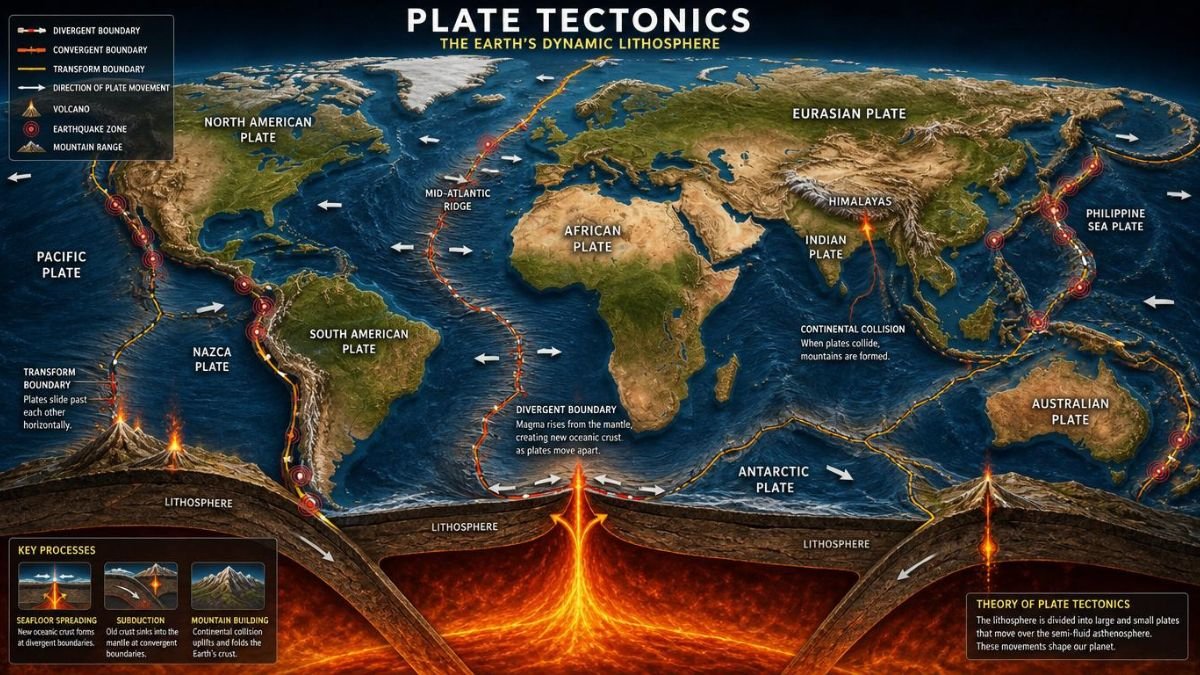
It is the lithosphere that is broken into tectonic plates — roughly a dozen major ones and several smaller ones, fitting together like irregular tiles across the surface of the planet. The plates are not all the same: oceanic plates are thin (typically around five to ten kilometers) and composed of denser, darker rock called basalt, while continental plates are thicker (up to seventy kilometers in some places) and composed of lighter, granitic rock.

The Engine Beneath

What drives the plates? The answer is the Earth's internal heat — a combination of heat left over from the planet's formation billions of years ago and heat produced by the ongoing radioactive decay of elements in the mantle and core. This heat drives convection currents in the mantle: hot rock rises, spreads laterally as it cools, and eventually sinks again where it becomes denser and colder. The tectonic plates ride on top of this convective system, carried along partly by the flow of the mantle beneath them and partly by the weight of the leading edge of the plate as it sinks into the mantle at subduction zones — a process geologists call slab pull, which may actually be the dominant driving force.

Types of Plate Boundaries

The most geologically active and dramatic places on Earth are found where plates meet, and what happens at those meetings depends entirely on what kind of plates are involved and how they are moving relative to each other.

Divergent boundaries are where plates move apart. At mid-ocean ridges, oceanic plates are pulling away from each other, and the gap is filled by magma rising from the mantle, creating new oceanic crust. The Mid-Atlantic Ridge, which runs down the center of the Atlantic Ocean, is creating new seafloor at a rate of a few centimeters per year, slowly widening the Atlantic. On land, divergent boundaries produce rift valleys — the East African Rift is a dramatic example of a continent being slowly pulled apart; in tens of millions of years, eastern Africa may become a separate landmass.

Convergent boundaries are where plates collide. The outcome depends on the plates involved. When two continental plates collide, neither is dense enough to sink, so they crumple and pile up into mountain ranges. The Himalayas are the most spectacular current example: the result of the Indian subcontinent colliding with Eurasia over the past fifty million years, a collision that continues today and is why the Himalayas are still rising. When an oceanic plate collides with a continental plate, the denser oceanic plate is forced beneath the continental plate in a process called subduction, creating deep ocean trenches, volcanic arcs, and significant seismic activity. The Cascadia Subduction Zone off the coast of the Pacific Northwest of North America is one of the most carefully monitored fault systems in the world.

Transform boundaries are where plates slide horizontally past each other. No crust is created or destroyed, but the friction and stress generated by the grinding motion produces some of the world's most significant earthquake zones. The San Andreas Fault in California, where the Pacific Plate is sliding northward past the North American Plate, is the most famous example in the world.

Earthquakes — When the Stress Breaks

Tectonic plates do not move smoothly. The rock surfaces of adjacent plates are rough and irregular, and for most of the time they are locked together by friction — stress builds along the fault line as the plates continue trying to move but cannot. When the accumulated stress eventually exceeds the frictional resistance, the locked sections release suddenly, generating seismic waves that radiate outward as an earthquake.

The point underground where the rupture initiates is called the focus or hypocenter. The point on the Earth's surface directly above it is the epicenter, which is the location typically reported in news coverage. Earthquakes vary enormously in magnitude and in depth, and both factors affect their impact. A deep earthquake — one occurring hundreds of kilometers underground — releases enormous energy but produces less surface disruption than a shallower one of similar magnitude. The depth and the nature of the rock and soil through which seismic waves travel both critically affect how much damage an earthquake causes at the surface.

Megaquakes and Subduction

The largest earthquakes in recorded history have all occurred at subduction zones, where one tectonic plate is being forced beneath another. The 1960 Valdivia earthquake in Chile — the largest ever recorded, at a magnitude of 9.5 — was a subduction zone event. The 2004 Indian Ocean earthquake, which triggered the devastating tsunami that killed over 200,000 people, was a subduction event off the coast of northern Sumatra. The 2011 Tohoku earthquake and tsunami in Japan, which caused the Fukushima nuclear disaster, was a subduction event along the Japan Trench.

These megathrust earthquakes are so large because subduction zones can lock two enormous plates together over a vast area, allowing stress to accumulate over decades or centuries before it releases in a single catastrophic rupture. The Cascadia Subduction Zone, which has been generating such megathrust events roughly every three to five hundred years, last ruptured in January 1700. The accumulated stress since then is a subject of serious concern for Pacific Northwest communities and emergency planners.

The Deep Consequences — Mountains, Oceans, and Life

Plate tectonics is not just the mechanism behind earthquakes and volcanoes — it is the foundational process that has shaped everything about the planet, including the conditions that made life possible.

Mountain ranges created by plate collisions affect global weather patterns, creating rain shadows, monsoon systems, and temperature gradients that determine the distribution of biomes. The Himalayas, for example, are responsible for the monsoon patterns that water most of South and Southeast Asia. Ocean currents — which distribute heat around the planet and regulate climate — are shaped by the positions and shapes of continents and ocean basins, which are determined by plate tectonics over geological time.

Subduction zones recycle carbon dioxide into the mantle, and volcanic activity returns it to the atmosphere — a process that, operating over hundreds of millions of years, has regulated Earth's climate and maintained conditions within the range that life requires. The distribution of species across continents — the great biogeographical puzzles that Darwin and others puzzled over — makes sense only in the context of where continents were and when they were separated.

The ground is not just beneath us. It is the platform on which everything else happens — the climate, the ecosystems, the distribution of resources that have shaped human civilization. Understanding that it is moving, that it has always moved, and that its movement is the engine of so much that we take for granted, is one of the genuinely humbling insights that modern science provides.

LET'S GET CRITICAL

The article you just read presents plate tectonics as a settled, well-established, and essentially complete scientific theory. And in its broad outlines, it is. But that framing — 'we understand this' — glosses over some genuinely fascinating areas of active research, ongoing scientific debate, and important nuance. Let's poke at a few of them.

Start with the driving mechanism. The article presents mantle convection and slab pull as the explanation for what moves tectonic plates. This is accurate as a summary of current understanding, but it significantly undersells the degree to which the precise mechanisms are still being actively researched and debated. The relative contributions of mantle convection, slab pull, ridge push (the force exerted as new oceanic crust is created at mid-ocean ridges and pushes plates laterally), and basal drag (friction between the moving mantle and the overlying plate) are still being quantified. Different tectonic settings appear to be dominated by different forces. The simple 'the Earth's heat drives convection, which moves the plates' is true but collapses a great deal of complexity into a comfortable narrative.

Second, the article does not engage with the question of when plate tectonics started. The standard teaching version implies that it has been operating since the early history of the Earth. The actual scientific picture is considerably more uncertain. Some researchers believe modern-style plate tectonics began only about one billion years ago. Others argue for an earlier onset, perhaps three billion years ago. Still others suggest that the style of tectonics may have changed over geological time — that early Earth may have had a different, less mobile tectonic regime before modern-style subduction was established. This question has enormous implications for understanding early Earth's habitability, the emergence of life, and the composition of the early atmosphere.

Third, the article discusses earthquake prediction primarily in terms of understanding the mechanisms and identifying high-risk zones. What it does not engage with is the much more contentious question of short-term earthquake prediction — the aspiration to predict specific earthquakes in terms of magnitude, location, and time. This remains one of the most challenging problems in all of science. The chaotic, nonlinear dynamics of fault systems mean that small changes in initial conditions can lead to dramatically different outcomes. Some researchers believe short-term probabilistic prediction may become possible with better sensor networks and machine learning; others argue that the fundamental physics of fault systems makes deterministic short-term prediction inherently impossible. The distinction matters enormously for emergency planning and public policy.

Fourth, the article presents the story of Wegener's vindication in a satisfying arc: dismissed by the establishment, proved right by later evidence, theory triumphant. This is true, but it is a simplified version of a messier history. Several researchers before and after Wegener had similar ideas and were similarly dismissed. The actual process by which plate tectonics became accepted was not a single moment of revelation but a gradual accumulation of evidence across multiple disciplines, with considerable resistance from established geologists throughout — some of whom had invested their careers in alternative frameworks. The history is actually a rich lesson in how scientific consensus forms and reforms, and how social and institutional factors shape which ideas get taken seriously and when.

Fifth — and this is a genuinely important omission — the article doesn't discuss the relationship between plate tectonics and human risk in ways that reflect current urgency. Beyond earthquake zones, volcanic risks associated with subduction zones (including supervolcanic systems like Yellowstone, whose eruptive history is understood only through the tectonic context), tsunami generation mechanisms, and the long-term climate implications of changes in tectonic activity are all areas where the science is active and the human implications are significant. The article frames plate tectonics largely as a wonder of nature. It is also a risk framework for much of the world's population, and that dimension deserves more than it received.

FANTASTIC GUEST: ALFRED WEGENER

Alfred Wegener (1880-1930) was a German meteorologist, polar researcher, and geophysicist who proposed the theory of continental drift in 1912. His hypothesis — that the continents were once joined in a single supercontinent he called Pangaea and had since drifted apart — was dismissed and ridiculed by most of the geological establishment of his time. He died on a research expedition to Greenland before his ideas were vindicated. He is perhaps the most instructive example in the history of science of a correct idea that was rejected for the wrong reasons.

Danny: Mr. Wegener, welcome. I want to acknowledge something immediately: you are probably the most vindicated dead scientist I have ever had the pleasure of interviewing.

Wegener: Thank you. It is a very specific kind of pleasure, vindication, posthumously. You are right about everything, but you do not live to see it. I do not fully recommend it as a career strategy.

Danny: Let's talk about the experience, because I think it's one of the most instructive stories in all of science. You proposed continental drift in 1912. You presented evidence that, in hindsight, seems genuinely compelling — the fit of the coastlines, the matching fossils, the matching geological formations. What was the reaction?

Wegener: The reaction was, in the most diplomatic phrasing I can manage, dismissive. The geologists told me I was a meteorologist, not a geologist, and should perhaps restrict myself to the atmosphere where I belonged. A meteorologist looking at the continents was, apparently, like a carpenter offering opinions on surgery. The credentials problem was used very effectively to avoid engaging with the evidence.

Danny: That's fascinating — using credentials as a way to dismiss an argument rather than address it. Was there anything to the criticism? Were you, as a meteorologist, missing something the geologists understood about the physics?

Wegener: There was one genuine weakness in my position, and I will give my critics credit for identifying it correctly even if they used it wrongly. I could not explain the mechanism. I could show that the continents had moved — the evidence for that was, I believe, overwhelming. What I could not demonstrate was how. I proposed various mechanisms — a force from the Earth's rotation, a gravitational effect — that were physically inadequate when examined carefully. My critics were correct that those specific mechanisms did not work. Where they went wrong was in concluding that the absence of a satisfactory mechanism meant that the motion had not occurred. The evidence that it had occurred was still in front of them.

Danny: That distinction is really important — the difference between 'we don't know how this happened' and 'this didn't happen.' Do you think the rejection was primarily about the physics, or was there something else going on?

Wegener: There was something else, yes. I was an outsider proposing something that overturned an enormous amount of work that had been done by geologists within a framework of fixed continents. The research programs, the careers, the textbooks, the institutional commitments — all of these were invested in a different picture of the Earth. A new theory that is correct but inconvenient creates resistance that is not purely intellectual. This is not a criticism unique to geology. It is a feature of how human institutions, including scientific ones, actually work.

Danny: The vindication came in the 1950s and 1960s through ocean floor mapping. You couldn't have known about the mid-ocean ridges or seafloor spreading. If you had had that evidence, do you think the theory would have been accepted sooner?

Wegener: I believe the conceptual framework would have been accepted sooner, yes. The mechanism was the primary intellectual obstacle. Once there was a demonstrated mechanism — the creation of new seafloor at mid-ocean ridges, the subduction of old seafloor at trenches — the resistance collapsed relatively quickly. The establishment went from 'this is impossible' to 'we always suspected something like this' with remarkable speed, which is itself an interesting feature of scientific progress.

Danny: That's a slightly uncharitable description of what happened. Although accurate.

Wegener: I am a man who was right about the most fundamental feature of the Earth's surface and spent twenty years being told I was a confused meteorologist. I am permitted a small amount of uncharitableness.

Danny: Fair enough. Let me ask you about the science itself, because the article we've published focuses on how plates move and what they produce. What aspect of plate tectonics do you think people most underestimate in terms of its significance?

Wegener: The time scales. When I speak to people about continental drift, the number they struggle most to internalize is not the distance — the fact that South America and Africa were once joined is comprehensible. The number they struggle with is the time. Hundreds of millions of years. The Atlantic Ocean, which seems to be one of the permanent features of the world, is geologically very young — it began opening roughly 175 million years ago. Before that there was no Atlantic. There will be, in some form, an ocean where there is currently dry land, and dry land where there is currently ocean, in another 100 million years. People understand the words but do not feel the scale.

Danny: How did you feel it? What did it take for you to genuinely internalize deep time?

Wegener: I spent years in Greenland. Standing on ice sheets kilometers thick, formed over thousands of years. Looking at rock formations and understanding that each layer represents millions of years of accumulated history. When you work with these materials, with these time scales, the geology becomes — not abstract, but deeply personal. The Earth is not a backdrop to human history. It has its own history that dwarfs ours completely, and we are a very recent, very thin layer on top of it.

Danny: The article touches on the human consequences of plate tectonics — earthquakes, tsunamis, volcanic eruptions. You spent your career studying the Earth in ways that were ultimately about understanding rather than prediction. If you were working today, with modern instrumentation and computing, what would you want to know?

Wegener: I would want to understand the early Earth. The question of when modern-style plate tectonics began — whether the early Earth had a different tectonic regime, and how the transition to modern tectonics affected the conditions for life — this seems to me both scientifically fundamental and practically underexplored. We know the theory for the present. We do not fully understand the history. And the history matters, because the conditions that allowed life to emerge and persist on this planet are inseparable from the geological processes that regulated those conditions over billions of years.

Danny: Last question. If you could have one conversation with the geologists who dismissed you — the ones who are now, presumably, sharing whatever afterlife you occupy — what would you say to them?

Wegener: I would say: you were looking at the right evidence and asking the wrong question. You asked 'how could the continents move?' when the question the evidence demanded was 'why are they where they are?' The same facts, and two different questions, lead to very different conclusions. I think this is perhaps the most important lesson I have about science: the question you bring to the evidence shapes what you see in it. I was asking the right question because I was looking at the whole picture — the coastlines, the fossils, the formations — from the outside, without the prior investment in a particular answer. That outsider perspective was a disadvantage in terms of institutional reception and a considerable advantage in terms of what I could see.

Danny: Mr. Wegener, it has been an absolute pleasure. And for what it's worth — you were right.

Wegener: I know. It is still gratifying to hear.

EDUSTORY: THE FAULT LINE

The seismologist's office was on the third floor of the geology building, and the shelves were so full of rocks that Marta, when she first came for a postdoc interview six years ago, had wondered whether the floor could bear the weight. It apparently could. She had since added several rocks of her own.

She was at her desk at eleven-thirty on a Tuesday morning, working through the latest GPS displacement data from the monitoring stations along the fault, when her phone buzzed. It was a text from her daughter.

The text said: 'Dad says you're leaving for the field on Friday. Are you coming to the play? It's Thursday night. Please say yes.'

The play was the school production of The Wizard of Oz. Her daughter, Yasmin, was playing the Wicked Witch of the West, a casting decision that Marta found both appropriate and slightly worrying.

She typed back: 'I'll be there. I promise. Green face and everything.'

Her colleague Omar appeared in the doorway. He was forty-one, a structural geologist who had been her closest collaborator for four years and who had the irritating quality of always looking calm regardless of the circumstances.

'The Parkfield data came in,' he said.

'And?'

'The creep rate has increased. About twelve percent above the baseline average for the last eighteen months.'

She turned her chair. 'That's significant.'

'I think so. It's within the range of natural variation — technically. But combined with the GPS signals from the last two quarters...' He came in and sat down across from her desk, putting a printout on top of a collection of igneous samples she had been meaning to file for three weeks. 'Combined with those signals, the pattern has changed.'

Marta looked at the printout. The data was a graph of surface displacement rates at seven monitoring stations positioned at intervals along a hundred-kilometer stretch of fault. The line that should have been approximately flat was, over the last several months, developing a slight but unmistakable gradient — a pattern that, in her experience, indicated differential strain accumulation. Different sections of the fault were moving at different rates. Stress was not being distributed evenly.

'What are you thinking?' she said.

'I'm thinking this is worth a paper. Possibly worth a presentation at the December conference. I'm thinking we should increase the monitoring frequency and add two more GPS stations in the segment between markers four and five.'

'And in terms of —'

'In terms of everything else? I don't know. It's a pattern change. Patterns change. Faults are complicated. The last two significant events in this segment were seventy and forty years ago respectively, which puts us within a plausible recurrence window for a moderate event. But that's been true for fifteen years.'

She nodded. This was the uncomfortable mathematics of seismology: the recurrence intervals were probabilistic, not deterministic. A fault that produced a significant event approximately every thirty to fifty years had been accumulating stress for forty years. That told you something. It did not tell you when.

'I'm going to call Chen's group at Caltech,' she said. 'Their borehole strainmeters are closer to the segment I'm interested in. I want to see if their data shows the same gradient.'

'Good idea.' Omar picked up one of the igneous samples from her filing pile — it was a piece of dacite from a volcanic arc she had visited in Chile three years ago — and turned it over in his hands. 'Yasmin's play is Thursday.'

'I know.'

'You promised her last month.'

'Omar.'

'I know. I'm just —'

'I'm going,' she said. 'I already told her.'

He put the dacite down. 'Good.'

She called Chen's group after lunch. The borehole data did show a slight anomaly in the same segment — less pronounced than what the GPS was showing, but in the same direction. She wrote this up in a summary email to Omar and to their department head, with a request for resources to add the additional monitoring stations.

The reply from her department head arrived the following morning. It approved the additional stations. It also noted, in a final paragraph, that the university's communications office had been asking whether there was anything in current research 'of public interest' that might serve as the basis for an outreach piece. Would Marta and Omar be interested in contributing something?

She sat with that for a moment.

The responsible answer was a carefully worded description of ongoing monitoring research, the nature of probabilistic seismic hazard assessment, and the current state of scientific understanding regarding the fault system in question — all framed in a way that communicated the importance of preparedness without overstating what the data could actually tell anyone.

The irresponsible answer was to imply more than the data showed — to turn a pattern change in a monitoring dataset into a prediction, which it was not and could not be.

She had seen both things happen. She had watched colleagues write papers that carefully hedged every claim with appropriate probabilistic language and then watched those same papers turned into newspaper headlines that said essentially 'scientists warn of imminent major earthquake.' The gap between what scientists said and what got communicated to the public was one of the most consistently frustrating features of her professional life.

She started drafting a response to the communications office.

The draft went through six versions over the course of the afternoon. The first version was too technical. The second was too cautious — so hedged that it communicated nothing useful. The third made a claim she wasn't sure the data supported. The fourth was technically accurate but so full of qualifications that it would surely be edited into something misleading by whoever processed it for the public. The fifth was better. The sixth she sent.

It described the monitoring work. It explained what creep rate changes indicated and what they didn't. It explained the probabilistic nature of seismic hazard assessment. It said that the data currently suggested continued close monitoring was warranted, which was true. It did not say that an earthquake was coming, which was also true, in the specific sense that the data did not say that.

Thursday evening, Yasmin was magnificent as the Wicked Witch. She had clearly decided that the role demanded commitment, and she delivered it — the cackle, the dramatic cape swirl, the collapse at the end — with an energy that made the audience both laugh and, briefly, genuinely alarmed.

Marta sat in the third row between her husband Rafael and Omar, who had brought his niece. She watched her daughter inhabit the stage with a total absence of self-consciousness that Marta found, in ways she couldn't fully articulate, moving. The ability to be fully present in something. The willingness to be completely there.

In the intermission, Omar leaned over and said, 'The Caltech data came back. Three more stations showing the same gradient.'

She looked at him.

'I'm telling you now so you don't have to check your phone,' he said.

She looked back at the stage, where a crew of nine-year-olds was energetically rearranging the set for Act Two.

'Same direction?' she said.

'Same direction. I've flagged it for our Monday call.'

She nodded. Rafael, on her other side, reached over and took her hand without looking at her. He knew what the conversation had been about. He had been listening to her talk about this fault for four years.

'Is it —' he started.

'I don't know,' she said. 'Not yet. Maybe not for a long time. Maybe longer than we can measure. That's the honest answer.'

He nodded. He had learned, slowly and with some frustration, that this was the only answer she could give that was actually true. He had also learned that she was very good at her job, and that the best thing he could do was to know when to let her work and when to be the person who held her hand at school plays.

The lights dimmed for Act Two. Yasmin swept back onstage in a fresh display of theatrical menace. The audience, which included a significant number of nine-year-olds who were very invested in the outcome despite presumably knowing how it ended, leaned forward.

Marta watched her daughter work.

Under the auditorium floor, under the soil and rock and the deep infrastructure of the city, the fault was doing what it had always done: accumulating stress in slow, invisible increments, patient as geology, indifferent to plays and data sets and the careful language of probability assessments.

It had been doing this for millions of years.

It would continue.

AUTHOR'S COMMENTARY

The challenge with writing a story about plate tectonics is that the geological processes the article describes operate on time scales that are genuinely incomprehensible to human experience. The narrative of plate movement is measured in centimeters per year and millions of years of consequence. Human stories operate in minutes and decades. The dramatic tension of a seismologist's work is, in many ways, the inverse of dramatic tension in fiction: it is the tension of not knowing, of probabilistic rather than deterministic outcomes, of being unable to provide the kind of definitive answer that narrative convention expects.

Marta exists at exactly that intersection. She is a scientist who understands the mechanics of her subject with professional precision, and she is also a mother who promised to attend a school play. The connection between those two things is not metaphorical — it is structural. Her professional life is about managing the gap between what the data shows and what it doesn't, between what can be communicated responsibly and what gets distorted in the translation. Her personal life is about the same gap in different forms: being present, being honest about uncertainty, showing up.

The six drafts of the communications office response are the story's most direct engagement with the article's themes. The problem of communicating probabilistic scientific findings to a public that wants certainty is real and chronic and genuinely difficult. Seismologists face it constantly. The response Marta eventually sends — technically accurate, appropriately hedged, almost certainly vulnerable to being edited into something misleading — is the best available option in a situation that doesn't have a perfect option. This is the adult version of the geological situation: you work with what the data gives you, you hedge for what it doesn't, and you accept that the communication will be imperfect.

Omar's line at intermission — 'I'm telling you now so you don't have to check your phone' — is my favorite moment in the story, and it tells you everything you need to know about the collaboration between them. He knows her well enough to anticipate the physics of her attention. He gives her the data because the data exists and she needs to have it, and he times it in a way that allows her to also be present for Yasmin's second act. This is a small, practical act of care, and it is also a kind of ethical work — the maintenance of the conditions that allow someone to do two important things simultaneously.

The final image — the fault beneath the auditorium, accumulating stress in slow invisible increments — is the story's connection to deep time, which Wegener talks about in the interview and which is, I think, the most genuinely disorienting thing about plate tectonics. The performance ends. The applause fades. The data is filed. And the fault continues doing what it has been doing for millions of years, indifferent to all of it. That indifference is not menacing in the story; it is simply the scale at which the Earth operates. We are very small and very brief, and the planet is very large and very patient. The story doesn't ask you to find that terrifying. It asks you to find it, as Marta does, worth knowing.

LET'S DISCUSS

Ideas become yours when you speak them out loud and test them against other people's thinking. Don't let this issue sit passively in your memory — take it into a conversation and see what happens.

Question 1:

The article describes Wegener's theory as initially dismissed because he couldn't explain the mechanism, even though his evidence was compelling. The critical thinking section points out that 'we don't know how' and 'this didn't happen' are logically different claims. Can you think of other examples — in science, in everyday life, or in any other field — where the absence of an explanation for something has been used as evidence that it didn't happen? What does this tell us about how we evaluate evidence?

Question 2:

The story follows Marta's struggle to communicate probabilistic scientific findings to a public that typically wants certainty. Seismologists can say 'there is an elevated probability of a significant event in the next X years' but cannot say 'an earthquake will happen on this date.' How should scientists, journalists, and governments communicate risk when the science is genuinely probabilistic? And what responsibility does the public have to engage with that kind of uncertain information rather than demanding a certainty that doesn't exist?

Question 3:

Wegener says in the interview that the Earth has its own history that 'dwarfs ours completely' and that we are 'a very recent, very thin layer on top of it.' Does engaging with deep geological time change how you think about human concerns, human history, or human problems? Or is the comparison between geological time and human time a kind of false perspective — since human experience is what actually matters to the humans living it?

Question 4:

The critical thinking section raises the question of when plate tectonics actually began, and whether early Earth had a different tectonic regime. It also notes that the relationship between tectonic activity and the emergence of life is underexplored. If the conditions for life on Earth depended on specific geological processes that operated in a specific way at a specific time, what does that suggest about the likelihood of similar conditions arising elsewhere in the universe? And does plate tectonics as a prerequisite for life change how you think about the search for extraterrestrial life?

Question 5:

The story ends with the image of the fault continuing to accumulate stress, 'indifferent to plays and data sets and the careful language of probability assessments.' The critical thinking section points out that the article frames plate tectonics largely as a wonder of nature but doesn't adequately address risk. For the hundreds of millions of people living in high-seismic-hazard zones — many of them in low-income communities with limited infrastructure — what does 'understanding plate tectonics' actually require in terms of policy, preparedness, and global responsibility? Is geological wonder a luxury?

WHAT NOW?

A Balanced Framework for Understanding Plate Tectonics

This article has covered a lot of ground — from geological mechanisms to human consequences to the history of scientific discovery. A framework for thinking about this material needs to hold the scientific rigor alongside the human implications, and the wonder alongside the risk.

Core Framework Principles

Principle 1: The Earth's surface is dynamic, not static.

The single most important conceptual shift plate tectonics requires is abandoning the intuition that the ground is permanent and fixed. Features that seem ancient and immovable — mountain ranges, ocean basins, continents — are products of ongoing processes and are continuing to change on geological timescales.

Principle 2: Mechanism matters as much as observation.

Wegener's story demonstrates that observational evidence and mechanistic explanation are both necessary for scientific acceptance. Having evidence that something happens is not enough without a plausible explanation of how. Conversely, the absence of a known mechanism does not mean the observation is wrong.

Principle 3: Probability is not uncertainty about the outcome — it is honest about the limits of knowledge.

Seismic hazard assessments are probabilistic because the science is genuinely probabilistic, not because scientists are being cagey. Learning to engage with probabilistic information — rather than demanding certainty or dismissing probability as meaningless — is one of the important scientific literacies the topic demands.

Principle 4: Deep time requires active imagination.

The time scales of geological processes are genuinely difficult to internalize. The effort to engage with them — to feel, not just intellectually acknowledge, what 500 million years means — changes how you see the world.

Principle 5: Wonder and risk are not opposites.

The same processes that create the Himalayas, regulate Earth's climate, and have made life possible also generate the largest earthquakes in history and will eventually reshape every map we draw. Holding both the beauty and the hazard simultaneously is the most complete engagement with the subject.

Seven-Day Action Plan

Day 1: Find a physical or interactive map of the world's tectonic plates. Identify which plate you are currently on and what the nearest plate boundary is. Look up the seismic and volcanic history of your region — is it geologically active, and why?

Day 2: Look at a world map and try to mentally reconstruct Pangaea. Notice how the coastlines of South America and Africa fit together. Find one other continental fit that surprises you. Think about what the world would have looked like to an organism living 250 million years ago.

Day 3: Look up the seismic hazard map for your country or region. Find out the last significant earthquake event in your area and research its cause — which fault, what type of boundary, what depth. This is practical knowledge with real value.

Day 4: Read about one specific historical earthquake or volcanic eruption — the 1906 San Francisco earthquake, the 1980 Mount St. Helens eruption, the 2004 Indian Ocean tsunami, or any event relevant to your region. Focus not on the disaster statistics but on what the event revealed scientifically about the fault or volcanic system involved.

Day 5: Watch a video or read an article about seafloor spreading — the mid-ocean ridge system and how new oceanic crust is created. This is the evidence that actually convinced the scientific establishment, and seeing it explained visually makes the mechanism far more intuitive than any text description.

Day 6: Find out what basic earthquake preparedness looks like for your specific location. Not as panic preparation, but as responsible knowledge — the difference between what a homeowner in Tokyo needs to know and what someone in a non-seismic region needs to know is significant. Knowing what applies to your situation is different from generalized fear.

Day 7: Spend ten minutes trying to genuinely imagine deep time. Find the age of your region's oldest surface rocks. Imagine what the planet's surface looked like when those rocks were formed. You don't need to find this paralyzing or existentially unsettling — it can simply be interesting to appreciate how brief everything you know is, relative to everything that has happened.

LANGUAGE FOCUS: VOCABULARY AND SPEAKING

This article contains some of the richest scientific vocabulary you are likely to encounter in Earth science, and several of the words do double duty — they have specific technical meanings in the geological context and broader meanings in everyday English. Let's go through the most important ones.

Tectonic comes from the Greek tektonikos, meaning 'of a builder,' and was originally used in architecture to describe the art of construction. In geology, it was adopted to describe the large-scale structure of the Earth's crust and the forces that shape it. The word has also migrated into general English in a way that's worth knowing: 'tectonic shift' or 'tectonic change' is used metaphorically to describe a fundamental, large-scale change in any system — an industry, a political landscape, a cultural moment. If you read that there has been a 'tectonic shift in the global economy,' the writer is borrowing geological language to describe something that changes the underlying structure of a system, not just its surface features. This is a useful metaphor to have in your vocabulary, but use it when you genuinely mean fundamental structural change, not just 'a big change.'

Subduction is one of the most important technical terms in the article, and it comes from the Latin subducere, meaning 'to lead away from below.' In geology, it describes the process by which one tectonic plate is forced beneath another into the mantle. The word has a specific and non-negotiable meaning in geology, but the root idea — one thing being drawn beneath another, disappearing under the surface — makes it a vivid and occasionally useful metaphor in other contexts. In any case, knowing it precisely is important: subduction is not the same as collision, not the same as erosion, and not the same as sinking. It is a specific mechanism of plate consumption that occurs at specific types of boundaries.

Viscous is an adjective that appears when the article describes the mantle as behaving viscously over geological timescales. Viscosity is the resistance of a fluid to flow — honey is more viscous than water; the mantle, over millions of years, flows despite being technically solid. The distinction the article is making is important: something can be solid under short-term stress (like the mantle under the impact of seismic waves, which travel through it as a solid) but flow under sustained, long-term stress (like the mantle over millions of years of convective heat transfer). This apparent contradiction is the key to understanding how the mantle can simultaneously be solid and drive plate movement. In everyday English, 'viscous' simply describes a thick, slow-flowing substance — 'a viscous liquid' is one that flows reluctantly, like syrup or motor oil.

Lithosphere is the term for the rigid outer layer of the Earth — the crust plus the uppermost solid part of the mantle — that forms the tectonic plates. It comes from the Greek lithos, meaning 'stone.' The lithosphere is distinguished from the asthenosphere below it, which is also solid rock but more ductile and capable of slow plastic flow. Understanding this distinction is key to understanding plate movement: the plates (lithosphere) move on top of a layer that, while technically solid, can deform slowly over time (asthenosphere). The 'sphere' suffix, as in lithosphere, biosphere, atmosphere, and hydrosphere, always refers to a layer or system enveloping the Earth — a useful pattern to know.

Magnitude, in the context of earthquakes, is a measure of the energy released by an earthquake — specifically, it is a logarithmic scale, meaning that each whole number increase represents approximately 31.6 times more energy released. This is why the difference between a magnitude 7.0 and a magnitude 9.0 earthquake is not a factor of two but a factor of roughly a thousand in energy release. The Richter scale, which most people know by name, was the original magnitude scale developed by Charles Richter in 1935. Modern seismologists primarily use the moment magnitude scale, which is more accurate for large earthquakes, but the numbers are similar enough that the distinction is rarely critical for non-specialists. In everyday English, magnitude simply means 'size, scale, or importance' — 'the magnitude of the problem' means its scale and significance.

Epicenter is a word that has become extremely common in non-geological English, usually used metaphorically to mean 'the center' or 'the most intense point' of something. In its geological meaning, it is specifically the point on the Earth's surface directly above the focus (or hypocenter) of an earthquake — the point underground where the rupture initiates. The epicenter is where ground shaking is typically most intense, though this can be modified significantly by local geological conditions. In everyday English, you might hear 'New York is the epicenter of global finance' or 'the epicenter of the protests was the town square.' These are legitimate metaphorical uses, though technically, an epicenter is always directly above something, which the metaphorical uses sometimes ignore.

Convection is the process of heat transfer through fluid movement — hot, less dense material rises; cool, denser material sinks; lateral flow connects the two, creating a circular pattern. In the Earth, mantle convection is driven by the temperature difference between the hot interior and the cooler surface. Convection also operates in the atmosphere (driving weather patterns) and in the oceans (driving ocean currents). Understanding convection as a general process — heat driving circulation — helps you connect the mechanism behind plate tectonics to a wide range of other natural phenomena.

Paleontology is the study of ancient life through fossils, and it appears in the article as one of the lines of evidence that supported Wegener's continental drift hypothesis — the presence of identical fossil species on continents now separated by thousands of kilometers of ocean. Paleo- is a prefix meaning 'ancient' or 'old,' appearing in paleontology, paleomagnetism (the study of ancient magnetic field orientations preserved in rocks), paleoclimatology (the study of ancient climates), and many other scientific disciplines. Each of these fields contributes evidence to the plate tectonic picture by providing information about the ancient Earth.

Seismology is the scientific study of earthquakes and seismic waves. The seismo- root comes from the Greek seismos, meaning 'earthquake.' A seismologist is a scientist who studies earthquakes and the propagation of seismic waves through the Earth — these waves also serve as the primary tool for imaging the Earth's interior, since different types of waves travel at different speeds through different materials, allowing scientists to construct models of the interior structure. Seismic activity means earthquake activity, and a seismically active region is one with frequent earthquakes.

Supercontinent refers to a very large landmass formed by the merging of multiple continental plates. Pangaea, which Wegener proposed and the article describes, was the most recent supercontinent, existing from roughly 335 million years ago until about 175 million years ago. But Pangaea was not the first. Before it was Rodinia, which existed approximately 1.1 billion years ago and broke apart around 750 million years ago. The cycle of supercontinent formation and breakup — sometimes called the Wilson Cycle — is one of the grand rhythms of geological time.

Speaking Section — Explaining Complex Science to a General Audience

One of the most valuable speaking skills you can develop is the ability to explain complex scientific ideas to people who don't share your technical vocabulary. This is a skill that scientists, teachers, and anyone who works with specialized knowledge needs, and it is more demanding than it looks.

The core challenge is analogy. Good analogies translate an unfamiliar concept into the terms of something the listener already understands, without sacrificing so much precision that the explanation becomes misleading. The article itself uses several: the plates move 'at the speed your fingernails grow'; the continents fit together 'like puzzle pieces'; the mantle 'flows very slowly, like extremely slow-moving honey.' These analogies are doing real work — they give you a sensory and scale reference for something abstract.

The skill to practice is building your own analogies. For each of the technical terms above — viscosity, convection, magnitude as a logarithmic scale, subduction — try to construct an analogy that would make it comprehensible to someone with no scientific background. The analogy doesn't need to be perfect; it needs to be accurate enough to be useful and simple enough to land.

A second technique is what science communicators call 'the elevator pitch' — explaining an entire concept in the time it takes to ride an elevator (typically one to two minutes). Try this: explain plate tectonics in two minutes to someone who has never heard of it. You cannot use any jargon that you don't immediately define. You must make it interesting, not just accurate.

Speaking Challenge: Choose one of the following concepts and prepare a two-minute explanation for a non-scientist audience. Your explanation must use at least one analogy, must not use unexplained jargon, and must convey both what the concept means and why it matters. The concepts: (1) Why earthquakes happen at fault lines. (2) How new ocean floor is created at mid-ocean ridges. (3) What the magnitude scale actually tells you about earthquake size. Record yourself if possible and listen back for the places where your language became technical without realizing it.

LANGUAGE FOCUS: GRAMMAR AND WRITING

Writing Challenge

Here is your prompt: Write 500 to 700 words explaining a complex scientific concept from this article to a general audience. Your explanation should be accurate, accessible, and engaging — neither dumbed down nor technically overwhelming. You are writing for someone who is curious and intelligent but has no background in geology.

You are not writing a textbook entry. You are writing a piece of engaging popular science writing — the kind of thing you might read in a magazine like Scientific American's general features, or in a book by a science communicator. The goal is for your reader to finish your piece understanding something they didn't before, and to find that understanding interesting rather than dutiful.

Grammar and Style Tools for Science Writing

1. The Present Tense for Ongoing Processes

One distinctive feature of science writing about ongoing natural processes is the use of the present tense even when describing things that have been happening for billions of years. 'The Pacific Plate moves northward at approximately six centimeters per year' uses present tense because the process is ongoing. 'Subduction occurs where an oceanic plate meets a continental plate' uses present tense because subduction is a current, active process, not a historical event. This use of the present tense creates a sense of immediacy and aliveness in science writing, and it is grammatically appropriate whenever the process being described is currently active.

2. Scale Markers — Making Large Numbers Meaningful

One of the most common failures in science writing is stating large numbers without giving the reader any frame of reference. '200,000 kilometers of mid-ocean ridges' means nothing to most readers. '200,000 kilometers of mid-ocean ridges — roughly five times the circumference of the Earth' means something. Whenever you write a number that is outside normal human experience (very large, very small, very fast, very slow), follow it immediately with a comparison that anchors it to something familiar. This is not dumbing down; it is communicating accurately, because a number without context is not information.

3. The Passive Voice for Processes Without Agents

Scientific processes often have no human agent — they happen through the operation of physical forces rather than through anyone's decision. The passive voice is appropriate and natural in these contexts: 'New oceanic crust is created at mid-ocean ridges.' 'Stress is accumulated along locked fault segments.' 'The Himalayas were formed by the collision of the Indian and Eurasian plates.' These are correct uses of the passive because there is no agent to name. The advice to 'avoid the passive voice' applies to situations where you are hiding agency that should be visible; it does not apply to natural processes where no agency exists.

4. Defining Technical Terms In-Line

In popular science writing, technical terms should usually be defined the first time they appear, either in a parenthetical, a relative clause, or an appositive. 'The epicenter — the point on the Earth's surface directly above the earthquake's focus underground — was located 15 kilometers from the city center.' This keeps the writing accessible without requiring a glossary. The key is to define once and then use the term freely — repeated definitions are condescending; no definition is alienating. Find the right balance by imagining the specific reader you are writing for.

5. Varying Sentence Length for Rhythm and Emphasis

Good science writing varies sentence length deliberately. Short sentences create emphasis and clarity, especially when introducing a key idea. Longer sentences, with their chains of clauses and qualifications, carry the weight of explanation and nuance. The article's opening does this: 'Stand still for a moment. Feel the solidity of the floor beneath you.' Two short imperative sentences draw the reader in. Then the longer explanatory sentences follow. For your writing challenge, avoid a succession of sentences that are all the same length — this produces a monotonous rhythm that makes even interesting content harder to engage with.

Let's Play & Learn

Interactive Vocabulary Building

Crossword Puzzle

Check Your Understanding | Quiz

Instructions: Choose the best answer for each question and write a brief justification in the space provided.

Part One — Comprehension Questions (1–15)

1. Alfred Wegener proposed the theory of continental drift in 1912. What was the primary reason his theory was rejected by the scientific establishment?

  • A) His evidence from matching coastlines and fossils was considered unreliable
  • B) He was a meteorologist rather than a geologist, so his credentials were questioned
  • C) He could not provide a convincing physical mechanism explaining how continents could move
  • D) His theory contradicted the emerging evidence from ocean floor mapping

My justification: ___________________________________________________________

2. What discovery in the 1950s and 1960s finally provided convincing evidence for the movement of the Earth's surface?

  • A) The discovery of matching fossil species on separated continents
  • B) The mapping of mid-ocean ridges and the discovery of seafloor spreading
  • C) The development of GPS technology that could measure plate movement directly
  • D) The identification of the San Andreas Fault as a transform boundary

My justification: ___________________________________________________________

3. What is the lithosphere?

  • A) The liquid outer core of the Earth
  • B) The layer of the mantle that flows viscously over geological time
  • C) The rigid outer layer of the Earth comprising the crust and uppermost mantle, which forms the tectonic plates
  • D) The transition zone between the upper and lower mantle

My justification: ___________________________________________________________

4. The article identifies two primary driving forces for plate movement. Which of the following best represents them?

  • A) Volcanic eruptions and the rotation of the Earth
  • B) The gravitational pull of the moon and ocean tides
  • C) Mantle convection currents and slab pull — the weight of the leading edge of a plate as it descends into the mantle
  • D) The pressure from mid-ocean ridges and the weight of mountain ranges

My justification: ___________________________________________________________

5. What distinguishes oceanic plates from continental plates?

  • A) Oceanic plates are older and thicker than continental plates
  • B) Oceanic plates are thinner and composed of denser basaltic rock; continental plates are thicker and composed of lighter granitic rock
  • C) Continental plates move faster than oceanic plates
  • D) Oceanic plates contain more radioactive elements, producing more internal heat

My justification: ___________________________________________________________

6. The East African Rift is described as an example of:

  • A) A transform boundary where plates are sliding past each other
  • B) A convergent boundary where continental plates are colliding
  • C) A divergent boundary on land where a continent is being slowly pulled apart
  • D) A subduction zone where oceanic crust is descending beneath the continent

My justification: ___________________________________________________________

7. The Himalayas were formed by:

  • A) A subduction zone where an oceanic plate descended beneath Asia
  • B) A transform boundary where two plates slid past each other
  • C) A hotspot volcano system similar to the Hawaiian Islands
  • D) The collision of two continental plates — the Indian subcontinent and Eurasia — neither of which could sink beneath the other

My justification: ___________________________________________________________

8. What is the difference between the epicenter and the hypocenter of an earthquake?

  • A) The epicenter is the most destructive area; the hypocenter is where it is felt least
  • B) The hypocenter is the point underground where the rupture initiates; the epicenter is the point on the surface directly above it
  • C) The epicenter is measured in terms of energy; the hypocenter in terms of geographic location
  • D) There is no practical difference; the terms are interchangeable in modern seismology

My justification: ___________________________________________________________

9. Why do the largest earthquakes in recorded history occur at subduction zones?

  • A) Subduction zones produce thicker crust that stores more energy
  • B) Subduction zones are located near large population centers, producing greater reported damage
  • C) Subduction zones can lock two enormous plates together over a vast area, allowing stress to accumulate over decades or centuries before releasing in a single catastrophic rupture
  • D) The mantle is hotter at subduction zones, producing larger thermal events

My justification: ___________________________________________________________

10. According to the article, the Cascadia Subduction Zone last ruptured in:

  • A) 1906
  • B) 1960
  • C) 1700
  • D) 2011

My justification: ___________________________________________________________

11. In the Fantastic Guest interview, Wegener argues that the main lesson his experience offers about science is:

  • A) That outsiders to a field should defer to credentialed experts
  • B) That the question you bring to evidence shapes what you see in it — and asking the right question is as important as having the evidence
  • C) That scientific progress requires dramatic public demonstrations of evidence
  • D) That the mechanism for a phenomenon must be established before the phenomenon can be accepted

My justification: ___________________________________________________________

12. In the EduStory, the data pattern Marta and Omar identify in the fault monitoring records indicates:

  • A) That a large earthquake will occur within six months
  • B) That the fault has become inactive and stress is dissipating
  • C) A gradient showing differential strain accumulation — different sections of the fault moving at different rates, with stress not being distributed evenly
  • D) That the fault has shifted to a different type of boundary

My justification: ___________________________________________________________

13. The critical thinking section raises the question of when plate tectonics began. What is the main point of that discussion?

  • A) That the current scientific consensus on the age of plate tectonics may be wrong by a factor of two
  • B) That this question is irrelevant since plate tectonics clearly operates today
  • C) That the standard version of the theory implies plate tectonics has always operated this way, while the actual scientific picture is more uncertain and has significant implications for understanding early Earth conditions and the emergence of life
  • D) That geological evidence shows plate tectonics began exactly 3 billion years ago

My justification: ___________________________________________________________

14. Marta's communications office response goes through six drafts primarily because:

  • A) The science is uncertain and she cannot be honest about that without confusing the public
  • B) She needs to find language that communicates responsibly about probabilistic risk without overstating what the data shows or understating its significance — navigating the gap between technical precision and public understanding
  • C) She is afraid of the professional consequences of going public with the data
  • D) The department head has asked her to minimize the apparent risk to avoid public panic

My justification: ___________________________________________________________

15. The article states that plate tectonics affects which of the following global systems?

  • A) Only geological systems — earthquakes, volcanoes, and mountain formation
  • B) Geological and climate systems but not biological ones
  • C) Geological, climate, ocean circulation, and biological systems — including the distribution of species and the regulation of atmospheric CO2
  • D) Climate systems primarily — the geological consequences are of secondary importance

My justification: ___________________________________________________________

Part Two — Vocabulary Questions (16–30)

16. "The company underwent a tectonic shift in its business model." In this sentence, "tectonic" is being used:

  • A) To describe a physical geological event affecting the company's facilities
  • B) Metaphorically to describe a fundamental, structural-level change, not just a surface adjustment
  • C) As a synonym for "dramatic" or "sudden"
  • D) To indicate that the change was slow but inevitable

My justification: ___________________________________________________________

17. Which of the following correctly describes why oceanic plates undergo subduction while continental plates typically do not?

  • A) Oceanic plates are more recently formed and therefore more geologically unstable
  • B) Oceanic plates are composed of denser basaltic rock, making them heavier than continental plates at the same depth and causing them to sink into the mantle when forced against a less dense continental plate
  • C) Continental plates are thicker and therefore create more friction, preventing them from descending
  • D) Subduction only occurs where plates are moving faster than a certain threshold speed

My justification: ___________________________________________________________

18. "The mantle behaves viscously over geological timescales despite being technically solid." This sentence means:

  • A) The mantle is actually a liquid that appears solid due to extreme pressure
  • B) The mantle is solid under short-term stress but flows slowly under sustained long-term stress — like a very thick fluid
  • C) Geological timescales are too short for the mantle's solid structure to be affected
  • D) "Viscously" is being used incorrectly — it applies only to true liquids

My justification: ___________________________________________________________

19. "The epicenter of the protests was the central plaza." This use of "epicenter" is:

  • A) Incorrect — epicenter can only be used in geological contexts
  • B) Correct — it accurately uses the metaphorical meaning of the most intense central point
  • C) Correct only if the protests involved seismic activity
  • D) Technically inaccurate because an epicenter must be directly above something

My justification: ___________________________________________________________

20. The magnitude scale for earthquakes is described as logarithmic. What does this mean for how we interpret the numbers?

  • A) Each whole-number increase in magnitude represents twice the energy of the previous level
  • B) Magnitude numbers are not directly comparable across different events
  • C) Each whole-number increase represents approximately 31.6 times more energy — so a magnitude 9 releases roughly 1,000 times more energy than a magnitude 7
  • D) The scale is logarithmic because it was originally based on the logarithm of the earthquake's depth

My justification: ___________________________________________________________

21. "Paleontological evidence helped confirm Wegener's hypothesis." Which of the following is an example of such evidence?

  • A) The discovery of matching geological formations and rock types on both sides of the Atlantic
  • B) The measurement of current plate movement rates using GPS satellite technology
  • C) The identification of identical fossil species — plants and animals from the same ancient time period — in rock formations on continents now separated by thousands of kilometers of ocean
  • D) The mapping of mid-ocean ridges and the discovery of their pattern of symmetric magnetic stripes

My justification: ___________________________________________________________

22. "Slab pull" is described as possibly the dominant force driving plate movement. Which of the following best explains what slab pull is?

  • A) The force exerted by the mantle as it flows beneath the plates, dragging them along
  • B) The weight of the cold, dense leading edge of a subducting plate as it descends into the mantle, pulling the rest of the plate along behind it
  • C) The pressure force generated as new oceanic crust forms at mid-ocean ridges and pushes plates outward
  • D) The gravitational pull of the moon's tidal forces on the oceanic lithosphere

My justification: ___________________________________________________________

23. The article uses the phrase "divergent boundary." Which of the following geological features is formed at a divergent boundary?

  • A) A deep ocean trench where one plate descends beneath another
  • B) A mountain range formed by the crumpling of colliding continental plates
  • C) A mid-ocean ridge or continental rift valley, where plates are pulling apart and new material fills the gap
  • D) A transform fault where plates slide horizontally past each other

My justification: ___________________________________________________________

24. The word "stratigraphy" refers to:

  • A) The study of seismic wave propagation through different rock types
  • B) The study of rock layers — their sequence, composition, and depositional environments — which allows correlation of formations across separated regions
  • C) The mapping of current plate boundaries using satellite technology
  • D) The measurement of crustal thickness using gravity anomalies

My justification: ___________________________________________________________

25. "Recurrence interval" in seismology refers to:

  • A) The time between the first and second aftershock of a major earthquake
  • B) The average time interval between significant earthquakes on a specific fault, used to make probabilistic assessments of future seismic hazard
  • C) The period of time during which a fault is considered active after a major event
  • D) The number of times a fault has ruptured in the last million years

My justification: ___________________________________________________________

26. Wegener used the word "Pangaea" from Greek roots meaning "all earth." Which of the following word constructions uses a similar pattern of Greek roots?

  • A) Geology — from "geo" (Earth) and "logos" (study)
  • B) Seismology — from "seismos" (earthquake) and "logos" (study)
  • C) Atmosphere — from "atmos" (vapor) and "sphaira" (sphere)
  • D) All of the above use a similar pattern of combining Greek roots to form scientific terms

My justification: ___________________________________________________________

27. In the story, Omar says the Parkfield creep rate increase is "within the range of natural variation — technically." The qualification "technically" suggests:

  • A) That the data was collected using technically advanced equipment
  • B) That the statement is technically correct but the speaker wants to signal that it doesn't fully capture the significance of the pattern — the technical truth and the meaningful interpretation may differ
  • C) That Omar is uncertain about his methodology
  • D) That the statement applies only in a narrow technical sense and is not relevant to the broader discussion

My justification: ___________________________________________________________

28. The critical thinking section's point about short-term earthquake prediction argues that:

  • A) Modern technology has made short-term earthquake prediction essentially solved
  • B) Short-term prediction is impossible and should not be attempted
  • C) The chaotic, nonlinear dynamics of fault systems make deterministic short-term prediction fundamentally challenging, and whether it will ever be possible is itself a matter of scientific debate
  • D) Short-term prediction is possible but governments refuse to act on predictions for economic reasons

My justification: ___________________________________________________________

29. "Convection" drives plate movement. Which of the following everyday examples involves the same physical process?

  • A) A ball rolling down a slope due to gravity
  • B) The circular movement of hot air near a radiator — rising near the heat source, cooling, and sinking further away, creating a circulation pattern
  • C) The compression of rock under the weight of overlying material
  • D) The stretching and fracturing of rock under tensional forces

My justification: ___________________________________________________________

30. Marta's six drafts of the communications office response demonstrate what kind of language challenge?

  • A) The challenge of writing scientific content in a language that is not her first
  • B) The challenge of communicating probabilistic scientific findings honestly and accurately to a general public that typically expects certainty — finding language that is neither misleadingly alarming nor irresponsibly reassuring
  • C) The challenge of describing a very technical geological process in accessible terms
  • D) The challenge of meeting a word count limit set by the communications office

My justification: ___________________________________________________________

1. CORRECT: C

The article and the interview with Wegener both make this point explicitly: the evidence was there, but Wegener couldn't explain the mechanism. His critics correctly identified the mechanistic weakness — his proposed driving forces were physically inadequate — but incorrectly used this to dismiss the observational evidence itself. A is wrong: the coastline fit and fossil evidence was genuinely compelling. B is mentioned as a factor but not the primary reason. D is wrong: ocean floor mapping came decades later and actually vindicated him.

2. CORRECT: B

The article specifically credits mid-ocean ridge mapping and seafloor spreading as the evidence that provided a convincing mechanism and established plate tectonics. A was Wegener's original evidence and predated the 1950s. C postdates the theory's establishment. D was identified earlier but didn't establish the mechanism.

3. CORRECT: C

The article defines lithosphere precisely as the rigid outer layer comprising crust and uppermost mantle. A is the outer core. B is the asthenosphere. D is a real geological layer but not the lithosphere.

4. CORRECT: C

The article identifies mantle convection and slab pull as the two main driving forces, with slab pull potentially dominant. A, B, and D describe forces that either don't exist, are negligible, or are not the forces the article identifies.

5. CORRECT: B

The article explicitly contrasts oceanic plates (thin, dense, basaltic) with continental plates (thicker, lighter, granitic). A is wrong — oceanic plates are geologically younger. C is not discussed in the article. D is not how the distinction is made.

6. CORRECT: C

The article explicitly describes the East African Rift as a divergent boundary on land where a continent is being slowly pulled apart. A, B, and D describe different types of boundaries.

7. CORRECT: D

The article specifically explains the Himalayas as a continental collision — Indian subcontinent crumpling against Eurasia. A would produce volcanic activity, not the folded sedimentary rock of the Himalayas. B and C are different geological settings.

8. CORRECT: B

The article defines both terms: hypocenter (focus) is the underground rupture initiation point; epicenter is the surface point directly above it. A conflates location with intensity. C is not the distinction. D is wrong — the terms are distinct.

9. CORRECT: C

The article explains this mechanism explicitly: subduction zones lock vast areas of two plates together, allowing enormous stress accumulation over long periods before catastrophic release. A, B, and D are incorrect mechanistic explanations.

10. CORRECT: C

The article states the Cascadia last ruptured in January 1700. 1906 was the San Francisco earthquake. 1960 was the Valdivia earthquake in Chile. 2011 was the Tohoku earthquake.

11. CORRECT: B

Wegener explicitly says this in the interview: 'The question you bring to the evidence shapes what you see in it.' He was asking 'why are the continents where they are?' while others were asking 'how could they move?' A, C, and D are not his stated lesson.

12. CORRECT: C

The story describes a gradient in the GPS displacement data and a creep rate change — differential movement across the fault segment indicating stress accumulation is not uniform. A would be a deterministic prediction the data cannot support. B is the opposite of what the data shows. D is not suggested.

13. CORRECT: C

The critical section explicitly makes this argument about the implications for early Earth and life emergence. A introduces a specific false claim. B dismisses the question without engaging with it. D invents a specific date the section doesn't provide.

14. CORRECT: B

The story makes this explicit through the description of each draft's problem — too technical, too hedged, overstating the claim, vulnerable to being edited misleadingly. A mischaracterizes the problem. C and D introduce motives the story doesn't support.

15. CORRECT: C

The article explicitly discusses all four systems — geological, climate, ocean, and biological (fossil distribution, CO2 cycling). A and B are incomplete. D reverses the priority.

16. CORRECT: B

The vocabulary section explains that 'tectonic shift' in non-geological English means fundamental structural change, not just a large or sudden change. A misreads it as literal geology. C and D are partially accurate but miss the specific meaning — it's about structural level, not speed or inevitability.

17. CORRECT: B

The article explains subduction in terms of density: denser oceanic plate descends beneath less dense continental plate. A is wrong — age and stability are different from density. C conflates thickness with friction. D is not the mechanism described.

18. CORRECT: B

The article makes this distinction: solid under short-term stress (seismic waves travel through it as through a solid) but flows under sustained geological-timescale stress. A is wrong — it's technically solid. C reverses the relationship. D misunderstands viscosity.

19. CORRECT: B

The vocabulary section acknowledges this as a legitimate metaphorical use. A overstates the restriction. C is absurd. D is a subtlety worth knowing (a true epicenter is always above something) but the metaphorical use is standard English.

20. CORRECT: C

The article states this explicitly: each whole number increase equals roughly 31.6 times more energy, so two steps represents roughly a thousandfold difference. A describes a linear scale, not logarithmic. B is wrong — the numbers are comparable within the scale. D is incorrect about the reason for the logarithmic nature.

21. CORRECT: C

The article describes fossil evidence specifically as identical species found on both sides of the Atlantic in same-age formations. A is geological, not paleontological. B and D are later, different types of evidence.

22. CORRECT: B

The article defines slab pull as the weight of the descending leading edge pulling the rest of the plate along. A describes basal drag. C describes ridge push. D is not a recognized plate driving force.

23. CORRECT: C

The article explains that divergent boundaries produce mid-ocean ridges (oceanic) or rift valleys (continental). A is subduction zone. B is convergent continental collision. D is transform boundary.

24. CORRECT: B

The vocabulary section defines stratigraphy as the study of rock layers. A is seismology. C is satellite geodesy. D is gravimetry.

25. CORRECT: B

The article uses recurrence interval in the context of probabilistic hazard assessment — how often a fault produces significant events. A describes aftershock timing. C describes fault activity period. D describes event history, not interval.

26. CORRECT: D

All three examples follow the same pattern of combining Greek roots into scientific terms. Geology (geo + logos), seismology (seismos + logos), atmosphere (atmos + sphaira) all demonstrate this pattern, as does Pangaea (pan + gaia).

27. CORRECT: B

'Technically' here signals epistemic caution — the statement is true within the defined parameters but the speaker wants to flag that the full picture is more complex. It's a hedge that invites the listener to go further. A, C, and D miss this pragmatic function of the word.

28. CORRECT: C

The critical section explicitly presents both positions — those who believe machine learning and better sensors may enable probabilistic prediction, and those who argue fundamental physics makes it impossible. A overclaims. B is too definitive. D introduces an external factor the section doesn't raise.

29. CORRECT: B

The radiator example exactly describes convection: heat source causes local fluid (air) to rise, cooler air fills the space, a circulation pattern develops. A is gravity, not convection. C is compression. D is tensional fracture.

30. CORRECT: B

The story makes this explicit through the description of each draft's failure mode. A, C, and D introduce problems the story doesn't depict.

Related Posts

0 Comments

Submit a Comment

This site uses Akismet to reduce spam. Learn how your comment data is processed.

Recent Posts

Categories

Follow Us