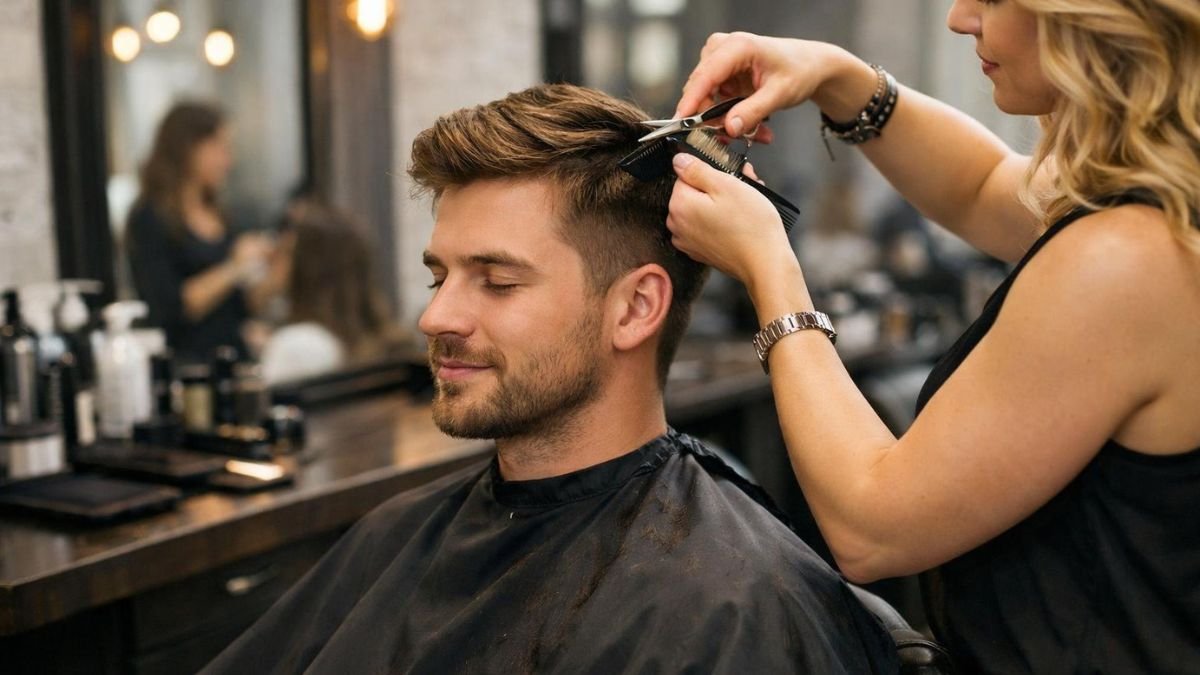
Have you ever sat in a salon chair, stared at your reflection, and thought… 'How on earth do I explain what I want?' Maybe you ended up just saying 'shorter' and hoping for the best. Or maybe you nodded along while the stylist talked about layers and thinning and you had absolutely no clue what any of that meant. If that sounds familiar, you're in the right place. Let's fix that — and let's have some fun doing it.
We're going to walk through this topic together, starting from the very basics and gradually working our way up to the kind of English that would let you have a full-blown conversation with a stylist in London or New York. Think of it as a journey: we'll begin at the entrance of the salon and, by the end, you'll be chatting confidently about everything from split ends to color theory.
LEVEL 1 — THE BASICS (A1/A2)
Let's start with the words you'll use most. When you walk into a barbershop or a hair salon, you're going to need some basic vocabulary. The place where men typically go is called a barbershop, and the person who cuts your hair there is a barber. A hair salon is more general — anyone can go — and the person helping you is usually called a hairstylist or a hairdresser. These words get mixed up a lot, but now you know the difference.
So what can you actually ask for? The simplest thing is a haircut, which is just the general act of getting your hair cut. If you only want a little bit taken off, you'd ask for a trim. If you want your hair washed, you ask for a shampoo or a wash. And if you want it styled nicely afterward, that's a blow-dry.
Now here's where a lot of beginners get stuck — how do you tell the barber or stylist how much to cut? You can say things like:
"A little shorter, please."
"Not too short on the sides."
"Just a trim — about an inch off."
"I'd like it medium length."
Notice the grammar here — we're using polite requests. 'I'd like…' is your best friend at this level. It's short for 'I would like,' and it sounds polite and natural. Compare 'I want a haircut' with 'I'd like a haircut, please.' Both work, but the second one is smoother. Another great phrase is 'Could you…?' as in 'Could you take a little off the top?'
Let's talk about parts of the head, because you'll need these. The top is the, well, top of your head. The sides are the areas above your ears. The back is the back of your head (no surprises there). The fringe is the hair that falls over your forehead — in American English, people often call this bangs. And your neckline is where your hair meets the back of your neck.
A few useful adjectives: short, long, straight, curly, wavy, thick, thin. These are the building blocks. 'I have curly hair.' 'I want it shorter on the sides.' Simple, direct, effective.
LEVEL 2 — ADDING COLOR AND DEPTH (B1/B2)
Alright, now that you've got the basics down, let's add some color — literally and figuratively. At the intermediate level, you're not just asking for 'shorter.' You're describing styles, giving opinions, and having a real back-and-forth conversation.
Let's start with more specific haircut vocabulary. Layers are when the hair is cut at different lengths to add movement and volume — very popular in longer hairstyles. An undercut is when the sides and back are cut very short while the top stays long. A fade is a smooth gradient from very short hair at the bottom to longer hair at the top — you'll hear 'skin fade,' 'mid fade,' and 'high fade.' A bob is a classic short-to-medium hairstyle, usually ending around the chin. And then there's a pixie cut, which is a very short style that's cropped close to the head.
If you're at a salon and the stylist asks, 'What are we doing today?' — that's your cue to describe what you want. At this level, you can be much more specific:
"I'm thinking of getting layers to add a bit of volume."
"Could I get a low fade on the sides and keep the top about three inches?"
"I'd like to keep the length but get rid of the split ends."
See how we're using more complex structures now? 'I'm thinking of getting…' uses the gerund after 'thinking of,' which is a very natural intermediate pattern. 'I'd like to keep the length but get rid of the split ends' uses a contrast structure with 'but' and the phrasal verb 'get rid of.'
Speaking of phrasal verbs — the salon is full of them. You grow out your hair (let it get longer over time). You chop it off (cut a lot of it, dramatically). Your color fades out over time. You touch up your roots when you need to re-dye the hair near your scalp. These are the kinds of phrases that make you sound much more natural.
Now let's talk about color. Highlights are lighter streaks added to your hair. Lowlights are darker streaks. A full color means your entire head is dyed one shade. When your natural color starts showing at the top, those are your roots, and you might need a root touch-up.
Grammar spotlight: the present perfect is incredibly useful here. 'I've been growing my hair out for six months.' 'I've never dyed my hair before.' 'Have you ever tried a pixie cut?' These sentences connect past experiences to the present — exactly what you need when discussing your hair history with a stylist.
LEVEL 3 — FLUENCY AND NUANCE (C1/C2)
Welcome to the advanced level, where we're not just getting haircuts — we're discussing them like someone who reads Vogue and subscribes to three hairstyling channels. This is where your English gets really precise, really expressive, and really fun.
Let's start with advanced salon vocabulary. A balayage is a French technique where color is hand-painted onto the hair in sweeping strokes, creating a natural, sun-kissed look. An ombré is a gradient effect where the hair transitions from dark at the roots to lighter at the ends. A keratin treatment smooths and strengthens the hair by infusing it with protein. And if someone offers you an olaplex treatment, they're talking about a bond-building treatment that repairs damage at a molecular level.
At this level, your conversations with a stylist might sound like this:
"I've been considering a balayage, but I'm worried about the upkeep. How often would I need to come in for touch-ups?"
"My hair's been feeling a bit lifeless lately. Do you think some face-framing highlights would add dimension without too much commitment?"
"I'm trying to grow out a bad layered cut from a few months ago. What would you recommend in the meantime to keep it looking intentional rather than messy?"
Notice the sophistication here. We're using conditional structures ('Do you think… would…'), hedging language ('a bit,' 'without too much'), and nuanced vocabulary ('dimension,' 'commitment,' 'intentional'). This is the kind of English that makes you sound not just fluent, but articulate.
Let's talk about some idiomatic expressions related to hair. A 'bad hair day' is when your hair just won't cooperate — but people also use it metaphorically to mean any day when nothing goes right. If you 'let your hair down,' you relax and have fun. To 'split hairs' means to argue about tiny, unimportant differences. And if something makes 'your hair stand on end,' it's terrifying.
Writing tip: if you're ever writing a review for a salon, the advanced approach avoids vague praise like 'It was great.' Instead, try: 'The stylist clearly understood the assignment — the balayage blended seamlessly, and the toner brought out exactly the right warmth for my skin tone.' See the difference? Specific, descriptive, and useful for other readers.
One more grammar point for this level: mixed conditionals. 'If I hadn't gone to that cheap place, my hair wouldn't be this damaged now.' This combines a past condition with a present result — it's complex, it's elegant, and it's exactly the kind of structure that separates advanced speakers from intermediate ones.
YOUR CHALLENGE
Here's your challenge: Record yourself (audio or video) explaining your hair history and what you'd ask for at your next salon visit.
Try to include at least three vocabulary words from each level.
Bonus: Write a 100-word salon review — real or fictional — using at least two phrasal verbs and one idiomatic expression.






0 Comments