
Vocabulary Preview
- Capricious: Given to sudden and unaccountable changes of mood or behavior.
- Ubiquitous: Present, appearing, or found everywhere.
- Vicissitudes: A change of circumstances or fortune, typically one that is unwelcome or unpleasant.
- Inscrutable: Impossible to understand or interpret.
- Mercurial: Subject to sudden or unpredictable changes of mood or mind.
- Machinations: Plots or schemes.
- Ephemeral: Lasting for a very short time.
- Archetype: A very typical example of a certain person or thing; a recurrent symbol or motif.
- Reverberate: To appear to vibrate or echo.
- Propensity: An inclination or natural tendency to behave in a particular way.
Listen
Or Read
The Mesoamerican Legend of Tezcatlipoca: The Smoking Mirror of Fate
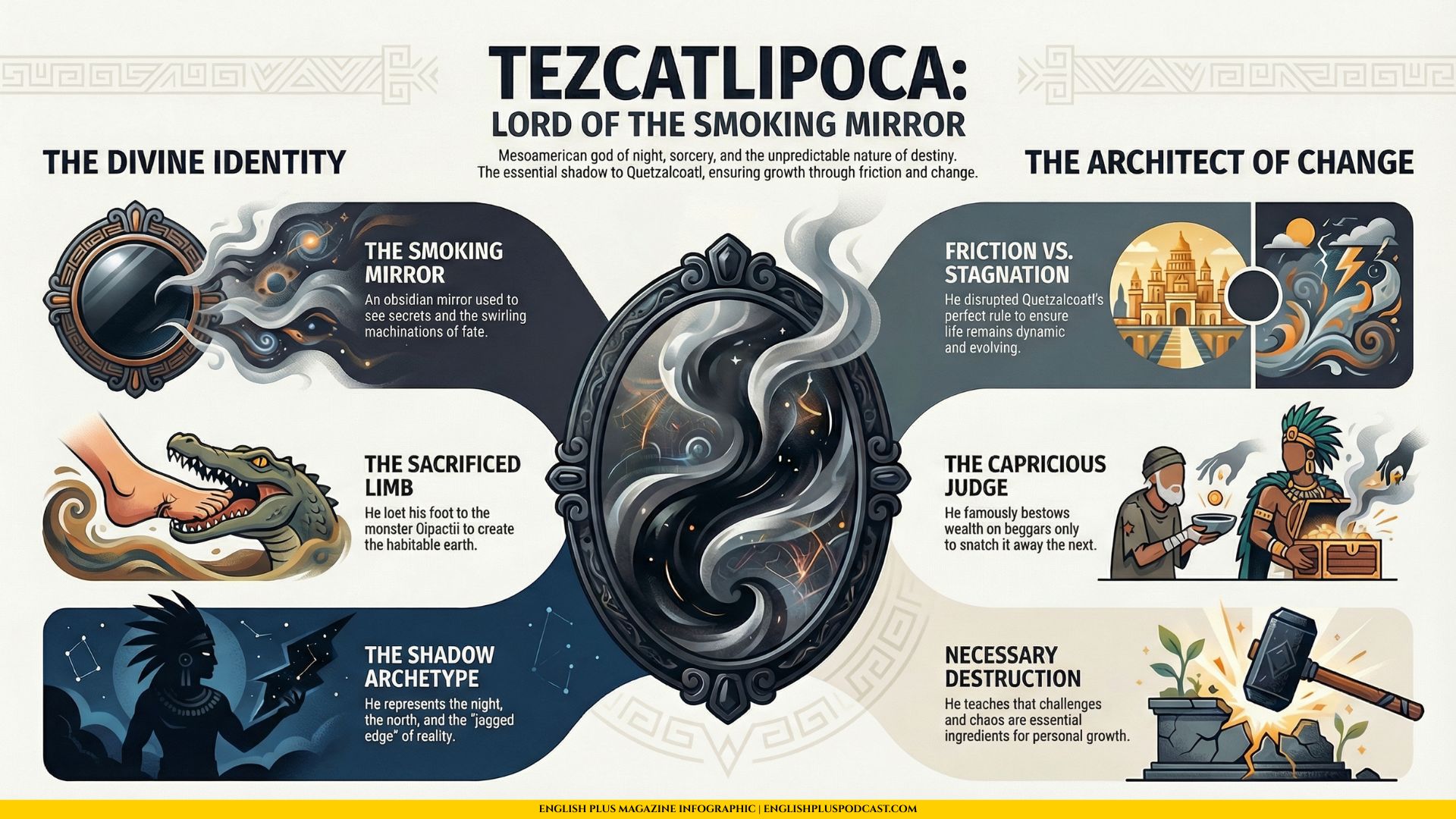
Have you ever stared into a mirror, perhaps a little too long, and felt a sudden, shivering sensation that the reflection staring back wasn't quite... you? Or maybe you’ve had one of those days where your perfectly laid plans were dismantled by a series of coincidences so bizarre they felt orchestrated by a cosmic prankster? If so, you might have already brushed shoulders with one of the most fascinating and terrifying figures in world mythology. We are stepping into the humid, vibrant world of Mesoamerican lore to talk about Tezcatlipoca, a deity whose very name—Smoking Mirror—sounds like the title of a noir thriller.
Tezcatlipoca is not your garden-variety god of thunder or harvest. He is the ubiquitous shadow that trails behind the sunlight, the invisible force of gravity that pulls the rug out from under you just when you think you’re standing on solid ground. In the Aztec pantheon, he represents the night, sorcery, conflict, and the north, but his true domain is the unpredictable nature of destiny itself. While his brother Quetzalcoatl, the Feathered Serpent, often gets the good PR as the benevolent creator and patron of civilization, Tezcatlipoca is the jagged edge of reality. He is mercurial, shifting his alliances and intentions with the wind, reminding us that order is just a temporary island in a sea of chaos.
Imagine a god who is missing a foot—not because of a war wound or a clumsy accident, but because he used it as bait to catch a giant earth monster. Yes, in one creation myth, Tezcatlipoca dangles his own limb to lure Cipactli, a crocodile-like beast, from the primordial waters to create the land we walk on. That is a level of commitment to a project that puts our daily to-do lists to shame. This act of sacrifice defines his character; he is willing to embrace pain and ugliness to birth existence. He is an archetype of the necessary destruction that precedes creation. But don't let that heroic act fool you into thinking he's a nice guy. He is famously capricious, known for bestowing immense wealth and power on a beggar one day, only to snatch it away the next, laughing as he watches the poor soul scramble in the dirt.
The most striking symbol associated with him is, of course, the obsidian mirror. This wasn't the crystal-clear glass we use to check our hair today; it was a dark, volcanic glass that offered a hazy, smoke-filled reflection. Aztec priests used these mirrors for divination, believing they could see the machinations of fate swirling in the black depths. Tezcatlipoca wore one in place of his missing foot (or sometimes on his chest), and through it, he was said to see everything—the secrets you keep in the dark, the lies you tell yourself, and the vicissitudes of fortune that await you. He is the inscrutable judge who knows that human morality is often just a mask we wear to hide our true nature.
Consider the legendary rivalry between Tezcatlipoca and Quetzalcoatl. It plays out like a cosmic soap opera. Quetzalcoatl was the ruler of the legendary city of Tollan, a place of perfection and high culture. But perfection, as Tezcatlipoca knows, is stagnant. It is ephemeral. So, the Smoking Mirror disguised himself—often as a decrepit old man—and tricked the pure Quetzalcoatl into getting drunk and disgracing himself, forcing the Feathered Serpent into exile. It sounds cruel, doesn't it? To dismantle a golden age just for kicks? But there is a deeper lesson here. The story suggests that a life without challenge, without the shadow side, is unsustainable.
This myth forces us to confront our own propensity for seeking comfort and stability at all costs. We want the eternal summer of Quetzalcoatl, but reality is a cycle that demands the winter of Tezcatlipoca. He represents the friction that creates fire. Without him, there is no change, no growth, no history. His actions reverberate through the ages, whispering that we must accept the messy, chaotic parts of our lives as essential ingredients of the whole. He teaches us that we are not just creatures of light and logic; we are also beings of instinct, shadow, and unpredictability.
So, the next time your Wi-Fi cuts out during an important meeting, or you spill coffee on your favorite shirt, or life takes a sharp left turn when you were signaling right, take a deep breath. Don't just curse your bad luck. Pause and give a little nod to the Smoking Mirror. Acknowledge that you are dancing with chaos, and remember that it is often in the disruption of our plans that we find out who we truly are. Fate isn't something that happens to you; it's a reflection you help create. And speaking of reflections, I have to ask: When you look into the "smoking mirror" of your own life—those dark, uncertain moments—what do you see staring back at you? Let me know in the comments below!
Word Power
Now, let’s pull back the curtain and look at some of the heavy-hitting vocabulary we used to tell that story. It’s one thing to just read these words, but it’s another to really own them, so let’s break them down like we’re chatting over coffee.
First up, we described Tezcatlipoca as capricious. This is a fantastic word to describe someone or something that changes mood or direction on a dime, often without any good reason. Think of a cat that wants you to pet it one second and bites you the next—that cat is capricious. In our story, the god gives and takes away power randomly. In real life, you might talk about capricious weather in the spring or a capricious boss who changes the project requirements every morning.
Then we called him ubiquitous. This word is all about being everywhere at once. We used it to say that Tezcatlipoca is a shadow that follows everyone. In the modern world, smartphones are ubiquitous; you can't walk down a street without seeing one in every hand. It’s a great word to use when something feels inescapable or overwhelmingly common.
We also talked about the vicissitudes of fortune. This is a fancy, slightly poetic way of talking about the ups and downs of life. It implies a lack of control over these changes. You don’t just have "bad luck"; you suffer the vicissitudes of the economy or the vicissitudes of aging. It adds a sense of gravity and inevitability to the situation.
I described the god as inscrutable. If you look at someone's face and literally cannot guess what they are thinking—no smile, no frown, just a blank wall—they are inscrutable. We used it for Tezcatlipoca because his motives are hidden. You might use this for a poker player, or maybe that one quiet neighbor who never waves back.
We also used the word mercurial. This is similar to capricious but focuses more on the temperament or liveliness of the change. It comes from the element mercury (quicksilver), which flows and changes shape instantly. A mercurial personality is volatile and quick-witted. Creative geniuses are often described this way—brilliant one moment, despairing the next.
Then there was machinations. This is a darker word. It refers to complex, secret plots, usually with a bad intent. We talked about seeing the machinations of fate in the mirror. You hear this word a lot in politics or corporate dramas—the machinations of a rival company trying to take over the market.
We mentioned that perfection is ephemeral. This is a beautiful word that means lasting for a very short time, like a soap bubble or a sunset. We used it to say that Quetzalcoatl’s golden age couldn’t last forever. You might describe a trend on social media as ephemeral fame, or the ephemeral beauty of cherry blossoms.
Tezcatlipoca is an archetype. An archetype is a perfect example or a universal symbol that shows up in stories across cultures. He is the archetype of the trickster or the shadow. In real life, you might say your grandfather is the archetype of the gruff but lovable old man.
We said his actions reverberate through the ages. To reverberate is to echo, physically or metaphorically. A loud drum reverberates in your chest. But an event, like a major scandal, can reverberate through a community for years. It means the impact keeps bouncing around and being felt long after the initial noise.
Finally, we talked about our propensity for seeking comfort. A propensity is just a natural leaning or tendency. If you have a propensity for procrastination, it means you're naturally likely to put things off. It’s a slightly more formal and precise way of saying "habit" or "inclination."
Speaking Tips & Challenge
Now that you have these words in your toolkit, don't let them gather dust! Here is how you can actually use them without sounding like you swallowed a dictionary.
- Don't overdo it: Use one or two of these in a conversation, not all ten. If you say, "My mercurial boss has a propensity for capricious machinations," people will look at you weirdly.
- Context is King: Use ephemeral when you want to sound a bit philosophical about time. Use ubiquitous when you want to complain about something annoying that is everywhere (like ads!).
- Pair them up: Vicissitudes pairs well with "life" or "fortune." Inscrutable pairs well with "expression" or "motives."
Your Speaking Challenge:
I want you to think of a minor annoyance or a sudden change that happened to you this week. Maybe your train was late, or a friend cancelled plans.
Retell that short story to a friend (or to yourself in the mirror!) using at least three of the new words.
Example: "The bus schedule is so capricious lately; I waited an hour! It's just one of the vicissitudes of city life, I guess. But my anger was ephemeral because I found a great coffee shop while waiting."
Go give it a try!
Have you ever felt like the world was stuck on pause, waiting for a single spark to hit play and unleash a torrent of color, genius, and noise?








0 Comments