Podcast Episode
The Great Reality Check
Welcome to the point in our intellectual journey where common sense goes to die. If you are comfortable with the world—if you like the fact that your coffee cup stays on the table when you aren't looking at it, or that you can't be in Paris and Tokyo at the exact same time—you might want to brace yourself. We are about to dive into the subatomic realm, a place so baffling that Richard Feynman, one of the greatest physicists who ever lived, famously said, "If you think you understand quantum mechanics, you don't understand quantum mechanics."
So, if you finish this article feeling slightly confused, congratulations. You are reacting exactly the way a rational human being should.
The world we live in, the "macroscopic" world, operates on what we call classical mechanics. This is the physics of Isaac Newton. It is the physics of billiard balls, falling apples, and planetary orbits. It is deterministic. It is reliable. If you throw a baseball at a window, you can calculate the force, the trajectory, and the inevitable shattering of glass. Cause leads to effect. Past determines future.
But zoom in. Zoom past the cells in your body, past the molecules, past the atoms, and down to the fundamental particles that make up the universe—electrons, photons, quarks. Down here, the rules of Newton don't just bend; they shatter. Down here, magic is real, ghosts are possible, and certainty is a myth. This is the playground of Quantum Mechanics.
The Double-Slit Disaster
To understand why this field gave Einstein a migraine, we have to look at the most famous experiment in physics history: The Double-Slit Experiment.
Imagine you have a machine that shoots tennis balls. You set up a wall with two vertical slits in it. Behind that wall is a backstop to catch the balls. If you fire tennis balls at the wall, some will bounce off, but some will pass through the slits. On the backstop, you will see two distinct bands of marks where the balls hit. Simple, right? That is how particles behave.
Now, imagine you put the whole thing in a swimming pool and push waves of water toward the slits. The waves pass through both slits, but on the other side, they interfere with each other. The crest of one wave hits the trough of another, canceling it out, or two crests hit and amplify. On the back wall, you don't get two bands; you get an "interference pattern"—a series of many alternating bright and dark bands. That is how waves behave.
Here is where it gets weird. Scientists decided to do this with electrons. We used to think electrons were tiny particles, like miniature tennis balls. So, they fired them one by one at the double slits. Logic dictates there should be two bands on the back wall.
There weren't. There was an interference pattern. The electrons were behaving like waves.
"Okay," the scientists thought, scratching their heads. "Maybe the electrons are bouncing off each other." So they fired the electrons one at a time. Shoot one. Wait an hour. Shoot another. Even when fired individually, the single electron somehow passed through both slits at once, interfered with itself, and landed as part of a wave pattern.
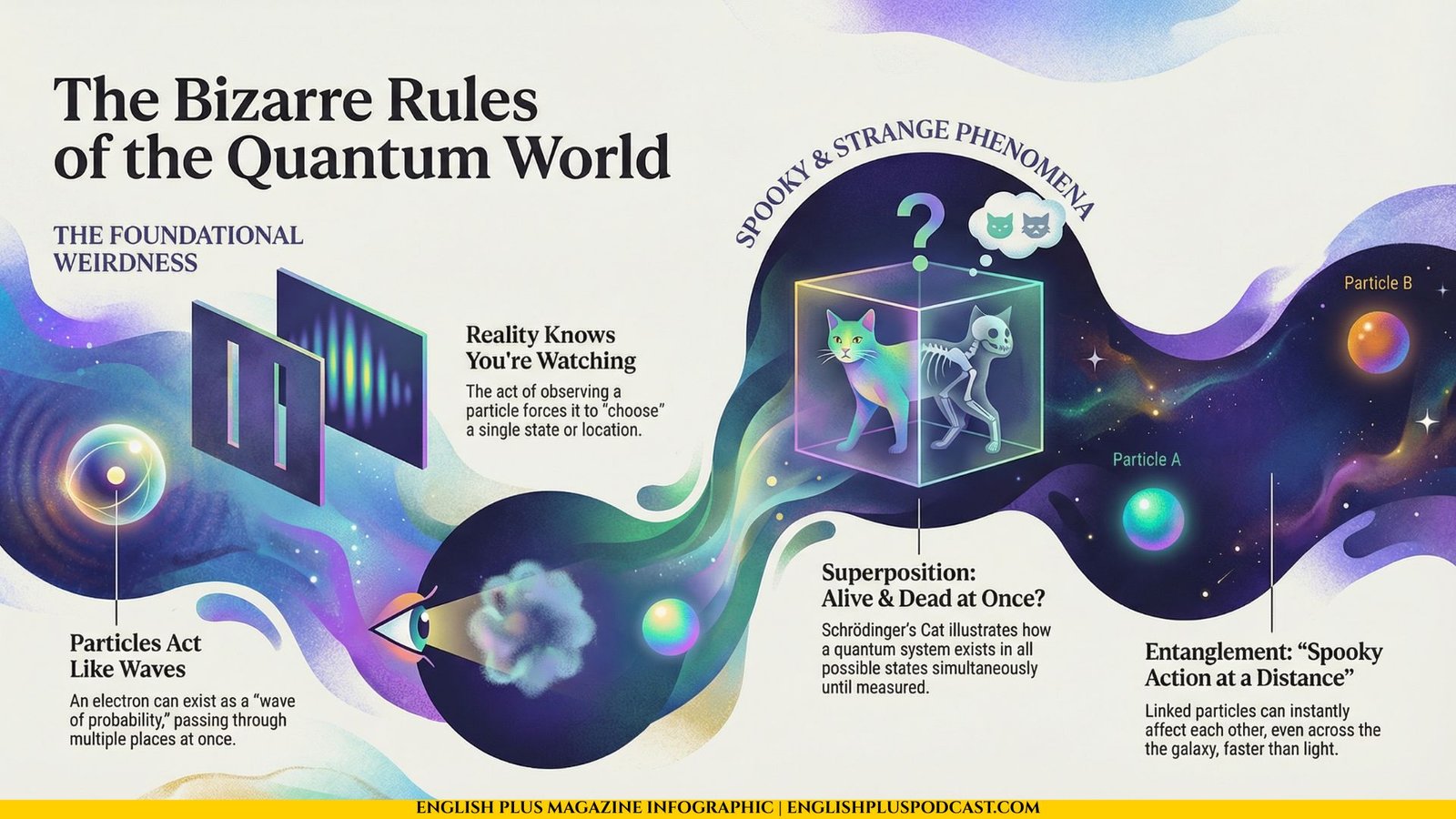
This is the first fundamental concept of quantum mechanics: Wave-Particle Duality. Matter is not solid. At its core, matter exists as a wave of probability. An electron isn't a "thing" in a specific place; it is a smear of potential places. It is a ghost until it hits the wall.
The Observer Effect: Reality is Shy
The scientists were naturally disturbed by the electron behaving like a wave. So, they decided to spy on it. They put a detector next to the slits to see exactly which slit the electron went through. They turned on the detector, fired the electron, and watched.
The moment they measured it, the electron stopped acting like a wave. It went through one slit and hit the back wall like a tennis ball. The interference pattern disappeared.
When they turned the detector off? The wave pattern came back.
This is the Observer Effect. It suggests that the act of measurement affects reality. The universe seems to know when you are watching. When unobserved, a particle exists in a "superposition" of all possible states—it is going through the left slit, the right slit, and both slits simultaneously. But the moment you observe it, nature forces it to choose. The "wave function" collapses, and it becomes a distinct particle.
This has led to a century of philosophical arguments. Does the moon exist if no one is looking at it? According to strict quantum interpretation, until a measurement is made, the moon is just a probability distribution. Of course, "measurement" doesn't necessarily mean a human eye; it means interaction with another particle. But the implications are unsettling. It implies that reality is not fixed; it is rendered on demand, like a video game that only draws the world where the player is looking.
Schrödinger’s Unfortunate Cat
To illustrate how absurd this is, Erwin Schrödinger came up with a thought experiment that has been misunderstood by pop culture ever since. He didn't actually believe this happens; he was using sarcasm to show how ridiculous the theory was.
Imagine a cat in a sealed steel box. Inside the box, there is a tiny amount of radioactive material, so small that there is a 50% chance an atom will decay in the next hour and a 50% chance it won't. If it decays, a Geiger counter detects it and triggers a hammer that smashes a vial of poison, killing the cat.
According to quantum mechanics, until you open the box, the atom is in a superposition of decayed and not decayed. Therefore, the hammer is both smashed and not smashed. And consequently, the cat is both dead and alive at the same time.
Schrödinger called this "burlesque." He was pointing out that applying subatomic rules to everyday objects is nonsensical. A cat cannot be dead and alive. But mathematically, the quantum state describes exactly that. This concept of Superposition—being in multiple states at once—is the basis of quantum computing. A classical computer bit is a 0 or a 1. A quantum bit (qubit) is 0, 1, and everything in between simultaneously, allowing for computational power that makes our best supercomputers look like abacuses.
Entanglement: The Ultimate Long-Distance Relationship
If you thought duality and zombie cats were weird, meet Quantum Entanglement. Einstein hated this one. He called it "spooky action at a distance."
Entanglement happens when two particles interact in a way that their quantum states become linked. They share a single existence. You can separate these particles by inches, or you can separate them by the width of the entire galaxy. It doesn't matter.
If you measure the first particle and find it spinning "up," the second particle will instantly snap into the state of spinning "down." Faster than the speed of light. Instantaneously. It’s as if you had two coins, one in New York and one on Mars. You flip the New York coin and it lands on heads; at that exact moment, the Martian coin flips itself to tails to balance the equation.
This broke Einstein's heart because it seemed to violate the speed of light limit. How does the second particle know what the first one did instantly? Is there a secret signal? We have since proven that there is no secret signal. They are simply part of the same whole, regardless of distance. Space, in this context, is irrelevant.
Tunneling: Walking Through Walls
Let’s bring this back to something you use every day: the sun. Or, if you prefer, your USB drive. Both rely on Quantum Tunneling.
In classical physics, if you roll a ball up a hill and it doesn't have enough energy to reach the top, it rolls back down. It cannot get to the other side. In quantum mechanics, because a particle is a probability wave, there is a tiny, non-zero chance that the particle is already on the other side of the hill.
Sometimes, a particle simply "borrows" energy from nowhere, vanishes from one side of a barrier, and reappears on the other side. It tunnels through the wall.
Without this, the sun wouldn't shine. Protons in the sun's core repel each other. They shouldn't be able to get close enough to fuse and release energy—they don't have enough heat to overcome the repulsion barrier. But thanks to tunneling, occasionally they just cheat, skip the barrier, and fuse anyway. Without this "cheating," our star would be cold and dead, and we wouldn't be here to be confused by physics.
God Does Not Play Dice
Einstein famously refused to accept the randomness of quantum mechanics, stating, "God does not play dice with the universe." He believed there must be hidden variables, underlying rules we just didn't understand yet, that would make everything predictable again.
He lost that debate. As far as we can tell, the universe is fundamentally random. It is probabilistic. At the deepest level of reality, you cannot predict what will happen; you can only predict the chance of it happening.
This suggests that the universe is not a clockwork machine wound up at the beginning of time. It is a fuzzy, chaotic, blurry mess that only snaps into focus when we are forced to interact with it. It means that ambiguity is not a lack of knowledge; ambiguity is the fundamental nature of existence.
So, where does that leave us? It leaves us with a smartphone in our pocket that uses transistors (based on quantum mechanics) to access a GPS (based on relativity), all while our brains try to comprehend a reality that defies logic. The quantum world is bizarre, yes. It is counterintuitive. But it is also the most successful theory in the history of science. It has passed every test we have thrown at it. It is the operating system of the universe, whether we understand the code or not.
Reading Comprehension Quiz
Focus on Language
Vocabulary and Speaking
Let’s unpack the language we used to describe the impossible, because having the right vocabulary to describe complex or abstract concepts is a "survival skill" for advanced English speakers. We used words that do heavy lifting—words that carry a lot of philosophical and physical weight.
Let's start with Counterintuitive. We said the quantum world is counterintuitive. This is a beautiful compound word. "Intuition" is your gut feeling, your instinct, the thing that tells you if you drop a cup, it falls down. "Counter" means against. So, something counterintuitive goes against your gut feeling. It feels wrong, even if it is factually right. In real life, you can use this constantly. For example, "It is counterintuitive, but to get out of a skid in a car, you have to steer into it." Or in relationships, "It’s counterintuitive, but sometimes you have to care less to get more attention." It’s a sophisticated way of saying, "This doesn't make sense, but it works."
Next, consider the word Deterministic. We described classical physics as deterministic. This comes from the word "determine." If a system is deterministic, the past totally predicts the future. If you know the speed and position of every ball on a pool table, you know exactly where they will end up. There is no mystery. In everyday life, you might complain that a movie was too deterministic—you knew exactly how it would end from the first scene. Or you might say, "I don't believe in a deterministic universe; I believe in free will." It’s a great word for discussing fate versus choice.
Then we have Ambiguity. We said ambiguity is the fundamental nature of existence. Ambiguity refers to inexactness, or the quality of being open to more than one interpretation. If a politician gives a speech and you don't know if they are for or against a tax cut, they are being ambiguous. In the workplace, ambiguity is usually the enemy. "I need clear instructions; this ambiguity is killing my productivity." But in art or poetry, ambiguity is good—it lets the viewer decide what it means.
We talked about a Paradox. The twin coins behavior seems like a paradox. A paradox is a statement or situation that seems to contradict itself but might actually be true. Or, it’s a situation that defies logic. "It’s a paradox that you need experience to get a job, but you need a job to get experience." Using this word shows you can spot contradictions in life.
Let's look at Macroscopic. We contrasted the quantum world with the macroscopic world. "Macro" means big. "Scope" relates to looking. So, macroscopic is anything big enough to be seen with the naked eye. The opposite is microscopic. We often get stuck using "big" and "small." Elevate your language. Instead of saying "in the big picture," you could say, "on a macroscopic level, the economy looks good, but individual families are suffering."
We used the term Trajectory. We talked about the trajectory of a baseball. This is the path an object follows through space. But metaphorically, it is incredibly useful. "I'm not happy with the trajectory of my career." "The trajectory of this conversation is heading toward an argument." It implies a path that has momentum and direction.
How about Simultaneously? We used this a lot. It means at the exact same time. It’s better than "at the same time" because it emphasizes the synchronization. "The two runners crossed the finish line simultaneously." In our busy lives, we often "multitask," which is trying to do things simultaneously, usually resulting in doing both poorly.
We mentioned Fundamental. Fundamental particles. This means the base, the core, the essential foundation. If you say, "We have a fundamental disagreement," it means you aren't just arguing about which restaurant to go to; you are arguing about your core values. It suggests something that cannot be broken down any further.
We used Probabilistic. This is the adjective for probability. If something is probabilistic, it involves chance. Weather forecasting is probabilistic. You can’t say "It will rain." You say "There is an 80% chance of rain." Describing life as probabilistic is a very mature worldview. "Success isn't guaranteed; it's probabilistic. You work hard to improve your odds, not to guarantee the outcome."
Finally, let's look at Implication. The implications are unsettling. An implication is a conclusion that can be drawn from something, although it is not explicitly stated. It’s the "if this is true, then that must also be true" connection. "She didn't say no, but the implication was clear." Understanding implications is key to reading between the lines.
Now, let's move to the Speaking Section.
One of the hardest things in English—or any language—is explaining a complex idea to someone who doesn't know anything about it. This is the art of the Analogy. In the article, we used tennis balls and swimming pools to explain wave-particle duality.
To improve your speaking, you need to practice "bridging." A bridge connects a new concept to a known concept.
The structure is: "[Complex Concept] is kind of like [Simple Concept]. Imagine you have [Scenario]..."
For example, if you want to explain "inflation" (complex) to a child, you don't talk about central banks. You say: "Inflation is kind of like when you have a lemonade stand. Imagine if everyone in the neighborhood suddenly found ten dollars. They would all want your lemonade, so you would run out. To stop running out, you raise the price to five dollars a cup. The lemonade is the same, but the money is worth less."
Here is your challenge: I want you to pick your job or your favorite hobby—something you know inside out. I want you to explain a specific, technical part of it to a complete beginner using an analogy involving food or traffic.
If you are a coder explaining a bug, maybe it's like a recipe where you accidentally put salt instead of sugar. If you are a manager explaining workflow, maybe it's like a roundabout in traffic.
Record yourself doing this for one minute. Focus on using the phrase "It's kind of like..." and "Imagine that..." This forces your brain to translate technical jargon into relatable English, which is the hallmark of fluency.
Vocabulary and Speaking Quiz
Grammar and Writing
In this section, we are going to channel your inner science fiction writer. Your challenge is to write a Flash Fiction piece (300 words). I want you to write a scene where a character wakes up one morning and realizes that one rule of quantum mechanics has suddenly applied to the macroscopic world. Maybe they are in two places at once (Superposition). Maybe they can walk through their bedroom door without opening it (Tunneling). Maybe every time someone looks at them, they change clothes (Observer Effect).
To make this writing work, we need to master Modals of Speculation and Conditionals. When you write about weird, altered realities, you are constantly dealing with uncertainty and hypothetical situations.
First, let's look at Modals of Speculation and Deduction.
Since your character is confused, they shouldn't just state facts. They should guess.
- Must be: When you are 90-100% sure. "I must be dreaming." (Not "I am dreaming").
- Can't be: When you are sure something is impossible. "That can't be my reflection; it's moving too slow."
- Might/Could/May: When it's possible but you aren't sure. "I might have slipped into a parallel universe." "This could be a hallucination."
Using these creates an atmosphere of confusion and mystery. Compare "I am a ghost" (boring statement) to "I might be a ghost, or I could just be invisible" (engaging speculation).
Second, and most importantly, we need the Second Conditional and Third Conditional.
The Second Conditional is for imaginary situations in the present.
- Structure: If + Past Simple, ... would + Verb.
- Example: "If I walked through that wall, I would end up in the neighbor's kitchen."
This sets up the rules of your new world.
The Third Conditional is for imaginary situations in the past (regrets).
- Structure: If + Past Perfect, ... would have + Past Participle.
- Example: "If I hadn't looked in the mirror, my face wouldn't have collapsed into a blur."
This is crucial for your character trying to figure out what went wrong.
Let's also talk about Sensory Imagery mixed with Abstract Concepts.
In sci-fi, you need to ground the weirdness in physical sensations. Don't just say "I felt weird."
- Bad: I felt like a wave.
- Good: My edges felt fuzzy, like static on an old TV screen. My hands didn't stop at the coffee cup; they vibrated through the ceramic, a sensation like sticking your fingers in cold Jell-O.
Tips for your Flash Fiction:
- Start In Media Res: Start in the middle of the action. Don't wake up and brush teeth. Start the moment the hand goes through the doorknob. "The brass knob didn't turn; it simply dissolved around my fingers like mist."
- Show the Panic: Use short sentences to speed up the pace when the character is scared. "I pulled back. Gasped. Tried again. Nothing."
- Use the Vocabulary: Try to slip in "Counterintuitive," "Ambiguity," or "Trajectory" naturally. "The trajectory of my toast was wrong; it floated up."
Writing Prompt Extension:
After you describe the event, I want you to write one paragraph where the character tries to rationalize it using the Modals of Speculation. "I reasoned that I must have eaten bad sushi. Or perhaps the government might be testing a weapon nearby. It couldn't be real magic... right?"
This exercise blends creative freedom with strict grammatical structures, which is the best way to internalize grammar. You aren't just memorizing rules; you are using them to build a world.
Grammar and Writing Quiz
Critical Analysis
Okay, I’m putting on my lab coat and my skeptical glasses. The article you just read is fun. It’s engaging. It uses great metaphors. But—and this is a massive but—it walks a dangerous line.
We need to talk about "Quantum Mysticism" or what scientists disparagingly call "Quantum Woo."
The article mentions that "reality implies a conscious observer." This is a very specific interpretation (Copenhagen) and it is often hijacked by self-help gurus. You will hear people say, "Quantum mechanics proves that if you think positive thoughts, you will attract money because you are collapsing the wave function of wealth."
That is absolute nonsense.
The word "observer" in physics does not mean "a human with a brain." It simply means "interaction." A photon hitting an electron is an observation. The universe was collapsing wave functions long before humans evolved. We must be very careful not to use quantum terminology to justify magic or spirituality. The math doesn't support it.
Also, the article leans heavily on the Copenhagen Interpretation (the "collapse" theory). But there are others. There is Pilot Wave Theory, which says particles are always particles, but they ride on a wave. In that theory, there is no spooky collapse, no observer effect, and everything is deterministic again. It’s just as valid mathematically, but it’s less "sexy" for a magazine article, so it gets ignored.
We also need to critique the limit of analogy.
When we say an electron is "like" a spinning coin, we are lying. It’s not like a coin. It has a property called "spin," but it isn't physically spinning. When we say it’s "here and there," we are using spatial language for something that doesn't follow spatial rules. The critical thinker needs to remember: The Map Is Not The Territory. The analogies are the map; the math is the territory. Don't confuse the two.
Lastly, the article celebrates the "mystery." But science is about solving mysteries. We shouldn't just throw our hands up and say, "It's magic!" Physicists are working on Quantum Gravity to unite the smooth world of relativity with the jagged world of quantum mechanics. The goal is to eliminate the weirdness, not worship it.
Let's Discuss
Here are five questions designed to melt your brain a little bit. These aren't yes/no questions. They are designed to explore the implications of what we just read.
1. Does reality exist if no one is watching?
The Copenhagen Interpretation suggests reality is a probability until measured. Does this mean the universe required a conscious observer to become "real"? If so, was the universe just a wave of probability for billions of years before life evolved? Or does a rock "observe" a rock? Where do we draw the line for an "observer"?
2. If the world is random, is Free Will a myth?
Classical physics said everything was pre-determined (Clockwork Universe). Quantum physics says everything is random (Dice Universe). Neither of those options really leaves room for "choice." If your brain is just atoms, and atoms follow quantum rules, are your "decisions" just random quantum fluctuations? Or does consciousness somehow override the physics?
3. The Multiverse: Science or Sci-Fi?
The "Many-Worlds Interpretation" says the wave function never collapses. Instead, every time something could happen, it does happen in a branching universe. In one universe, you finished this article; in another, you stopped reading. Is this a valid scientific theory, or just a way for physicists to avoid the uncomfortable problem of the observer? Is it comforting or terrifying to think there are infinite versions of you?
4. Why doesn't quantum weirdness affect us?
We are made of atoms. Atoms can tunnel through walls and be in two places at once. Why can't we? The answer lies in "decoherence"—interaction with the environment muddies the waters. But is it possible that biological systems (like our brains) actually use quantum effects? Could our thoughts be quantum phenomena?
5. Should we stop looking for "Common Sense"?
We evolved to hunt mammoths and find water, not to understand quarks. Our "common sense" is limited to our survival needs on the African savannah. Should we accept that the universe has no obligation to make sense to us? Is "understanding" just a human arrogance?






0 Comments