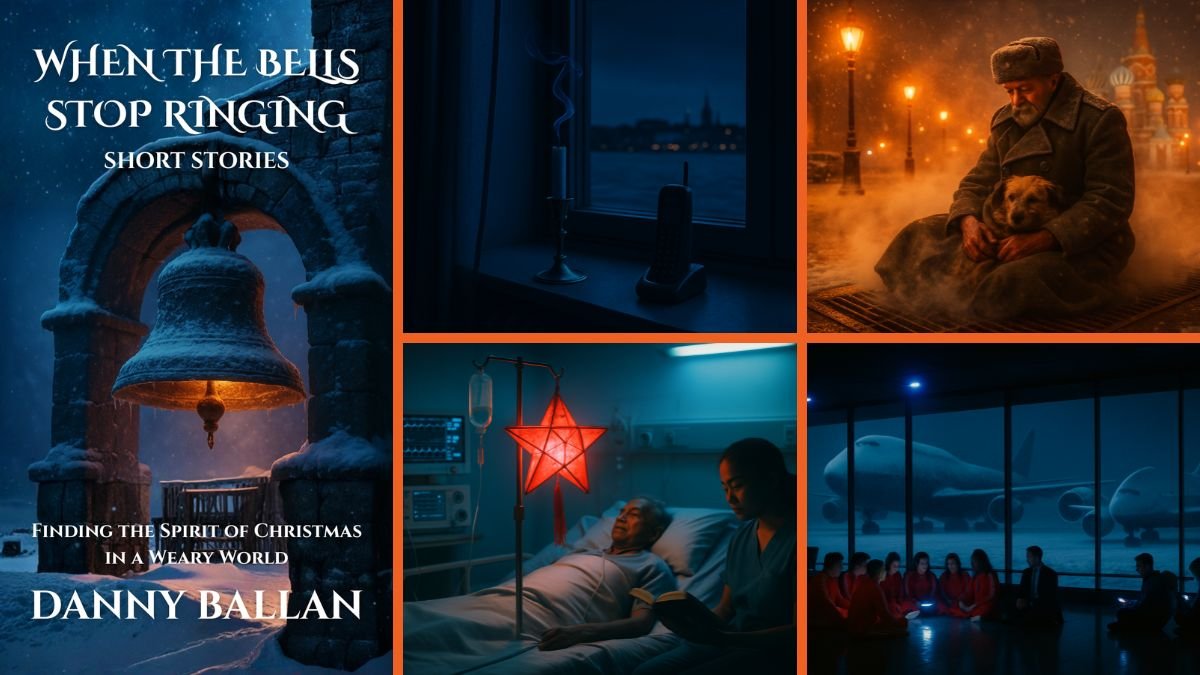
We spend our lives waiting for the "real" moment to start. We wait for the apology, the warm bed, the recovery, or the flight announcement. But what if the waiting room is actually where the life happens? In this episode of Thinking Out Loud, we dismantle the anxiety of the delay. We look at a mother in Sweden paralyzed by pride, a homeless veteran in Russia who refuses to abandon his dog, a nurse in the Philippines keeping watch over a coma patient, and a group of stranded travelers in Germany finding a song in the dark. We ask the difficult questions: Is your pride a shield or a cage? Why do we treat the sick like they are invisible? And how do we turn a brownout into a cathedral? Join me as we learn how to stop checking the clock and start singing in the dark.
You know, I realized something recently while staring at the little spinning wheel on my computer screen. You know the one. The "loading" icon.
I realized that I spend about 40% of my life waiting for the next thing to happen.
We are a species obsessed with "The Arrival." We want the destination. We want the resolution. We want the flight to land, the fever to break, the phone to ring, the apology to be spoken.
And the time in between? The waiting? We treat that like dead air. We treat it like a glitch in the system. We try to fast-forward through it, distract ourselves from it, or just grit our teeth until it’s over.
But looking at the stories we explored this week—from Stockholm, Moscow, Manila, and Frankfurt—I’m starting to think we have it all backwards.
I think the "dead air" might actually be the only air worth breathing.
This week, we looked at four very different kinds of waiting rooms. An apartment, a street grate, a hospital bed, and an airport terminal. And in every single one of them, the miracle didn't happen when the wait was over. The miracle happened when the people stopped fighting the wait.
Let’s talk about the most painful kind of waiting first. The waiting we inflict on ourselves.
Let’s talk about Astrid in Stockholm.
We all know an Astrid. We might be Astrid. She is sitting in her perfect apartment in Östermalm. It’s St. Lucia’s Day. The city is dark. And she has a candle in the window.
Now, usually, we think of a candle in the window as a romantic, welcoming symbol. "I’ll leave the light on for you." It’s sweet, right?
But Astrid’s candle isn’t sweet. It’s a weapon.
It’s a passive-aggressive beacon. She says she’s waiting for her son, Elias. But really, she’s engaging in a spiritual staring contest. She’s saying, “I am here. I am the mother. I am righteous. You come to me.”
How many of us are doing that right now?
We have these "Cold Wars" in our families. We have arguments that are so old we don’t even remember how they started—like Astrid, who can’t recall the syntax of the insults, only the heat of the pride.
We freeze people out. And then we sit in the cold, convincing ourselves that our silence is a form of strength. We tell ourselves, "I'm teaching them a lesson."
But who is really learning the lesson?
Astrid looks at that candle and realizes the terrifying truth: The candle isn't calling out to anyone. It’s just melting. It’s just burning itself alive until there’s nothing left but smoke.
That is what pride does. It consumes the vessel. It doesn't warm the room; it just burns the wick.
The moment Astrid decides to blow out the candle is one of the bravest things I’ve read in a long time.
Pfhh.
She chooses darkness over the false light of her own ego. And then she picks up the phone.
Let’s talk about the physics of the phone call for a second. The landline.
We’ve lost something with texting. With a text, you can fire and forget. You can edit. You can hide. But a phone call? That is real-time vulnerability.
The description of the ringing sound... Tuuuuut... Tuuuuut.... That is the sound of terror.
In the space between the rings, we live out our worst nightmares. He hates me. He’s dead. He’s happy without me.
We are so afraid of the silence on the other end of the line. We are so afraid of rejection that we choose the guarantee of loneliness. Think about that logic. I am so afraid you won't talk to me that I will ensure we never talk.
But when Elias answers... he isn't angry. He isn't armed for battle. He’s just... surprised. He’s thinking about saffron buns.
We build these monsters in our heads. We write scripts for other people, where they are the villains and we are the victims. But usually, when we finally break the silence, we find out they were just waiting, too.
The "What If" here is simple but heavy: What if the person you are waiting for is paralyzed by the same fear you are?
What if you blew out the candle and just made the call?
Now, let’s move from the emotional cold of Stockholm to the physical freeze of Moscow.
Let’s talk about Ivan and the Grate.
If Astrid’s story is about the waiting we choose, Ivan’s story is about the waiting we are forced into. He is homeless. He is waiting for the winter to end, or for life to end—whichever comes first.
And then comes the offer of salvation. The Social Patrol. The warm van. The gymnasium.
It’s the solution to his problem. But it comes with a condition: No dogs.
This is where we get into the philosophy of "The System" vs. "The Soul."
The System sees Ivan as a biological unit that needs to be kept above 37 degrees Celsius. It sees the dog, Laika, as a hygiene violation.
But Ivan sees Laika as his soul. She is the only thing in the world that looks at him with trust. She is his pack.
So, he chooses the cold. He chooses the grate.
This destroys me, honestly. The idea that a man would risk freezing to death rather than abandon the only creature that loves him. It redefines what "home" is. We think home is a roof. Ivan teaches us that home is a pact. It’s a refusal to let go.
But the real hero of this story—aside from Ivan—is the volunteer. The girl in the yellow vest.
She represents a different way of dealing with the wait.
The patrolman leaves. He says, "You know the rules," and drives away. He can’t solve the problem, so he abandons it.
The girl can’t solve the problem either. She can’t change the rules at the shelter. She can’t build Ivan a house.
So what does she do? She changes the geometry of the situation.
She gets down on the grate.
She brings soup. She brings a blanket. And she sits in the snow.
We often think that if we can’t fix someone’s life, we have nothing to offer. I can’t cure your cancer. I can’t pay your debt. I can’t bring back your dead wife. So we stay away. We feel awkward.
But the girl in Moscow proves that presence is a form of heat.
She didn’t try to pull Ivan up to her level (the van). She went down to his level (the street).
She validated his choice. She fed the dog. She acknowledged that Ivan and Laika were a family unit.
This Christmas, or whatever holiday you celebrate, you will see people who are "stuck" on the grate. Maybe literally, maybe metaphorically. You can’t save them all. You can’t fix the system overnight.
But you can sit down. You can pour the tea. You can wait with them.
And speaking of waiting with the vulnerable... let’s go to Manila. To Noche Buena.
This story... this one hits hard for anyone who has ever spent time in a hospital.
Hospitals are weird places during the holidays. The rest of the world is exploding with joy—fireworks, karaoke, roast pork. But inside the ICU, it’s just the beep... beep... beep... of the machines.
We are terrified of these rooms. Be honest. When a distant relative is sick, or a friend is in a coma, we hesitate to visit. Why?
Because it breaks the illusion. We are celebrating life, and that room is a reminder of death. We fear the coma is contagious. We fear the silence will stick to our clothes.
Reya, the nurse, is the "Night Watch."
She is looking after Lolo Ben. A John Doe. A man drifting in the gray water of unconsciousness.
He can’t hear her (probably). He can’t thank her. He can’t give her a Christmas bonus.
But she hangs the parol—the lantern—anyway. She reads to him anyway.
Why?
Because she believes in the dignity of the person, even when the person isn't "there" to claim it.
This is the ultimate form of altruism. Doing good for someone who can never repay you, and who might not even know you did it.
But then the door opens. And Marco runs in.
The grandson. The man who has been battling traffic, ferries, and panic to get there.
Imagine Marco’s perspective. He is failing. He is late. He is terrified that his grandfather is dying alone in the dark. That is a specific kind of hell—the guilt of not being there.
And then he sees the red light. He sees the lantern.
He realizes that someone was holding the line.
Reya wasn't just comforting the patient; she was saving the grandson. She saved him from the memory of a dark room. She allowed him to arrive into a space that was already loved.
We talk a lot about "holding space" for people. It’s a buzzword. But this is what it actually looks like. It looks like reading a story to a sleeping man. It looks like hanging a cheap bamboo star on an IV pole.
It is the promise we make to each other as a society: I will watch while you sleep. I will wait while you travel.
And then they eat the cold noodles on the medical cart. A nurse and a stranger. A family formed by circumstance.
It challenges us to think: Who is in the hospital right now, drifting, who needs a witness? Who needs a lantern?
And finally, let’s talk about the place where nobody wants to be. The Airport.
Frankfurt. Gate Z-15.
If there is a modern purgatory, it is an airport terminal during a blizzard.
This story is about the "Pause."
We are people of momentum. We have itineraries. We have deadlines. When the board says CANCELED, we take it personally. We feel like the universe is stealing our time.
Look at the characters at the beginning of the story. The businessman screaming about de-icing fluid. The tourist fighting a teenager for a power outlet. It’s toxic. It’s "survival of the fittest" in a grey carpeted box.
And then... the blackout.
I love that the breakdown of the machine is what saves the humans.
When the lights go out, the hierarchy dissolves. First Class, Economy, Diamond Status—none of it matters in the dark. Everyone is just a cold body needing comfort.
And then the humming starts.
The Nigerian choir. They don’t stand up and perform a concert. They just hum. It’s a self-soothing mechanism.
But it catches. Julian hums. Elias sings. The Brazilians join in.
They build a "Cathedral of Unity" out of a brownout.
There is a profound lesson here about The Interruption.
We view interruptions as enemies. This snowstorm is ruining my Christmas! This power outage is ruining my night!
But what if the interruption is the point?
If the flight hadn't been canceled, Elias would be eating a quiet dinner in Munich. Julian would be asleep on a plane. They would never have met. They would never have shared that moment of absolute harmony.
The "What If" is this: What if the destination is not the only place where life happens?
What if life is happening right now, in the delay?
Elias, the angry businessman, undergoes the biggest transformation. He goes from hoarding his status to sharing his power bank.
He realizes that he isn't "stuck" with these people; he is "gathered" with them.
It changes the whole energy of the room. A bag of chocolates becomes a feast. A coat becomes a blanket. A terminal becomes a home.
So, let’s weave these four threads together.
We have the Phone Call in Stockholm.
The Steam Grate in Moscow.
The Lantern in Manila.
The Choir in Frankfurt.
They are all teaching us how to Wait Well.
Waiting isn't passive. It’s an active state.
You can wait with pride, like Astrid, and burn yourself out. Or you can wait with courage, and make the call.
You can wait for the system to fix things, like the patrolman. Or you can wait with love, like the girl on the grate.
You can wait in fear, like the hospital visitors. Or you can wait with dignity, like Reya.
You can wait in anger, like the travelers. Or you can wait in harmony, like the choir.
We are heading into the thick of the holiday season. There will be delays. There will be awkward silences at the dinner table. There will be moments where you feel lonely, or frustrated, or stuck.
When that happens, I want you to remember the power bank. Remember the parol. Remember the canteen.
Don't fight the pause. Inhabit it.
Look around the waiting room—whether it's an airport or your own living room—and ask yourself: "Since I'm here, who can I sing with?"
Who needs a light in the window? Not a beacon of pride, but a signal of love.
Who needs you to get down on the grate and sit with them in the cold?
The flight might be canceled. The road might be closed. The phone might not have rung for two years.
But we are here. We are together. And as long as we have a voice, we can fill the dark with a song.
Think about it.





0 Comments