In Manila, Christmas is not a silent night. It is a symphony of firecrackers popping in the alleyways, karaoke machines blasting "My Way" from open windows, and the sizzle of lechon skin crackling over charcoal pits. It is Noche Buena—the midnight feast where families gather to eat hamonado, queso de bola, and sweet spaghetti until they can barely breathe.
But on the fourth floor of the Public General Hospital, the air was sterile and silent.
Reya adjusted her face mask, the elastic band digging into the skin behind her ears. She checked the monitor. Heart rate: steady. Oxygen saturation: 96%.
Her patient, Mr. Bautista—or Lolo Ben, as the nurses called him—lay perfectly still. He was a John Doe of sorts, admitted three weeks ago after a stroke. No emergency contact had answered the phone numbers in his wallet. He had been drifting in the gray waters of a coma ever since.
Reya rubbed her eyes. Down in the lobby, the security guards were sharing a box of donuts. Outside, the sky over Manila Bay was flashing with unauthorized fireworks, bursts of red and green reflecting off the glass of the ICU window.
Her phone buzzed in her scrub pocket. A video call from her mother in Batangas. Reya imagined the scene: the long table groaning with food, her cousins fighting over the karaoke microphone, her father slicing the roast pork.
She let it ring. If she answered, she would cry, and she couldn’t cry while inserting a catheter.
She looked at Lolo Ben. He looked so small in the hospital bed, consumed by tubes and wires. The loneliness of the room felt heavier than the humidity outside. On Noche Buena, no Filipino should be alone. It was an unwritten law of the islands.
Reya checked the clock. 11:30 PM. Her break time.
She could go to the break room and eat the cold container of adobo she had brought. She could scroll through Facebook and look at pictures of everyone else’s happiness.
Instead, she walked to her locker.
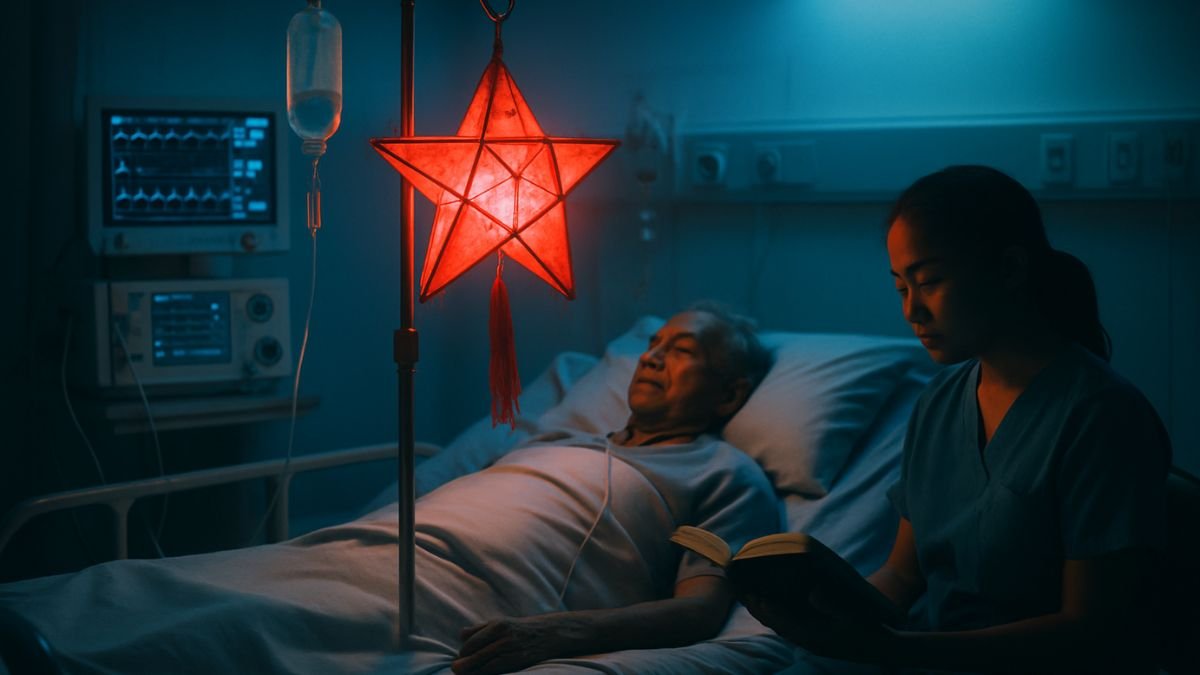
She pulled out a small object wrapped in newspaper. She unwrapped it carefully. It was a parol—a traditional star lantern. This one was tiny, made of simple bamboo sticks and translucent capiz shell paper, dyed a vibrant red. It had a small battery-operated light inside.
She walked back to Bed 4.
“Excuse me, Lolo,” she whispered, stepping around the ventilator.
She tied the parol to the metal hook of his IV stand, right next to the bag of saline. She flicked the switch. The star glowed, a soft, warm red pulse in the blue-lit room. It wasn't the giant, blinking LED lanterns that adorned the mansions in Makati, but it cast a gentle light on the old man’s face, softening the harsh lines of pain and age.
Reya pulled up a stool. She reached into her pocket and took out her phone, but not to check social media. She opened an ebook app.
“You know,” she said softly to the unconscious man, “my Lola used to read this to me every Christmas Eve. I don’t know if you can hear me, Ben. But just in case.”
She began to read. It wasn't a medical chart or a shift report. It was the story of the first Christmas, translated into Tagalog. Her voice was low and melodic, competing with the rhythmic hiss of the ventilator.
“Noong araw, sa bayan ng Betlehem…”
She read for thirty minutes. She told him about the shepherds and the star. She told him about the hope that arrives in the darkest part of the night. She held his hand—his skin paper-thin and cold—rubbing her thumb over his knuckles to generate warmth.
Outside, the clock struck midnight. A roar of cheers went up from the streets below. Firecrackers exploded in a chaotic barrage. Noche Buena had arrived.
“Merry Christmas, Lolo Ben,” Reya whispered. She squeezed his hand.
For a second, she thought she felt a twitch. A muscle spasm, likely. But in the quiet of the ICU, she chose to believe it was a thank you.
The double doors of the ICU swung open with a whoosh.
Reya jumped, dropping her phone.
A man was standing there, breathless, sweating, clutching a plastic bag and a travel-worn backpack. He looked exhausted, his shoes muddy, his clothes wrinkled from a long journey. He looked wild with panic.
“Benjamin Bautista?” he gasped. “I am looking for my grandfather.”
Reya stood up. “He is here. Bed 4.”
The man rushed forward. He stopped at the foot of the bed, his chest heaving. He looked at the tubes. He looked at the machines. The devastation on his face was total.
“I came from Bicol,” he stammered, tears mixing with the sweat on his face. “The bus… the traffic… the ferry was canceled… I thought I wouldn’t make it. I thought he would be alone.”
He moved to the side of the bed and gripped the old man’s arm. “Lolo, I’m here. It’s Marco.”
And then, Marco stopped. He looked up.
He saw the parol.
The little bamboo star was glowing steadily on the IV pole, bathing his grandfather’s face in that warm, familiar red light.
Marco looked at the lantern, then at the chair pulled close to the bed, and finally at Reya. He realized the room wasn't empty. He realized that while he was stuck on a bus praying to reach Manila, someone had been here, holding the line.
His shoulders dropped. The frantic energy left him, replaced by a profound grace.
“You did this?” Marco asked, his voice thick.
Reya nodded. “He shouldn’t be in the dark on Christmas.”
Marco reached into his plastic bag. It was a container of pancit noodles, cold now, traveling hundreds of miles.
“I don’t have much,” Marco said. “But… kain tayo? Let’s eat?”
Reya smiled. It was the first real smile she had felt all night.
“Opo,” she said. “Let’s eat.”
In the sterile glow of the machines and the warm light of the parol, the nurse and the grandson shared a cold meal on top of a medical trolley. They weren’t family by blood, but on this Noche Buena, bound by the care of a sleeping old man, they were family enough.
A Prayer for the Keepers of Breath
Let us speak now to the sterile silence that hums beneath the noise of the celebration. Let us speak to the blue light of the monitor and the rhythmic sigh of the machine.
To the rooms where the party does not enter. To the white sheets and the tangled wires, and the people who lie in the drift, untethered from the calendar, waiting for a voice to call them back or a hand to let them go. We are a world that loves the feast, the firecracker, the loud declaration of life. But we are terrified of the quiet pause that comes before the end.
Let us confess the frightened truth to one another: We leave the sick to the saints. We tell ourselves that there are professionals for this—people in scrubs who are paid to touch the fever, to clean the wound, to watch the line go flat. We stay away because we are afraid that if we step into that room, the festive illusion will shatter, and we will be forced to see how fragile the thread really is. We fear that the coma is contagious, that the silence will stick to our clothes.
Let us ask for the strength of the night watch. The strength to sit in the plastic chair when there is nothing to do but be present. To read the story to ears that may not hear. To hold the hand that cannot squeeze back. To believe that the person inside the broken body is still there, deserving of dignity, deserving of a name, deserving of a holiday.
May we honor the ones who stay when the world goes home. The ones who hang the lantern on the IV pole. The ones who whisper, “You are not alone,” to a stranger. They are the proof that we belong to each other, even when we cannot speak, even when we cannot ask.
Let us learn the lesson of the ICU: We are all family in the face of the dark. When the titles fall away, when the history is erased by the stroke or the accident, we are just humans needing a witness. We are just travelers needing a star to guide us through the long night.
So, let us share the cold noodles on the metal cart. Let us break bread in the presence of the precarious. Let us refuse to let anyone drift away in the dark without a light to show them that they were loved.
May the star in the window—or on the metal stand—burn bright enough to warm the sterile air. And may we find that in keeping watch over another, we are keeping our own humanity alive.
The night is long. But we are here. We are here.
0 Comments