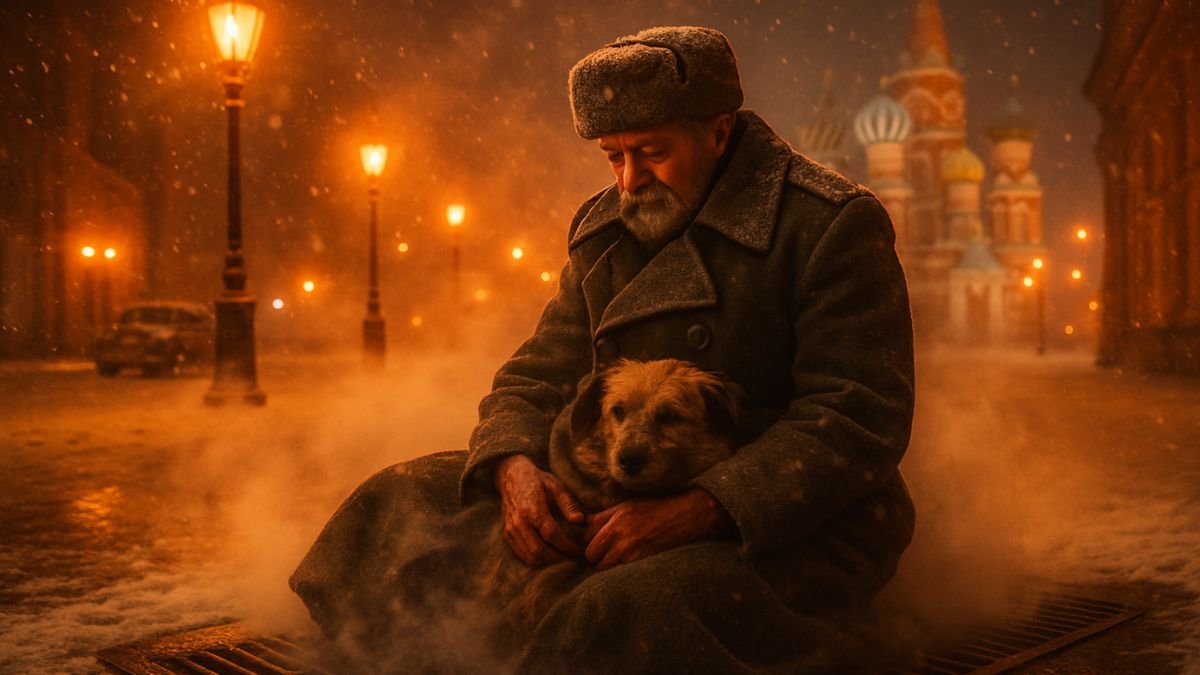
The cold in Moscow was not a weather event; it was a living entity. It prowled the wide avenues of the Garden Ring, searching for gaps in coats and cracks in windows. It turned the Moskva River into a jagged scar of ice and white silence.
Ivan adjusted his ushanka, the earflaps tied down tight against his jaw. He sat on a metal grate behind the Kurskaya metro station. Below him, the city breathed—a rhythmic exhalation of warm, damp steam from the labyrinth of pipes that kept the skyscrapers heated.
To the commuters rushing toward the station entrance, the grate was an eyesore, a cloud of fog smelling of rust and wet concrete. To Ivan, it was the difference between waking up tomorrow and freezing into a statue.
He wasn’t alone. Curled inside his oversized military greatcoat—a relic from a service life that felt like a different century—was Laika. She was a mongrel of indeterminate lineage, a mix of shepherd intelligence and terrier scrap. Her fur was coarse and matted with ice, but her body was a furnace against Ivan’s side.
A white van with blue stripes pulled up to the curb. The Social Patrol.
A man in a thick parka stepped out, his breath pluming in the headlights. He spotted Ivan through the steam.
“Grandfather,” the man called out, his voice muffled by a scarf. “It’s dropping to minus thirty tonight. Come. We have space in the gymnasium.”
Ivan looked up. The gymnasium meant a cot. It meant hot tea. It meant sleep without the fear of the steam dying down. He shifted his legs, stiff with arthritis, and prepared to stand.
Laika stirred. She poked her nose out of his coat and let out a low woof, her tail thumping once against the metal grate.
The patrolman frowned. He pointed a gloved finger. “No animals. You know the rules, Grandfather. Hygiene regulations.”
Ivan froze. He looked at the open door of the van, promising salvation. Then he looked down at Laika. She was looking at him with eyes that held absolute, terrifying trust. She didn’t know about hygiene regulations. She only knew that Ivan was her pack.
“She is quiet,” Ivan said, his voice raspy. “She sleeps under the cot. You won’t know she is there.”
“I can’t,” the man said, checking his watch. “If I let you bring a dog, I have to let everyone bring a dog. Then it’s a zoo, not a shelter. Leave her. She’s a stray. She’ll find a basement.”
Ivan looked at the snow piling up against the curb. A basement? In minus thirty? Leaving her was a death sentence.
Slowly, Ivan settled back down onto the grate. He pulled the coat tighter around the dog.
“Go,” Ivan said.
“Don’t be stupid,” the patrolman snapped. “You’ll freeze.”
“I am warm,” Ivan lied. He patted the dog’s head. “We are fine.”
The patrolman shook his head, cursed the stubbornness of old men, and climbed back into the van. The taillights disappeared into the swirling snow, taking the promise of a warm bed with them.
Ivan closed his eyes. He felt the steam dampening his trousers. It wasn’t a comfortable heat—it was wet and cloying—but it was heat. He whispered to Laika, telling her about the summers of his youth, about fields of wheat that stretched to the horizon, trying to distract himself from the numbness creeping into his toes.
An hour passed. The city grew quieter.
Then, footsteps crunched in the snow. Not the heavy boots of the patrol, but lighter, hesitant steps.
Ivan opened one eye. A young woman was standing there. She wore a bright yellow vest over her coat—a volunteer. She was holding a thermal bag.
She didn’t tell him to move. She didn’t lecture him about the cold.
She knelt down in the snow, right next to the grate.
“They told me you refused the ride,” she said. Her nose was pink from the cold. “Because of the dog.”
Ivan grunted. “She is not a dog. She is Laika.”
The girl smiled. It was a small, sad smile. “I can’t change the rules at the gym. The administrator is… strict.”
“I know,” Ivan said.
“But,” she said, unzipping the thermal bag, “the rules say nothing about eating dinner outside.”
She pulled out a heavy wool blanket—gray and thick, the kind that smelled of safety. She draped it over Ivan’s shoulders, tucking it around him and the dog. Then she pulled out two thermoses.
She poured a plastic cup full of steaming borscht, the smell of beets and dill cutting through the exhaust fumes. She handed it to Ivan. Then, she took a plastic container, filled it with soup, and set it down for Laika.
The dog lapped it up greedily. Ivan wrapped his hands around the cup, the heat stinging his frozen palms.
He expected the girl to leave. She had done her good deed. She could go home to her Christmas Eve.
Instead, she brushed the snow off the curb and sat down.
“What are you doing?” Ivan asked.
“It’s Christmas Eve,” she said, pouring a cup of tea for herself. “Nobody should eat alone on Christmas Eve.”
She sat with him in the freezing dark behind the metro station. She asked him about Laika. She listened as he talked about his service, about a time when he felt useful, about the world that had moved on without him.
Ivan drank his soup. He felt the warmth of the blanket, the warmth of the dog against his ribs, and the warmth of this stranger’s presence. He looked at the steam rising from the vent, mixing with the steam from their cups, rising toward the city lights.
He wasn't in a warm gymnasium. He didn't have a roof. But as Laika rested her head on his knee and the girl laughed at one of his old army jokes, Ivan realized he wasn't homeless.
Home wasn't bricks and mortar. Home was loyalty. Home was the refusal to abandon those you loved, and the kindness of a stranger who saw that loyalty and honored it.
“Thank you,” Ivan whispered into the steam.
“Merry Christmas, Ivan,” the girl said.
And in the ice of Moscow, under the orange glow of the streetlamps, the old soldier and his dog slept soundly, guarded by a blanket and a friend.
A Prayer for the Creatures We Keep
Let us speak now to the loyalty that cannot be measured in words. Let us speak to the fur that is warmer than any shelter, and the heartbeat that is steadier than any promise.
To the bonds we forge with the creatures who walk beside us in the cold. We are told that they are lesser, that they are property, that they are disposable in the face of human need. But in the deepest winter of our lives, when the world has turned its back and the doors are locked against us, we know the truth: They are the guardians of our souls. They are the only ones who do not judge the poverty of our circumstances, but only the richness of our love.
Let us confess the arrogant truth to one another: We think we are the ones who save them. We think we are the masters, the providers, the rescuers. But when the temperature drops and the silence grows loud, we realize that we are the ones being saved. We are being saved from the crushing weight of solitude. We are being saved by a nose nudged against a frozen hand, by a tail that thumps against the grate, by eyes that look at us and see not a failure, but a whole world.
Let us ask for the courage to honor that devotion. To refuse the comfort that demands we abandon the ones we love. To say no to the warm bed if it means leaving our heart behind in the snow. To understand that survival is not just about keeping the body alive; it is about keeping the spirit intact. And the spirit cannot survive betrayal.
May we be grateful for the volunteers who see the whole picture. The ones who understand that a man and his dog are not two separate problems to be solved, but a single family to be preserved. The ones who bring the soup to the curb because they know that love does not fit into a rulebook.
Let us learn the lesson of the steam vent: Home is not a place; it is a pact. It is the stubborn refusal to let go. It is the shared shivering. It is the knowledge that as long as we have each other, we are not truly lost.
So, let us wrap the blanket a little tighter around the ones who cannot speak their gratitude. Let us share the last of the meal. Let us sit in the cold and find that it is bearable, because we are not facing it alone.
May we be worthy of the trust they place in us. And may we find that in caring for the "least" of these, we have found the greatest part of ourselves.
We stay together. That is the law of love. We stay.





0 Comments