An Impossible Choice
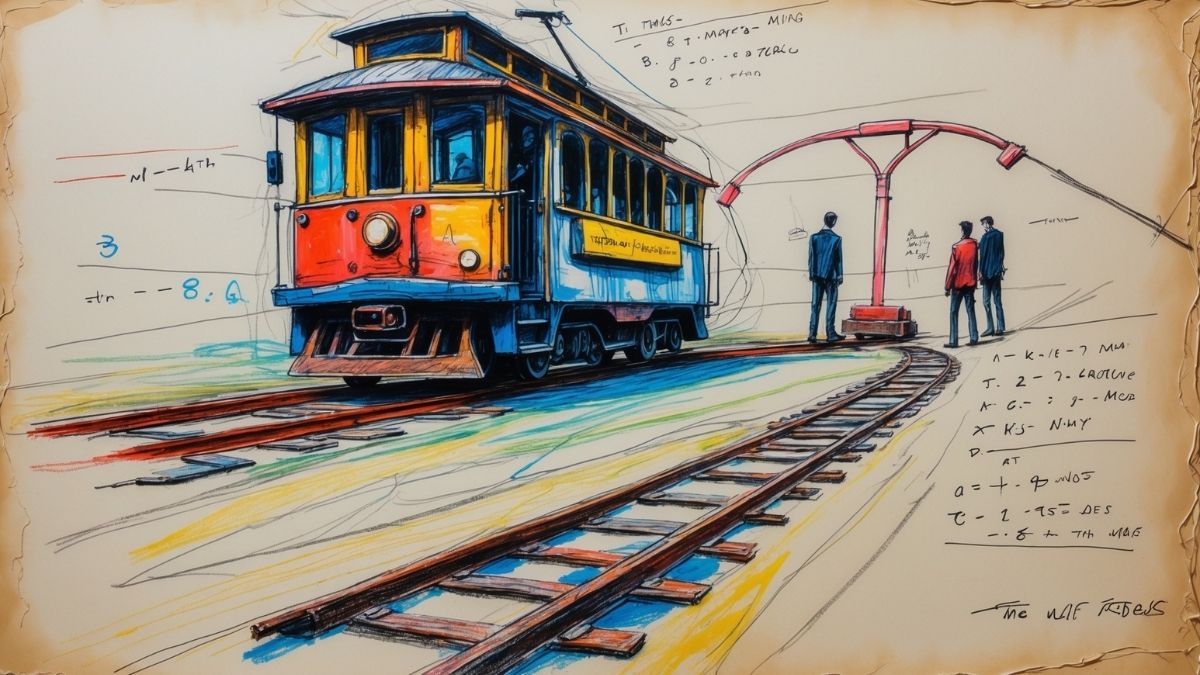
Imagine you're standing by a set of train tracks. In the distance, you see a trolley car, its brakes have failed, and it's hurtling uncontrollably down the track. Up ahead, you see five people tied to the tracks, completely unaware of the disaster about to unfold. You feel a surge of panic, but then you notice a lever next to you. If you pull it, you can divert the trolley onto a second track. But here's the catch: there is one person tied to that sidetrack. You have two choices: do nothing, and five people will die. Pull the lever, and one person will die, but you will have been the one to cause their death. What do you do?
This isn't just a morbid riddle; it's the gateway to one of the most famous and revealing thought experiments in modern philosophy. It’s The Trolley Problem, and the way you answer it shines a fascinating and sometimes uncomfortable light on the hidden code that governs your sense of right and wrong.
The Numbers Game: Utilitarianism
When most people first hear this scenario, their gut reaction is to pull the lever. The logic seems straightforward: saving five lives at the cost of one is a better outcome. Five is greater than one. It’s a tragic situation, but it’s simple math. If this was your answer, you’re thinking like a utilitarian. Utilitarianism is a school of thought championed by philosophers like Jeremy Bentham and John Stuart Mill, and its core idea is that the most ethical choice is the one that produces the greatest good for the greatest number of people. It’s a philosophy of consequences. You tally up the potential happiness and suffering on all sides and choose the option that leads to the best net result. In this case, a world with one death is better than a world with five. Simple, right? Well, let’s see.
The Game-Changing Twist
Let’s change the scenario slightly. Now, you’re standing on a footbridge overlooking the track. The trolley is still out of control, heading for the five people. There is no lever. However, standing next to you on the bridge is a very large man. You realize that his bulk is great enough that if you were to push him off the bridge and onto the tracks below, his body would stop the trolley, saving the five people. He will die, but the others will be saved. Do you push him?
Suddenly, the math feels different, doesn't it? The numbers are identical—sacrifice one life to save five—but for most people, the idea of actively pushing someone to their death feels monstrously wrong. Why?
Rules Are Rules: Deontology
If you felt a powerful revulsion to pushing the man, you’ve just run into a different ethical framework: deontology. Deontology, associated with the philosopher Immanuel Kant, argues that morality isn't about consequences; it's about duties and rules. Certain actions are just inherently right or wrong, regardless of the outcome. A deontologist might say there is a moral rule that says, "Do not kill innocent people." Pulling the lever is one thing—you are diverting a pre-existing threat. But pushing the man is a direct, intentional act of killing. You are using him as a means to an end, treating him as a tool, which violates a core moral duty. For a deontologist, your hands are clean if you do nothing, but they are stained if you push the man, even if more people live.
What Does It All Mean?
So what’s the "right" answer? That's the trick. There isn't one. The Trolley Problem is a diagnostic tool, not a test with a correct solution. It's designed to expose the tension between these two fundamental ways of thinking about morality. Do we judge our actions based on the results they produce (utilitarianism), or by their adherence to a set of moral rules (deontology)? Most of us, it turns out, are not purely one or the other. We’re a messy, inconsistent, and highly emotional mix of both. We want to save the most lives, but we don’t want to get our own hands dirty.
The Real-World Trolley: Your Self-Driving Car
You might be thinking this is all just abstract philosophical fun, but it’s not. We are programming the answers to the Trolley Problem into machines as we speak. Imagine a self-driving car. It’s about to get into an unavoidable accident. Should it swerve to the left and hit a motorcyclist wearing a helmet, or swerve to the right and hit one who isn't? Should it prioritize the life of its own passenger above all else, or should it sacrifice the passenger to save a group of schoolchildren crossing the street? These are no longer thought experiments. Engineers and programmers are building ethical algorithms, and the Trolley Problem is at the very heart of their work.
The Mirror on the Wall
Ultimately, the Trolley Problem forces us to look in the mirror. It asks us to define our values and confront the inconsistencies in our own moral logic. It reveals how much our decisions are driven not by cold, hard reason, but by deep-seated emotional instincts. It proves that being a good person is rarely about making easy choices between good and bad, but about navigating impossible choices between bad and worse.
So, I’ll leave you with a final variation to ponder. A doctor has five patients who will die without an organ transplant. A healthy young person walks in for a routine check-up. The doctor knows they could sacrifice this one person and use their organs to save the other five. Is this any different from pulling the lever or pushing the man?
Let me know what you think in the comments below.








0 Comments