Unraveling Emily Dickinson’s “Because I Could Not Stop for Death”

by | Apr 17, 2024 | Poetry

Because I Could not Stop for Death by Emily Dickinson

Because I could not stop for Death –
He kindly stopped for me –
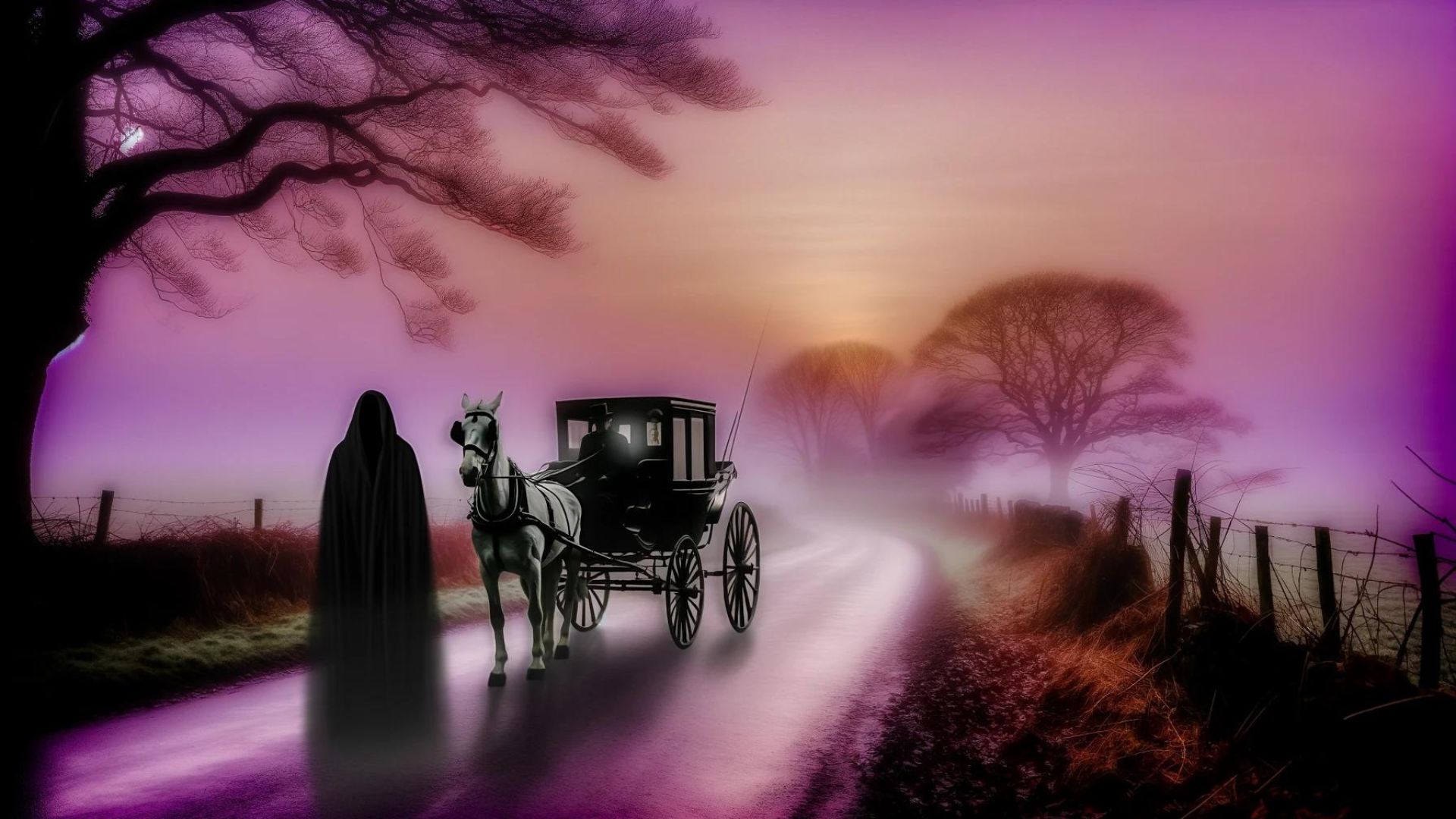
The Carriage held but just Ourselves –
And Immortality.

We slowly drove – He knew no haste
And I had put away
My labor and my leisure too,
For His Civility –

We passed the School, where Children strove
At Recess – in the Ring –
We passed the Fields of Gazing Grain –
We passed the Setting Sun –

Or rather – He passed Us –
The Dews drew quivering and Chill –
For only Gossamer, my Gown –
My Tippet – only Tulle –

We paused before a House that seemed
A Swelling of the Ground –
The Roof was scarcely visible –
The Cornice – in the Ground –

Since then – 'tis Centuries – and yet
Feels shorter than the Day
I first surmised the Horses' Heads
Were toward Eternity –

A Journey Beyond: Emily Dickinson’s Contemplation of Death

Emily Dickinson’s “Because I Could Not Stop for Death” isn’t a poem of fear, but rather one of quiet contemplation. Through personifying Death as a gentleman caller, Dickinson invites us on a carriage ride that unveils her unique perspectives on mortality and the possible journey that lies beyond.

Death as a Companion

Dickinson’s depiction of Death is surprisingly gentle. He “kindly stopped for me,” embodying less a menacing force and more a calm, inevitable guide. This portrayal challenges traditional views of Death as terrifying, suggesting a possible acceptance or even a hint of curiosity on the speaker’s part.

Time and the Afterlife

Throughout the poem, time seems to blur. The carriage passes symbols of life stages – children at play, fields of ripe grain, the setting sun – perhaps hinting that our earthly time is fleeting. The poem’s final stanzas evoke an eternal quality: “Since then – ’tis centuries – and yet / Feels shorter than the Day.” Did Dickinson believe in a specific afterlife, or does she suggest a timeless state beyond earthly existence?

Unanswered Questions and Individual Interpretation

Like many of Dickinson’s works, “Because I Could Not Stop for Death” leaves much open to the reader’s interpretation. Some analyze the poem through a religious lens, while others find a more secular meaning in its exploration of life’s transience. The true power of the poem lies in its ability to spark contemplation about our own mortality.

The Legacy

The poem forces us to confront a universal truth: death is an inevitable companion that will come for us all. However, how we choose to perceive that journey is profoundly personal. Dickinson’s poem offers neither easy answers nor despair. Rather, it encourages us to ponder our own relationship with time, mortality, and the potential mysteries that lie beyond the boundaries of our earthly lives.

In Conclusion

“Because I Could Not Stop for Death” exemplifies Emily Dickinson’s masterful use of language to explore profound themes. Its simple yet evocative imagery continues to challenge and inspire readers, inviting them to confront the universal questions of existence and the great beyond.
0 Comments

Submit a Comment

This site uses Akismet to reduce spam. Learn how your comment data is processed.

<a href="https://englishpluspodcast.com/author/dannyballanowner/" target="_self">English Plus</a>

English Plus

Author

English Plus Podcast is dedicated to bring you the most interesting, engaging and informative daily dose of English and knowledge. So, if you want to take your English and knowledge to the next level, you're in the right place.

You may also Like

Recent Posts

When The Bells Stop Ringing 12 | The Layover

When The Bells Stop Ringing 12 | The Layover

Frankfurt Airport is a cathedral of efficiency, designed to move millions without a hitch. But on Christmas Eve, a massive snowstorm has stopped the clock. At Gate Z-15, the mood is toxic: business travelers are shouting, tourists are hoarding power outlets, and the departure board is a sea of red ‘CANCELED’ signs. Then, the lights go out. In the sudden darkness, a low hum begins in the corner—a melody that transcends language. Join us for a story about what happens when our plans are ruined, and we are forced to find harmony in the delay.

read more
When the Bells Stop Ringing 11 | Noche Buena

When the Bells Stop Ringing 11 | Noche Buena

Manila is usually a symphony of noise—firecrackers, karaoke, and celebration. But inside the Public General Hospital, the air is sterile and silent. Reya, a nurse on the night shift, watches over ‘Lolo Ben,’ a coma patient with no family to claim him. It is Noche Buena, the midnight feast, and Reya refuses to let him spend it in the dark. She hangs a small paper lantern on his IV pole and begins to read. But the hospital doors are about to open, bringing a reminder that even in the quietest rooms, we are never truly alone.

read more
When The Bells Stop Ringing 10 | The Guardian in the Ice

When The Bells Stop Ringing 10 | The Guardian in the Ice

The cold in Moscow is a living entity, prowling the streets for any weakness. Ivan, a homeless veteran, sits on a steam grate behind a metro station, his only warmth coming from the mongrel dog, Laika, tucked inside his coat. When the Social Patrol van pulls up offering a warm bed in a shelter, there is a catch: no dogs allowed. Ivan looks at the open door of the van, and then at the loyal eyes of his companion. This is a story about the family we choose, and the lines we refuse to cross, even when the temperature drops to minus thirty.

read more
When the Bells Stop Ringing 9 | The Longest Ring

When the Bells Stop Ringing 9 | The Longest Ring

In Stockholm, the winter darkness arrives just after lunch, settling over the city like a heavy blanket. Astrid sits by her window, watching a candle burn down—a silent, stubborn signal to a son she hasn’t spoken to in two years. She calls it ‘waiting,’ but deep down, she knows it is pride. The candle is fading, and the silence of the phone is deafening. Tonight, Astrid faces the hardest journey of all: the distance between her hand and the receiver. A story for anyone who is waiting for the other person to blink first.

read more

Categories

Follow Us

Pin It on Pinterest