- The signals that aren't signals
- Build it with me: the vocabulary of the body
- What actually triggers growth
- Build it with me: Latin plurals and the language of process
- Effort, not weight
- Build it with me: comparison and equivalence
- The invisible first act
- Build it with me: the grammar of sustained effort
- Does muscle remember?
- Build it with me: reporting verbs, graded by strength
- Why any of this matters now
- Build it with me: analogy, and the like-versus-as rule
- Your Build
- Where this leaves us
Let me start with a small puzzle, and I'd like you to actually answer it before I go on.
Two people do the identical workout on the same day. Same exercises, same weights, same number of repetitions. One of them wakes up the next morning and can barely get down the stairs. Muscles screaming, walking like a much older person, genuinely uncomfortable for three days. The other feels basically fine by dinner.
Which one built more muscle?
Take a second. Commit to an answer.
Here's the honest one: you can't tell. Soreness gives you almost no information about growth. The sore person may have grown more, less, or exactly the same amount. And that answer bothers people, because the belief that soreness measures progress is one of the most widely held ideas in the world, and it has been comprehensively unhelpful for about fifty years.
So today we're going to take apart what actually happens when a muscle gets bigger. And I'll say upfront that I came to this topic with several beliefs that turned out to be wrong, one of which I held with total confidence for most of my adult life, and I'll tell you which one when we get there.
As always, we build the English alongside. This topic has some genuinely useful grammar hiding in it, including one structure that is the exact grammar of long-term effort, which is a nice thing to hand to a language learner.
The signals that aren't signals
Let's clear out the folk wisdom first, because it's occupying space we need.
Soreness. The technical name is delayed onset muscle soreness, usually shortened to DOMS. It typically shows up twelve to twenty-four hours after training, peaks somewhere around forty-eight, and fades. It's associated most strongly with eccentric contractions, which is the lowering phase of a movement, when the muscle is producing force while lengthening. It also shows up dramatically after anything unfamiliar. Change one exercise and you'll be sore even if you're highly trained.
That last fact is the giveaway. Soreness tracks novelty far better than it tracks growth. A beginner is sore constantly and grows slowly. An experienced lifter is rarely sore and grows faster. If soreness were the signal, that relationship would run the other way.
Lactic acid. Here's the one I believed for years, confidently, and repeated to other people, which is the embarrassing part.
Lactate does not cause next-day soreness. It can't. Blood lactate returns to resting levels within roughly half an hour to an hour after you stop. By the time you're sore, it's long gone. And the further insult to the folk version is that lactate isn't really a waste product at all. It gets shuttled around the body and used as fuel by the heart, the brain, and other muscles. It's not the garbage. It's a delivery.
There's even a small pedantic point worth having: at the pH inside your body, the molecule is present as lactate, not lactic acid. So the phrase gets the mechanism wrong, the timing wrong, the function wrong, and the chemistry slightly wrong, and it remains one of the most durable pieces of common knowledge in existence. I find that genuinely humbling. It suggests something uncomfortable about how much else I'm carrying around that has the same structure.
So if it isn't soreness and it isn't the burn, what is it?
Build it with me: the vocabulary of the body
First build, and we start with a countability problem that catches almost every advanced learner.
Flat draft:
"I want to make muscles."
Two problems. The verb is wrong, and the number is wrong.
Muscle works both ways, and the two senses are different. As a countable noun, a muscle is a specific anatomical structure. The muscles in your back. A torn muscle. As an uncountable noun, muscle is the tissue in general, considered as a substance. Building muscle. She's put on a lot of muscle.
When you're talking about growth, you almost always want the uncountable version, because you're not adding new muscles. You're adding tissue to the ones you have.
And you don't make muscle. The natural verbs are:
Build muscle: the standard, neutral phrase.
Put on muscle: slightly informal, very natural in speech. Put on also works for weight and for fat.
Gain muscle: neutral, common in writing.
Bulk up: informal, phrasal, implies deliberate size-seeking.
So:
"I want to build muscle." ✓
Now three more uncountable nouns that live in this topic and that grow illegal plurals constantly:
Damage is uncountable. Muscle damage, never damages. The plural damages exists but means financial compensation awarded by a court, which will make your sentence about a workout sound like litigation.
Tissue is uncountable in the biological sense. Muscle tissue. The countable a tissue is what you blow your nose into, which is a comedy risk worth avoiding.
Progress is uncountable. You make progress. Never a progress, never progresses.
Error repair on feeling bad. These four are not interchangeable and learners flatten them constantly:
Sore: an ache in a muscle, usually from use. This is the right word for post-training discomfort. My legs are sore.
Painful: describes a thing that causes pain, not usually a body part you own. A painful injury.
Aching: a dull, continuous, low-grade version. Slightly literary.
Injured: actual tissue damage requiring recovery. This is a different category, not a stronger version of sore, and conflating them is how people get hurt.
Prepositions, three that matter here:
You're sore from something. Sore from squats. You recover from something. \
You adapt to something. The body adapts to the load.
What actually triggers growth
Now the mechanism, and I want to build it in layers.
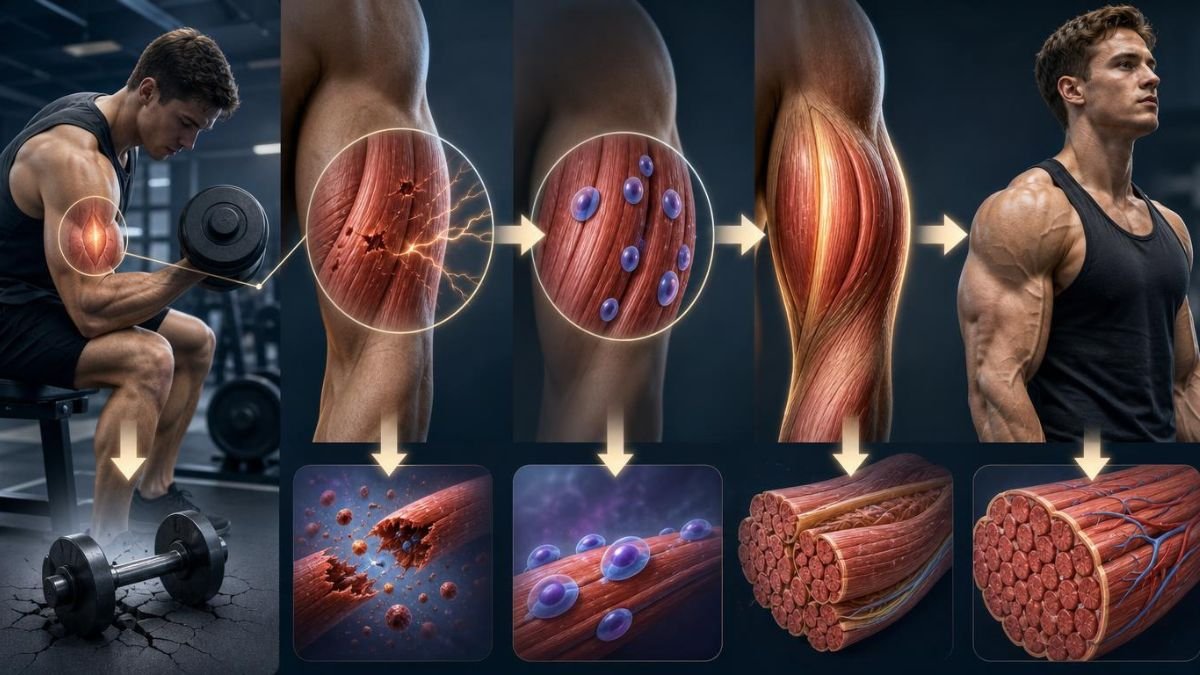
Start with something most people don't know about their own body: you are being continuously demolished and rebuilt. Muscle protein is constantly being broken down and constantly being resynthesized. Estimates vary, but something on the order of one to two percent of your muscle protein turns over every day. Which means the muscle you're carrying around is not a possession. It's a balance, maintained moment to moment between two opposing processes, and whether you gain or lose depends entirely on which one is running slightly ahead.
I keep coming back to how strange that is. The Ship of Theseus problem, the ancient puzzle about whether a ship remains the same ship once every plank has been replaced, isn't a thought experiment for your body. It's just a description of Tuesday.
So growth isn't building something new on top of something static. It's tilting an existing balance. And the thing that tilts it is mechanical tension.
Not effort in the emotional sense. Not sweat, not exhaustion, not the burn. Force, transmitted through the muscle fiber, held for long enough to matter. When a fiber is loaded, structures in the cell membrane physically deform, and that deformation gets converted into a chemical signal. The technical name for that conversion is mechanotransduction, which is a big word for a genuinely remarkable idea: the cell can feel, and it responds to being pulled on by changing what it manufactures.
Downstream of that signal sits the molecule I want to tell you about, because the story is too good to leave out.
In the 1960s, researchers collected soil samples from Rapa Nui, better known as Easter Island. One sample contained a bacterium producing a compound that suppressed immune function and slowed cell growth. They named the compound rapamycin, after the island.
Years later, scientists went hunting for what rapamycin actually binds to inside cells. They found a protein and, having no better name for it, called it the target of rapamycin. Today it's known as mTOR, and it is the central switch governing whether a cell builds.
Which means the master regulator of growth in your body is named after the drug that turns it off. It's a bit like naming a car after its brakes. Science does this more often than you'd hope.
When mechanical tension is high enough, mTOR activity increases, muscle protein synthesis rises, and it stays elevated for something like a day or two afterward. Which brings us to the title of this episode. The workout is the signal. The construction happens later, over the following forty-eight hours, mostly while you are asleep or eating or doing nothing at all.
You do not grow at the gym. You grow on the couch. This is the only fact in fitness science that has ever brought me personal joy.
Build it with me: Latin plurals and the language of process
Second build, and let's start with a category of error that marks writing as non-expert instantly.
Flat draft:
"The muscle responds to the stimulus, and the nucleuses multiply."
Two Latin borrowings, one of them mishandled. English took a great deal of scientific vocabulary from Latin and Greek and kept the original plurals in the technical registers. Here's the working set:
Stimulus becomes stimuli.
Nucleus becomes nuclei.
Criterion becomes criteria.
Phenomenon becomes phenomena.
Analysis becomes analyses, and note the pronunciation shifts.
Hypothesis becomes hypotheses.
And the trap inside the trap: criteria, phenomena, and data are already plural. So it's these data, not this data, in strict scientific writing, and one criterion, not one criteria. I'll be honest that this data has become so common that fighting it is close to a lost cause, and I'd let it go in speech. But in writing, in a scientific register, the singular still marks you.
Now the process language. Flat draft:
"Tension causes a signal, which causes protein synthesis, which causes growth."
Correct, and mechanically flat. Causes three times is doing all the work and none of the shading. Options, and they're not equivalent:
Triggers: implies a threshold. Below it, nothing; above it, a response. Perfect for this, because that's exactly how recruitment works.
Initiates: formal, starts a process.
Sets off: informal, slightly dramatic, faintly suggests a chain reaction.
Upregulates: technical, means increases the activity of. Excellent when accurate, insufferable when not.
Drives: continuous force rather than a single trigger.
Sets in motion: good for long consequences.
And the connectors that give a chain of causes its shape:
Which in turn: which in turn raises protein synthesis. The workhorse.
And that, in turn,: the spoken version, with the commas doing the pausing.
Downstream: borrowed from biology and now general. Everything downstream of that signal.
My build:
"Tension deforms the cell. The cell reads the deformation as an instruction, and that instruction, sustained over the following two days, is what actually lays down new tissue."
Pause here and build your own three-step causal chain about anything you understand well. Cooking, weather, an engine, an argument you had. Use triggers once, which in turn once, and don't use causes at all. Say it out loud.
Error repair, three that come up constantly in explanatory writing:
Affect is almost always the verb.
Effect is almost always the noun.
Training affects hormone levels. The effect is temporary.
And then English adds a joke: effect can also be a verb meaning to bring about, as in effect change, which is rare and formal and exists mainly to ruin the rule you just learned.
Lie and lay.
Lay is transitive and takes an object: you lay down new tissue.
Lie is intransitive: you lie down on the couch, and yes, that's the more relevant one for this episode.
The past tense of lie is lay, which is where everyone falls apart, and I still check it.
Effort, not weight
Now a finding that reorganized the field, and it starts in 1957 with a physiologist named Elwood Henneman.
Muscles are controlled in units. A single motor neuron plus all the fibers it commands is a motor unit, and Henneman showed that these are recruited in a fixed order: smallest first, largest last. This is the size principle, and it has never seriously been overturned.
Here's what it means practically. When you lift something light, you use only the small, fatigue-resistant units. The big, high-threshold units, the ones with the most growth potential, stay out of it. But as the small units tire, larger ones get called in to maintain the force. Keep going toward the limit of what you can do, and eventually you're recruiting everything you have.
Which produces a counterintuitive result. In a study out of McMaster University in 2016, researchers compared heavy loads with light loads, both taken to the point of failure, and found broadly comparable muscle growth.
Sit up for that one, because it rewrites the popular model. The heavy weight isn't magic. What the heavy weight does is get you to full recruitment quickly. A light weight can get you to the same place. It just makes you earn it through many more repetitions and considerably more discomfort, which is why nobody enjoys it and why heavy weights remain popular.
The variable that matters is how close you get to your limit, not how much is on the bar.
Build it with me: comparison and equivalence
Third build, and comparison is where confident speakers make small errors that natives hear immediately.
Flat draft:
"Light weights build the same muscle than heavy weights."
The error is than. Same takes as. Always.
"Light weights build the same amount of muscle as heavy weights." ✓
The full set:
The same as. Never same than, never same with.
Different from. Different than is common in American speech and disliked in formal writing. Different to is British. From is the safe choice everywhere.
Similar to. Comparable to or comparable with, both acceptable.
Now, degree. This claim needs calibration, because "the same" is stronger than the evidence supports:
Identical to — no meaningful difference. Very strong.
On par with: idiomatic, means equivalent in quality or level.
Broadly comparable: my choice here. Concedes that the numbers aren't identical while saying the practical difference is small.
Roughly equivalent: same job, slightly plainer.
Not far behind: concedes a real gap and calls it small.
And the double comparative, which is one of the most satisfying structures in English and underused by learners:
The closer you get to failure, the more the load stops mattering.
The pattern is the + comparative, comma, the + comparative. The harder you push, the less the weight matters. Build one now about something in your own life. It's a structure that makes you sound fluent because the rhythm is so distinctly English.
My build for this section:
"Taken close enough to failure, a light weight is broadly comparable to a heavy one. The bar isn't doing the work. Proximity to your limit is."
I'm not fully happy with proximity to your limit. It's accurate and a bit clinical. How close you get to the edge is warmer and vaguer. I keep switching. Tell me which one you'd say.
The invisible first act
One more piece of the picture, and this one has consequences well beyond muscle.
When an untrained person starts lifting, they get dramatically stronger in the first several weeks. Numbers climb fast. And for much of that period, very little actual tissue is being added.
The early gains are largely neural. The nervous system is getting better at recruiting motor units, at coordinating them, at reducing the protective inhibition that normally keeps you from producing maximum force. You're not building a bigger engine yet. You're learning to use the one you have.
Which means there's a period, and it's not short, where all the visible measures improve while the thing you actually wanted has barely started. Structural change lags behind functional change, and it lags by a lot.
I don't think I need to spell out the parallel for anyone learning a language, but I'll gesture at it. The period where you feel yourself getting more fluent while your actual vocabulary and grammar have barely moved is real, and it isn't fake progress. It's the nervous system reorganizing what it already has. The structural work comes later and more slowly, and if you quit during the gap between the two, you quit right before the part you were training for.
Build it with me: the grammar of sustained effort
This build is the one I most want you to take away, because it's the exact grammar of the thing we've been describing, and it's the single most persistent error at C1.
Flat draft:
"I am training since two years."
Two errors, and they're both structural.
English has a specific tense for an activity that started in the past and is still going: the present perfect, or the present perfect continuous. Not the present simple. Not the present continuous.
"I have been training for two years." ✓
And now the second error. For takes a duration. Since takes a starting point.
For two years. For six months. For a long time. Since 2024. Since January. Since I moved here.
So: I have been training since 2024 and I have been training for two years can describe the same fact, and swapping the prepositions breaks both.
Now the finer distinction, which is genuinely C2 territory. Compare:
"I have trained for two years." (Present perfect. Emphasis on the completed quantity, the accumulated fact.) "I have been training for two years." (Present perfect continuous. Emphasis on the ongoing activity, the process still running.) "I trained for two years." (Past simple. It's over. I don't train anymore.)
That third one is the important one. Past simple closes the door. If you say I studied English for five years, a native speaker will assume you stopped. If you're still going, you need the perfect.
Say all three aloud. The difference between the first two is subtle and the difference between the second and third is enormous, and learners routinely get the enormous one wrong.
My build:
"I've been training for eight months and I've gotten noticeably stronger, but I'm not sure I've actually built much yet. Apparently that's the normal order of events, which I found more reassuring than I expected."
Pause and write your own sentence using the present perfect continuous about something you've been working at for a while. Then check: did you use for with a duration and since with a start point? Did you accidentally use past simple and close a door you meant to leave open?
Does muscle remember?
Last piece of the science, and it's the one where I have to be careful, because it's genuinely unsettled.
Muscle fibers are unusual cells. They're enormous, sometimes running the length of the whole muscle, and they contain many nuclei rather than one. Each nucleus supervises a territory of the fiber, an arrangement called the myonuclear domain.
Sitting on the outside of each fiber, tucked under the surrounding membrane, are stem cells called satellite cells. Alexander Mauro identified them in 1961 with an electron microscope and named them for exactly where they sit, in orbit around the fiber. When training demands more from a fiber than its existing nuclei can supervise, satellite cells fuse with it and donate their nuclei, and the fiber's manufacturing capacity goes up.
Here's the contested part. There's evidence, strong in rodents, that nuclei acquired during training are retained even after the muscle shrinks from disuse. If that holds, it would mean detrained muscle keeps its expanded infrastructure and can rebuild much faster than it built the first time. Popularly, "muscle memory."
The human evidence is more complicated. Some studies support retention, others don't, and there's a separate and interesting line of work on epigenetic changes, chemical marks on DNA that alter which genes are readily expressed, persisting after training stops.
Where I land, and I want to be transparent that this is a judgment rather than a settled fact: the phenomenon is well documented, in that retraining really is faster than initial training. The mechanism is not settled, and I lose confidence at exactly the point where rodent findings get carried across to humans, which is a place where a lot of confident science has come apart before.
Build it with me: reporting verbs, graded by strength
This calls for a specific skill: attributing a finding at exactly the strength the evidence supports.
Flat draft:
"Studies prove that muscle memory is real."
Prove is almost always the wrong verb for empirical research. Science accumulates support; it rarely proves. And an informed reader will discount everything after that word.
Here's the ladder, weakest to strongest:
Hints at: very tentative, almost gestural.
Points to: tentative but directional.
Suggests: the standard cautious verb. Most findings deserve this one.
Indicates: slightly firmer.
Shows: firm. Reserve for clear, direct results.
Demonstrates: firm and specific, implies a well-designed test.
Establishes: very strong. Use when a finding is settled.
Proves: essentially never, outside mathematics.
And the prepositions after evidence, which are three different things:
Evidence for a hypothesis. Evidence for retention. Evidence of a phenomenon. Evidence of new nuclei. Evidence that plus a full clause. Evidence that nuclei are retained.
My build:
"The rodent work fairly clearly demonstrates nuclear retention. The human evidence suggests something similar, without establishing it, and the gap between those two verbs is where I'd put my remaining uncertainty."
That sentence uses three rungs of the ladder deliberately, and the precision is the point.
Why any of this matters now
Let me bring it to the present, because there's a version of this topic that's about appearance and a version that's about something considerably more serious.
Skeletal muscle is not just for lifting. It's the largest site of glucose disposal in your body, which makes it central to metabolic health. It secretes signaling molecules that affect other organs. And it's the main determinant of whether an older person can get out of a chair, climb stairs, and live independently.
Muscle loss with age has a name, sarcopenia, and the rate is on the order of three to eight percent per decade after thirty, accelerating later. That's a slow, quiet, entirely unremarkable process that eventually decides the shape of the last twenty years of a life. Resistance training is currently the single most effective intervention against it, at every age tested, including in people well into their nineties.
Two current threads make this unusually live. Extended bed rest and spaceflight produce startlingly rapid muscle loss, which is why exercise is non-negotiable on the space station. And the new generation of weight-loss medications has raised real clinical questions about lean mass loss alongside fat loss, which has pushed muscle preservation from a fitness concern into a mainstream medical one.
So this isn't a vanity subject. It's a slow-moving question about capability, and the mechanism we've just walked through is what you'd use to answer it.
Build it with me: analogy, and the like-versus-as rule
Last build, and I want to use the analogy I've been circling.
Flat draft:
"Language works like a muscle works."
There's the error. Like is a preposition and takes a noun. As is a conjunction and takes a clause with its own verb.
"Language works like a muscle." ✓ (noun after like) "Language works as a muscle does." ✓ (clause after as) "Language works like a muscle works." ✗
Like + noun. As + subject and verb. In casual American speech the rule erodes constantly, and in writing it still holds.
And as if and as though take a clause, often with a subjunctive: He trains as though he were being paid for it. That were rather than was is a small, old-fashioned marker that quietly signals careful English.
Now for analogy language generally:
Much as: Much as a muscle adapts to load, vocabulary adapts to demand. Elegant, slightly literary.
In the same way that: plain, clear, safe.
The same logic applies to: good for extending an argument.
The parallel holds up to a point: and this is the one I most want to give you, because it's the honest hedge. Every analogy fails somewhere, and naming that failure is what separates a thinking writer from a person with a nice metaphor.
My build:
"Much as a muscle adapts to a load it can barely handle, a learner adapts to material just past comfortable. The parallel holds up to a point. Muscle recovers on a schedule you can predict. Learning doesn't, and anyone selling you a fixed timetable for fluency is selling you something."
Your Build
Three prompts, and a harder optional fourth.
One. Write two sentences about something you've been working at for a long time. The first in present perfect continuous, using for with a duration. The second in past simple about something you genuinely have stopped. Then read them back and check that you haven't closed a door you meant to leave open.
Two. Explain any three-step process you understand well, in one sentence, using triggers and which in turn, and without using causes. Then check your Latin plurals if any snuck in.
Three. Take a finding you believe and state it three times using three different rungs of the reporting ladder: once with suggests, once with demonstrates, once with establishes. Then decide which one is actually honest. That third step is the whole exercise.
And the hard one. Name a belief you've held for years that turned out to be wrong, and describe the moment you found out. Use the present perfect for the holding and the past simple for the discovery, because that contrast is exactly what the two tenses are for. Mine was the lactic acid thing, and what I remember most clearly is not the correction itself but the small unpleasant thought that followed it: if I was that confident about that, what else am I carrying around?
Where this leaves us
There's a version of this episode that's just useful information about training, and I hope it was that. But the thing I keep returning to is stranger.
You are not a structure. You're a process that maintains the appearance of a structure. Every day some fraction of you is dismantled and rebuilt, and what you call your body is the running balance between demolition and construction. Load it and the balance tips one way. Neglect it and it tips the other. Nothing stays still, including when nothing appears to be happening.
And the timing is the part worth carrying. The work is the signal, not the growth. The growth happens later, quietly, mostly while you're not paying attention, and there's a long stretch at the beginning where everything is improving except the thing you were trying to change.
Which is, I'd argue, the least glamorous and most useful thing this topic has to teach anyone doing anything difficult. The gap between effort and visible result is not evidence of failure. It's the shape of how adaptation works.
Go do something slightly harder than usual this week. Then, crucially, go rest, and let it finish.








0 Comments