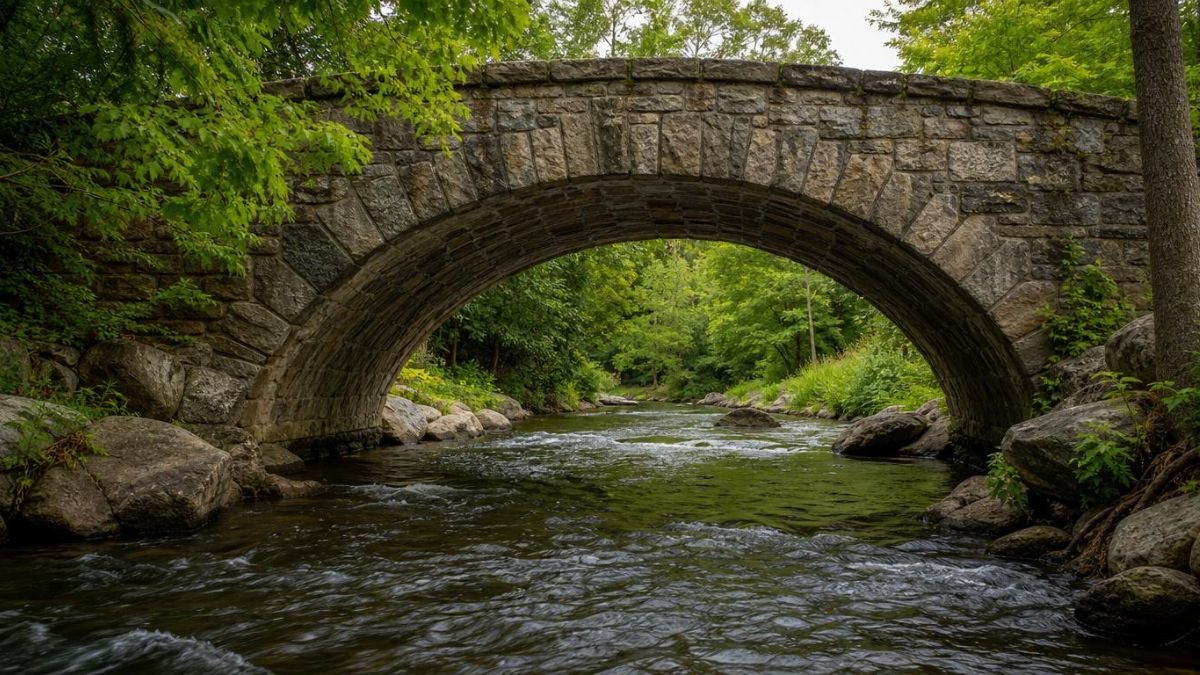
When you tell someone it’s all water under the bridge, which one are you actually pointing at — the water, or the bridge?
Because there are two things in that sentence, and I’ve noticed we only ever hear one of them.
Start with the water, since that’s the part everybody means. The image is a river moving beneath a bridge, and the point is motion. That water has gone. It’s downstream now, past the bend, mixing into something larger, and it is never, under any circumstance, coming back. You could stand on that bridge for the rest of your life and you would never see it again. The old Greek line about this is famous for a reason: you can’t step into the same river twice, because it isn’t the same river and you aren’t the same person. Rivers are things that only look like objects. Really they’re events. A river is water in the act of leaving.
So when someone says it’s water under the bridge, they’re making a claim about time. That happened. It moved. It isn’t here anymore.
And notice the small word doing enormous work in the middle of that sentence: under. The water goes under the bridge. Not over it. Because water that goes over a bridge is not forgiveness — that’s a flood, and after a flood there is no bridge left to stand on and no conversation to have. We all know relationships where that happened, where the thing that came through was simply bigger than the structure. So this phrase, casual as it sounds, is quietly reporting a piece of very good news: it passed beneath us. It was survivable. It went under.
And notice, please, that this is almost always said as a gift. It’s one of the most generous sentences in ordinary speech. You apologize, awkwardly, for something you did two years ago, and the other person waves a hand and says — water under the bridge. What they’ve done in that moment is release you. They’ve decided not to charge you for it. They’ve dressed an act of grace up as a casual observation about hydrology, which is a very human way of doing something enormous without making a scene about it.
But now look at the other half of the picture, the half nobody mentions. There’s a bridge.
The bridge is still there.
Think about what that means. A bridge is a structure that survived the water. It’s the thing that let people cross when crossing was impossible. It has been standing over that river through every flood and every dry season, and the whole reason you’re able to look down at the water at all is that you’re standing on something that held.
So the phrase isn’t only about what’s gone. It’s also, quietly, about what remained. The friendship that took the hit and is still here. The marriage that came through the year nobody talks about. The version of you that walked through that and is standing, right now, upright, looking down at it.
That reframes the whole thing for me. Because the sentence stops being forget it and starts being look what we built that outlasted it.
And here’s a test I’ve found useful. Real water under the bridge has two requirements, and most of us only ever satisfy one.
The first is that the water actually has to have moved. And there’s a counterfeit version of this phrase that skips that entirely — the too-fast forgiveness, the it’s fine, it’s fine, let’s not get into it, said three days after the wound while the water is still standing there in a pool, not going anywhere. That isn’t grace. That’s avoidance wearing grace’s coat. It’s using a beautiful sentence as a lid. And the trouble with lids is that the thing underneath keeps its temperature. Six months later it comes back up, hot, in an argument about something else entirely, and everyone is confused about why the dishwasher has produced this much feeling.
The second requirement is harder, and it’s about where you’re standing.
Because there is a particular kind of suffering where a person spends years leaning on the rail of that bridge, staring down at the current, replaying it. And they’ll tell you the water hasn’t moved. But it has. It moved a long time ago. What they’re watching is not the river anymore — it’s a memory of a river, re-supplied every morning from the inside. That’s the strange trick of rumination: it can pump the same water past you forever, and make you feel like the thing is still happening, when in truth the only thing keeping it in front of you is that you haven’t looked up.
And the tragedy of that is what it costs. Because while you’re facing down, the bridge you’re standing on is going somewhere. It has another side. It was built to get you across, and instead it has become the place you live.
That’s what a bridge is, in the end. It isn’t a viewing platform. It’s a passage. It exists because someone decided the far bank should be reachable. To stand on it and look down for years is to take a thing built for crossing and use it as a place to stop.
So maybe the fullest version of this phrase — the one we half-say without meaning it — sounds something like: yes, that happened, and it has genuinely moved on, and I am not going to spend my one life leaning over the rail. Something held. I’m going to walk the rest of the way across.
So here’s what I’ll leave you with tonight, and it’s two questions, because this phrase has two halves and you deserve both.
First: what have you been calling water under the bridge that hasn’t actually flowed yet — the thing you waved off too quickly, that’s still sitting there, still warm?
And second: what have you been standing over for years, watching, convinced it’s still moving past you? Because if you looked up — if you finally turned around and noticed the structure under your feet, the one that took all of it and is still holding — what would you see on the far bank that you’ve been refusing to walk toward?



0 Comments