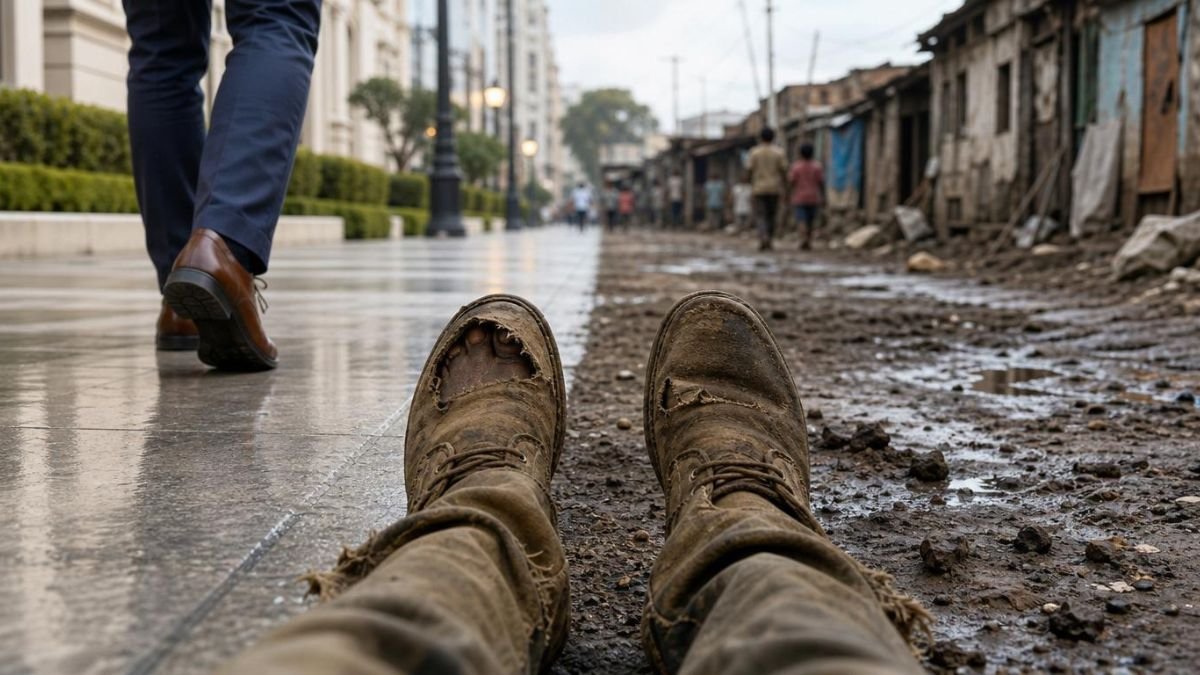
Why does this phrase ask for your feet, when understanding seems like something that should happen behind your eyes?
That’s the question I keep circling. Because if we’d invented this expression from scratch, in a room, with no history, I think we’d have reached for sight. See it from their point of view. See through their eyes. That’s how we usually talk about understanding — as a matter of perspective, of angle, of where you’re looking from.
But the phrase we actually kept says nothing about eyes. It says: put on their shoes, and walk.
And I think that choice is enormously wise, in three separate ways.
The first is that shoes hold a record.
A pair of shoes is one of the most personal objects a human being owns, because it’s shaped by use. Walk in a shoe for a year and it stops being a manufactured thing and becomes a document. The heel wears on one side because of how you stand. There’s a crease where your foot bends. A stretched place where the shoe surrendered to a bone. If you limp, the shoe knows. If you work standing up all day, the shoe knows. If you’ve been walking a long way on hard ground, the shoe is the only honest witness.
So the phrase isn’t asking you to imagine someone’s opinions. It’s asking you to put on the physical record of everywhere they’ve had to go. Their history, in the shape it left.
The second wisdom is that shoes are the one item of clothing that can hurt you.
You can wear someone else’s coat and feel nothing but warmth. But another person’s shoes are, almost always, wrong. Too narrow across the top. Worn down in the places your foot doesn’t wear. Pressing where nothing has ever pressed you. And within about ten minutes of walking, they hurt.
That’s not a bug in the metaphor. That’s the entire point of it. The phrase includes the blister on purpose.
Because there’s a comfortable, weightless version of empathy that we practice constantly — the kind where you sit still and feel sympathetic. It costs nothing. You have a warm feeling about someone’s difficult situation and then you get on with your afternoon. This phrase refuses that. It demands that the understanding be uncomfortable, because the life you’re trying to understand was uncomfortable, and any version that doesn’t hurt a little hasn’t touched the actual thing.
The third wisdom is in the distance. A mile.
Not a lifetime. Not forever. A mile — from the Latin mille passus, a thousand paces. It’s a real, countable, finite number of steps. Long enough that the shoes start to hurt. Short enough that it is entirely, obviously possible.
And there’s a humility in that number that I love. The phrase does not claim you can become the other person. It doesn’t promise full understanding, or say that after a mile you’ll know what it’s like to be them. It offers you a thousand paces. That’s all. It’s an approximation, honestly labeled as one.
Which is worth remembering, because there is a kind of person who has walked a mile and then announces they understand completely — and there’s something in that claim that quietly erases the other person all over again. Real walking teaches you the opposite. A mile in someone else’s shoes usually leaves you with a much sharper sense of how much further their road goes, and how little of it you’ve covered.
But now we come to the step everybody skips. And it’s not in the phrase, exactly — it’s underneath it, structurally necessary, and I think it’s the reason so few people ever manage this.
To put on their shoes, you have to take off your own.
There’s no other way. You cannot wear two pairs at once. Before a single step of that mile, there is a moment where you are standing barefoot on the ground — out of your own shoes, out of your own record, out of the accumulated shape of your own life — with nothing between you and the road.
That’s the cost. And it’s a real one, because your shoes are not just footwear. They’re your defenses. Your reasons. Your story about why you did what you did and why you deserve what you have and why you’d never have made the choices they made. Taking them off, even for a mile, means being briefly unprotected by your own narrative.
And that’s why most people won’t do it. Not because they lack imagination — most people have plenty. It’s because they intuit, correctly, that if they genuinely walked that mile they might have to revise something about themselves. They might discover that in those conditions, with that history, in those particular shoes, they’d have done exactly the same thing. And it is much safer to stand comfortably in your own footwear on the sidewalk, offering advice about how you’d have handled it.
So the phrase turns out to be much more demanding than the greeting-card version. It’s not be nice. It’s: remove your own protection, put on the record of someone else’s hard road, accept that it will hurt, walk a real distance, and be willing to come back changed.
And here’s what I’ve noticed about people who actually do it. They get quieter. They give less advice. They’re slower to explain other people’s lives to them. That’s the mark of it — not more talk about compassion, but less certainty about strangers.
So here’s what I’ll leave you with. There’s someone in your life, or in the news, or in your family, whose choices you’ve already fully explained to yourself. You know why they are the way they are. You worked it out a while ago, and the explanation has been sitting comfortably unchallenged ever since.
Now ask: whose shoes are those, exactly? And is the reason you’ve never tried them on that you can’t imagine their road — or that you know, somewhere in you, what you’d have to take off first?




0 Comments