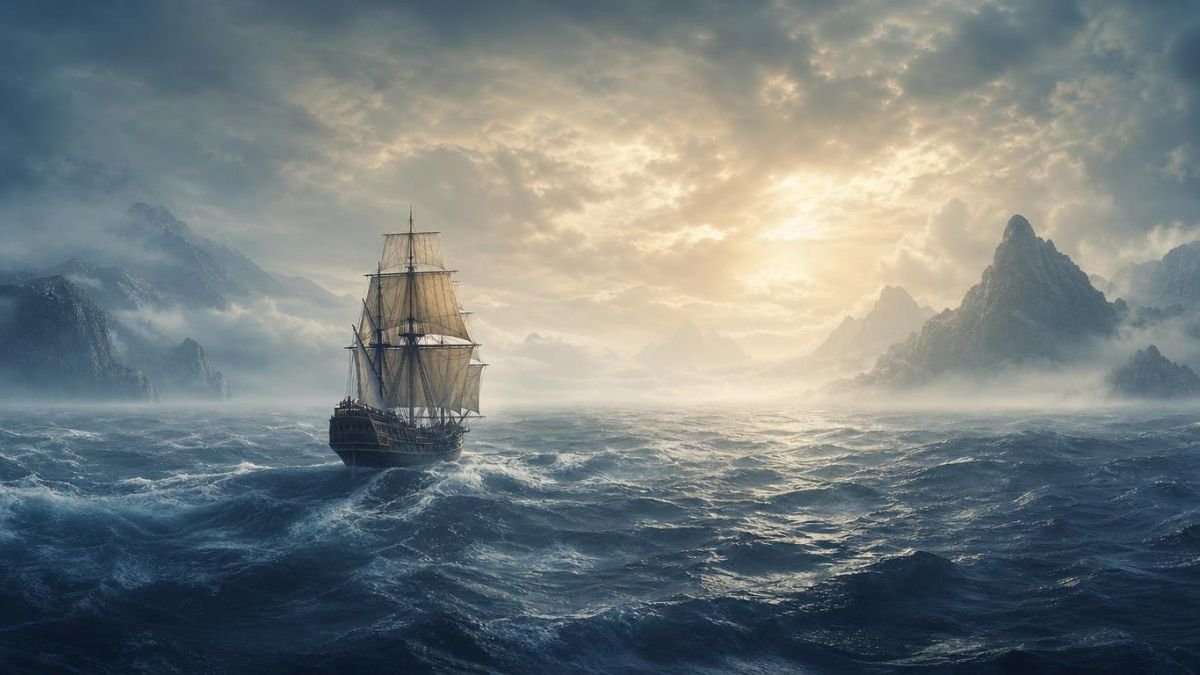
Is the water more dangerous because nobody has drawn it?
That's the assumption buried in this phrase, and I want to pull it out and look at it, because I think it quietly runs a great deal of our lives.
Uncharted waters. We say it about a new job, a diagnosis, a country's politics, a stage of a relationship nobody prepared us for. And the phrase always arrives with a shiver in it. It sounds like peril.
But a chart is a piece of paper. It's a record of where other people have been and what they found. And the sea itself has absolutely no idea whether it's been charted. The rocks are exactly where they were. The depth doesn't change when a surveyor arrives. Nothing about the water is altered by the existence of the map.
So uncharted waters are not more dangerous. They are equally dangerous, and you are less informed. That's the entire difference, and it's a difference located in you, not in the sea.
Which sounds like a technicality, and isn't, because it changes what the problem actually is. The problem is not out there in the waves. The problem is the gap between the world and your picture of it, and gaps like that can be closed by attention, patience, and going slowly — none of which help against actual rocks, but all of which help enormously against not knowing where they are.
Now, let's stay with the charts themselves, because their history is wonderful.
Sailors' charts were built from accumulated reports — soundings taken with a weighted line, coastlines sketched by people who came back. And the edges of the known were marked in various ways: blank space, decorative sea creatures, occasionally a warning. The famous phrase about dragons appears far more often in our imagination than on actual maps, but the impulse it represents is entirely real. When cartographers reached the limit of what anyone had reported, they filled the space with something, because a blank made people uneasy.
And that's the most human detail in the whole history of mapmaking. We would rather draw a monster than leave a gap. An imagined danger is more tolerable than an unknown, because at least it has a shape.
And you do this. Constantly. When a part of your future is genuinely uncharted — the outcome of a test, a conversation you haven't had, what happens after this year — you do not leave the space empty. You populate it. You draw the sea serpents in, in vivid detail, at two in the morning. And then you navigate as though the monsters were survey data.
That's the real cost of uncharted water. Not what's in it. What we put in it.
But now I want to give the phrase its due, because there is something genuinely different about unmapped territory, and it isn't the danger.
It's the loneliness.
When you're in charted water, you are in company. Everything you're experiencing has been experienced, recorded, and described by others. Someone has written the guidebook. There's a forum, a manual, a friend who's done it. And that company is worth more than we realize — half the comfort of a chart isn't the information, it's the proof that someone else was here and made it back to draw the line.
In genuinely uncharted water, that's gone. And most of the hardest parts of a life are exactly like this: not statistically rare, but unmapped for you, in your specific configuration. Everyone's grief is uncharted, even though grief is universal, because no one has ever lost this exact person from this exact life. Everyone's illness, everyone's marriage, everyone's decision to leave.
That's why generic advice lands so badly in those seasons. People hand you a chart of a different ocean and are surprised it doesn't fit.
And here's what I think the phrase is really for, then. Not warning — permission. To say I'm in uncharted waters is to say: nobody has done exactly this, so I am allowed to be slow, to be uncertain, to take soundings, to be wrong and correct course. It's a release from the expectation of competence. In charted water, being lost is a failure. In uncharted water, being lost is just the accurate description of where you are.
And there's a dignity available there that doesn't exist anywhere else. Because every chart in the world was made by someone who sailed without one. Every route you've ever taken safely exists because a person went into a blank space, took soundings, and came back to draw it. All knowledge was uncharted once. It's not a lesser condition — it's the earliest stage of the only process that has ever produced a map.
Which means, if you're out there now, you are doing the original work. And you are, whether you intend it or not, drawing something. The friend who goes through the rare illness becomes the one who can guide the next person. The one who navigates the strange family situation becomes the person someone calls in four years. Nobody sets out to be a cartographer. You just come back, and now you know where the rocks are, and someone asks.
So here's what I'll leave you with. The unknown part of your life is exactly as dangerous as it was going to be — no more — and everything extra you feel about it is something you drew there yourself. So think about the blank space you're most afraid of. And ask yourself honestly: what have you filled it with, in the dark, that nobody has ever actually reported seeing?




0 Comments