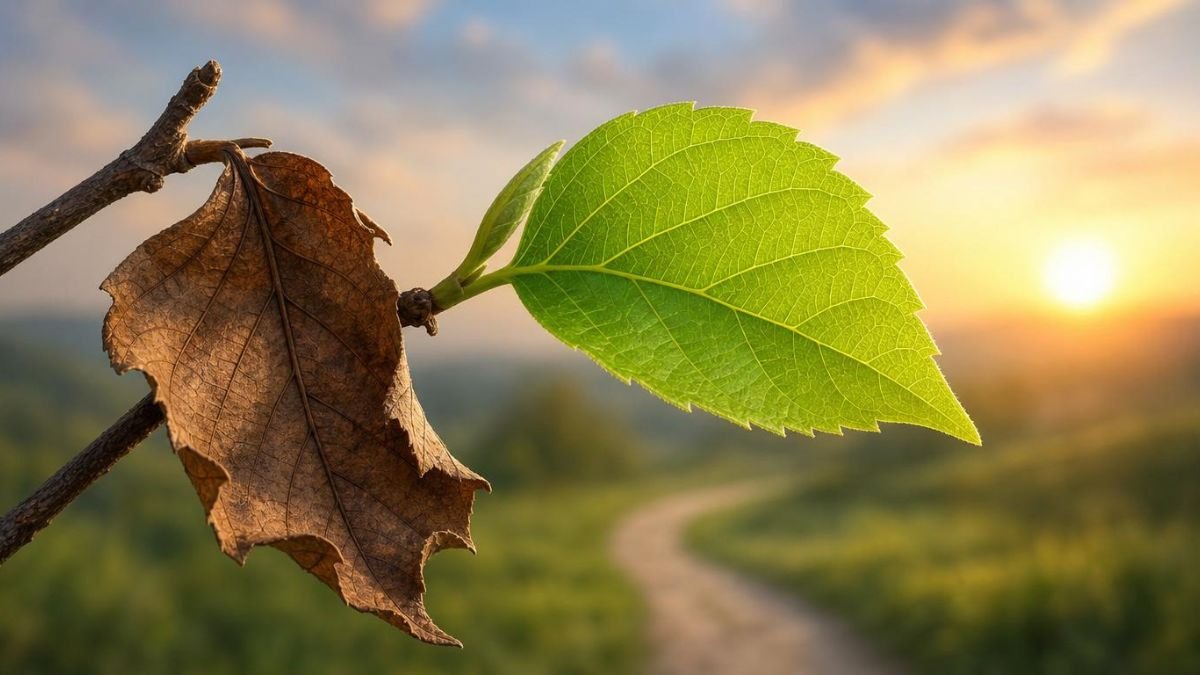
When you picture turning over a new leaf, what exactly are you seeing?
Be honest, because almost everyone sees the same thing. Something green, or something gold and dry on a path. A leaf from a tree, flipped over. Maybe a whole season changing. It’s a lovely image, and it has nothing at all to do with this phrase.
The leaf here is a page.
That’s the whole secret, and it’s been hiding in plain sight the entire time. A leaf, in the old sense, is a sheet of a book — a folio, a page with two sides. It’s why we still say leaflet for a small printed sheet, and loose-leaf for paper that isn’t bound in. When someone turns over a leaf, they are turning a page.
So the phrase isn’t about foliage or autumn or nature at all. It’s about a person sitting with a book, reaching out, and turning the page to a fresh one — and then writing something better on it than what came before.
And once you see it that way, this modest little expression becomes one of the most honest descriptions of change we have. Because it’s saying three things that a tree could never say.
The first is this: you are still in the same book.
That’s the part I want you to sit with, because we have other phrases for starting over and almost all of them lie to us. A clean slate — but a slate is wiped, and wiping means the old writing is destroyed, gone, unrecoverable. A fresh start. A blank page, as if it arrived from nowhere. These phrases promise erasure.
A book promises nothing of the kind. When you turn a leaf, every page you’ve already written is still bound in behind your thumb. Still legible. Still in order. Still yours. Nobody removed a single one. You can flip back at three in the morning and read any of them, and you will, because that’s what people do.
And I think that’s not a flaw in the metaphor. I think that’s the mercy in it.
Because the promise of erasure is a cruel promise. It sets you up to fail, since nothing is ever actually erased — not the thing you said, not the years you spent, not the version of yourself you’d rather not have been. And when the old writing inevitably shows through, the person who was promised a clean slate concludes that the change didn’t work. That they’re the same. That there’s no point.
The book model doesn’t set that trap. It says: keep all of it. The earlier chapters aren’t a mistake to be scrubbed; they’re where this story came from. They explain the character. And nothing in a book gets undone by what comes next — but everything in it gets recontextualized. A hard chapter reads completely differently once you know what it was leading to. Same words. Entirely new meaning. That’s not erasure. That’s something better, and it’s only available to people who keep turning.
The second thing the phrase says is that you have to turn it yourself.
A page does not turn on its own. There’s no wind in this metaphor. It’s a deliberate, tiny, physical act performed by a hand, and it happens at a moment somebody chooses. Which is worth remembering every January, when the whole world agrees to pretend that the change of a date can do the turning for you. It can’t. The first of January is a page like any other. So is a Tuesday afternoon in the middle of a bad week. The date has never been the mechanism.
And the third thing — the hardest one — is that the new leaf is blank.
That’s the part we forget when we’re fantasizing about change. We imagine the new page already has the better version of us written on it. It doesn’t. It has nothing on it. That’s the entire definition of a new leaf. You have turned away from what you were reading, and now you’re looking at an expanse of white paper that is offering you no help whatsoever.
The blank page is not a reward. It’s a demand. It asks: all right then — what are you actually going to write?
And that’s why turning over a new leaf is so much harder than it sounds, and why most attempts don’t survive February. Because the turn itself takes half a second. It’s the cheapest part. What follows is the slow, unglamorous business of filling a page in a different handwriting than the one you’ve used for years — and doing it while every previous page sits under your hand insisting that this is how you write.
But here’s what gives me hope about this phrase, and it’s the fact that a book is long.
You are not on the last page. Almost certainly not. And a book with three unpleasant chapters in the middle is not a bad book — sometimes it’s the only kind that turns out to be worth reading. What makes a book bad is not the presence of a difficult chapter. It’s the absence of any further chapters, which is to say: it’s stopping.
So the question is never whether the earlier pages were good enough. It’s whether you’re still willing to turn.
And I’d add one more thought. Some people don’t need a new leaf so much as they need to stop rereading an old one. There’s a particular page in most of our books — a failure, a humiliation, something we did or something done to us — that we go back to constantly. We know it by heart. And the strange thing about rereading a page is that it stops the book. Nothing new is written while you’re back there. You’ve mistaken one page for the whole volume, and you’re giving it a weight it could never have earned on its own, since it’s one leaf out of hundreds.
So here’s what I’ll leave you with tonight. There’s a page in your book you keep going back to — you know exactly the one, you thought of it before I finished the sentence. It has been read enough times now. Nothing further is going to come out of it.
So the question is this: what would actually have to happen for you to put your hand on the corner of it and turn? And once you did — once you were looking at all that terrifying blank paper — what is the first honest sentence you’d want to write there?



0 Comments