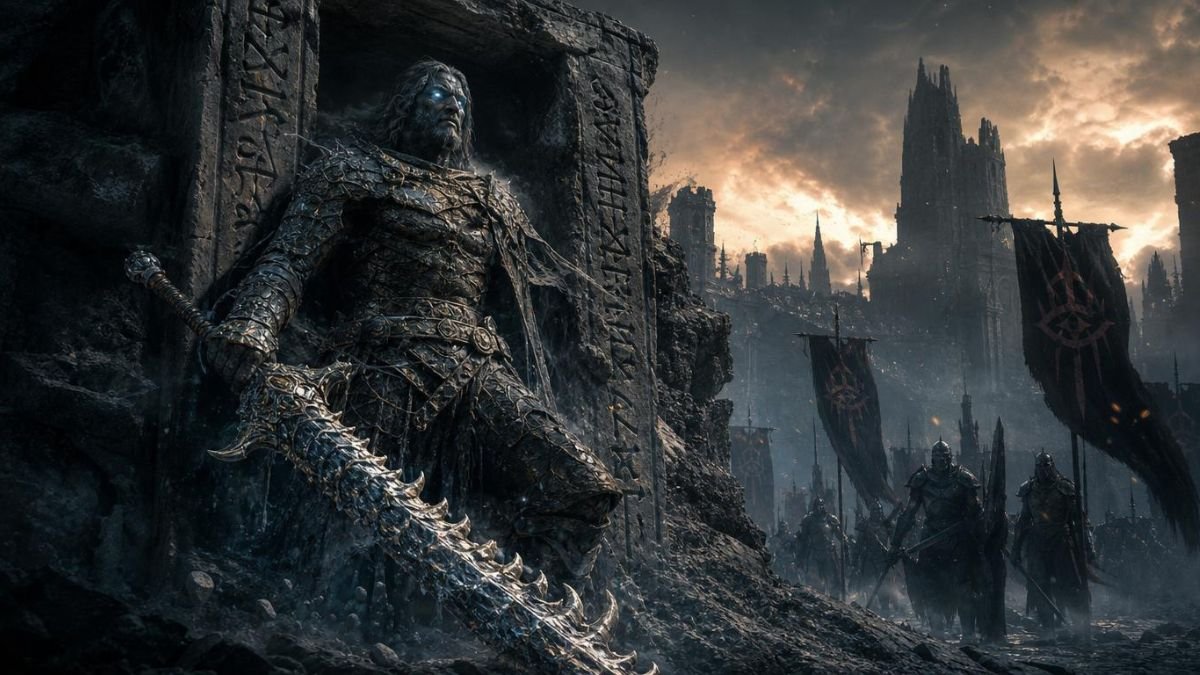
The stone did not release him gently.
It split at the sternum — a crack like a mountain confessing its age — and Cadmus fell forward onto moss-slicked cobblestones, gasping air that tasted of pine resin and cold rain. His lungs, long accustomed to nothing, convulsed. His fingers, grey and granite-heavy, clawed at the ground. Every nerve ending fired at once, translating three centuries of compression into a single, magnificent scream that he swallowed whole, because a soldier does not announce his waking to the enemy.
He did not yet know who the enemy was.
He remembered the dragon — Verakhos, silver-spined and vast as a storm system — and the sword he had drawn from its broken jaw while the beast still breathed its last. He remembered the mages who had surrounded him afterward, their faces hidden, their voices speaking in the liturgical cadence of men performing a necessary ugliness. He remembered the cold pressing in from all sides like a judgment. Then nothing. Then this.
The sword was still in his hand.
This surprised him more than his own resurrection. The blade — ivory-pale along its curved edge, every tooth of the great dragon flattened and folded and hammered into a single continuous killing surface — had not turned to ash or legend. It was real. It was warm. It hummed faintly against his palm the way it always had when something in the vicinity still breathed and therefore still deserved watching.
He stood.
The village around him was unfamiliar. The architecture was wrong — arches where he expected beams, tile roofs where thatching belonged. The language drifting from an open window nearby bore the skeleton of his own tongue but the flesh of something younger, more hurried. A child walking past with a bucket of water stopped and stared at him with the pure, uncomplicated horror that only children and honest men permit themselves.
"You are grey," the child said.
"It passes," Cadmus said, and his voice was gravel and rust and the sound of a door that has not been opened in a very long time.
He asked the child the name of the kingdom. The child told him. He asked the name of the king. The child told him that too, and the name meant nothing, which told him everything.
Cadmus walked into the village square. He had no coin, no allegiance, no living memory of anyone who might recognize his face beneath its grey patina. He had only the sword and the knowledge of how to use it, and the older, rarer knowledge of when not to.
A man in a guard's livery blocked his path. Young. Officious. Frightened beneath his posture, which Cadmus recognized as the most dangerous configuration a young man could inhabit.
"No weapons in the square," the guard said.
Cadmus looked at the sword. He looked at the guard. He considered the three hundred years of silence behind him and the unknown quantity of years ahead.
"This weapon has a name," Cadmus said. "The name is older than this kingdom. If you would like to argue ownership, I will need to speak to someone with considerably more authority than you possess."
The guard's hand moved toward his own blade and then stopped, arrested by some instinct wiser than his training — the instinct that recognized, in the grey-skinned stranger's eyes, not threat but history. Vast, impatient, immovable history.
The sword hummed.
Cadmus did not draw it. He walked past the guard, into the square, into the weak afternoon light, and felt the stone-cold leave his joints degree by slow degree. Somewhere in this kingdom — he was already certain of it — there was something that needed ending. There always was. That was why men like him were made. That was why, apparently, men like him were not permitted to stay dead.
He tilted his face toward the sun with the measured patience of a man who has learned that warmth, like justice, will eventually come if you simply do not move away from where it is supposed to fall.
The dragon's teeth caught the light and threw it back in all directions, indiscriminate, brilliant, and without apology.
The age that had imprisoned him had not forgiven him.
That was fine. He had not yet decided whether to forgive it either.
Author's Commentary
'The Rise of Cadmus' began with a single image: a sword made of something that should not survive. Dragon teeth are remnants of a creature defined by destruction, and yet here they become an instrument of something more measured — a weapon held in check by its bearer's judgment rather than his rage. The stone sleep is not punishment, exactly, but it functions like one, and Cadmus waking into a world that has moved on without him is an experience many of us understand in smaller, less dramatic registers.
We have all returned to something — a city, a relationship, a version of ourselves — and found that the world did not wait. The architecture changed. The language shifted. The names of the powerful are different. What do we do with the skills and convictions we preserved inside ourselves during our own private stone sleeps? Do they still apply? Does the world still need them, or need them in the way we imagined?
Cadmus's restraint in the square — choosing not to draw the sword — is the story's moral pivot. Power unused is still power. Patience is not passivity. The most interesting warriors, in fiction and in life, are those who know when the weapon stays sheathed.
Discussion Questions
Have you ever returned to something you valued — a project, a place, a skill — after a long absence, only to find the world had moved on? How did you navigate that gap?
Cadmus's only remaining possession is his sword. What is the equivalent in your life — the one competency or conviction that survives every personal upheaval?
The story ends in deliberate ambiguity. Do you think Cadmus is a force for good, a relic, or something more complicated? What details in the text shaped your reading?





0 Comments