The Story
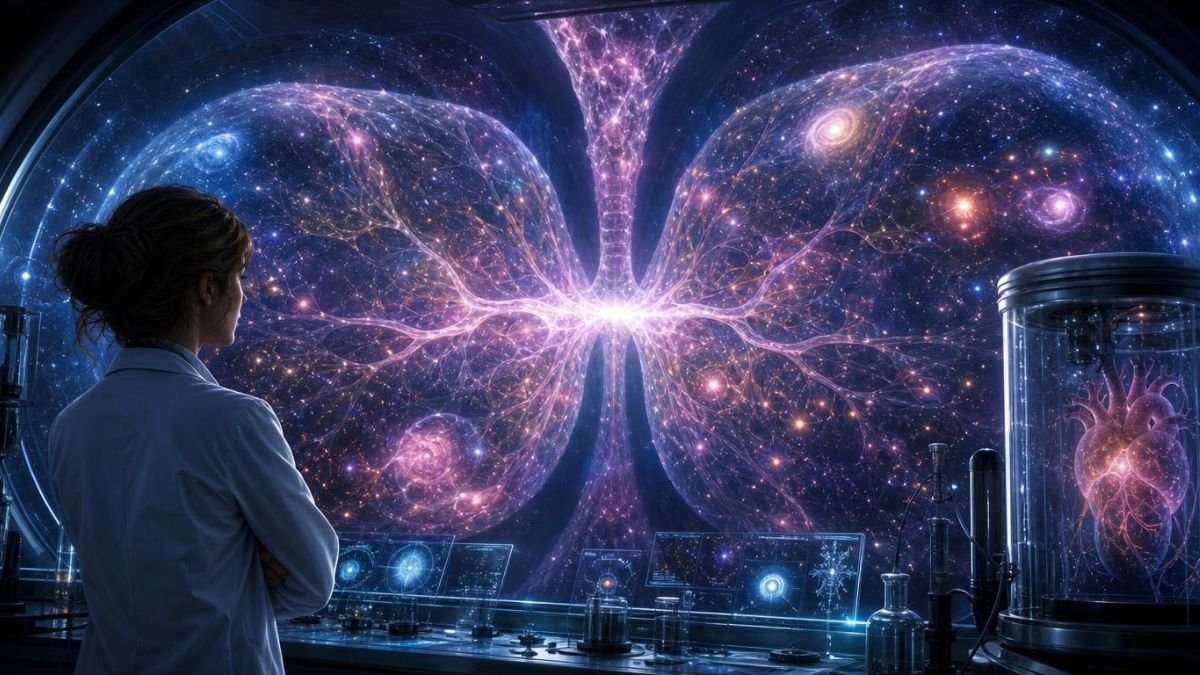
Dr. Helen Reed was forty-three years old, on her seventh consecutive night without proper sleep, and standing in front of a wall of monitors at the Atacama Deep Field Array when she discovered that the universe was breathing.
She did not, at first, use that word.
The word she used was "anomaly".
The data had been wrong for two months. Not wrong in the way that data is sometimes wrong, which is to say corrupted or misaligned, but wrong in the way that the sky is sometimes wrong, which is to say persistently, calmly, against all sense. The redshift readings from her cluster of galaxies were oscillating. They were not supposed to oscillate. They were supposed to monotonically increase, the way they had for every astronomer for ninety years, demonstrating the patient outward rush of everything from everything. Instead, hers were doing a small, almost shy, periodic thing. Out, then very slightly less out. Out, then very slightly less out.
She had run the calibration four times. She had asked the engineers to check the array. She had cross-referenced with the South African and the Korean arrays. The oscillation was real. It was small, on the order of parts per trillion. It was rhythmic. It had a period.
The period was nineteen point three four seconds.
Helen had spent her career being suspicious of beautiful numbers. Beautiful numbers were how you ended up on a magazine cover and then a footnote. She drank her cold coffee. She ran the calibration a fifth time.
The oscillation persisted.
At three in the morning, alone in the control room, she did the thing she had been refusing to do for two months. She held her breath.
She watched the screen.
When she breathed in, she counted. "One, two, three." The graph continued its small periodic dance, indifferent to her. When she breathed out, she counted again. "One, two, three, four." The graph continued.
She felt foolish.
She also did not stop.
She breathed slowly. She breathed deeply. She matched her breath, gradually, to the nineteen point three four second period on the screen. Inhale for roughly nine. Exhale for roughly ten. The numbers did not align exactly, but they aligned enough.
Nothing changed. Of course nothing changed. The universe was not, and could not be, taking a breath the size of itself. The universe was not an animal. The universe was a physics problem. She had spent twenty years becoming a person who could be trusted to say so.
She went home. She slept four hours. She came back.
She brought a graduate student named Theo Okafor-Bensimon into the room and showed him the data without telling him what to think.
He stared at it for a long time.
"That looks," he said, slowly, "like a respiration trace. From a sleep study."
"I know it does," Helen said. "Don't say it."
"I'm just saying what it looks like."
"I know what it looks like. Please. Don't say it."
They worked for six more weeks. They eliminated instrumental error. They eliminated atmospheric distortion. They eliminated solar effects, gravitational lensing, dark matter interference, computational artifact, and, in one particularly bleak afternoon, the possibility that the universe was politely mocking them. The oscillation remained.
They began, very quietly, to model it.
The model that fit best was not, technically, a physics model. It was a physiology model. The expansion rate of the universe, when plotted at fine enough resolution, behaved almost exactly like the lung volume of a very, very large, very, very slow-breathing organism. The Big Bang, in this model, was not an explosion. It was an inhalation. We were inside something that was, even now, drawing breath.
The period was nineteen point three four seconds at the local scale. Scaled to the actual size of the universe, accounting for relativistic time dilation across cosmological distances, the breath length was approximately fourteen point three billion years.
We had been alive, the entire history of life on Earth, during a single exhale.
Helen sat in the empty control room one night, after Theo had gone home, and tried to feel something appropriate. She had expected awe. What she got was something quieter and more uncomfortable. She felt small. Not in the romantic way that astronomy is supposed to make you feel small, which is really a kind of vanity dressed up as humility. She felt small the way a microbe feels small inside a lung it has never been told it is inside of.
She thought, "If it is breathing, it is alive. If it is alive, it can stop."
She thought, "Inhale is coming."
She did not publish for almost a year. When she finally did, the paper was titled, with characteristic dryness, "Observed Periodic Modulation in Cosmological Expansion Rates: An Anomaly." The word "breathing" appeared exactly once, in a footnote, in a sentence that began, "One may be tempted, irresponsibly, to characterize this pattern as—"
The footnote was the most-quoted sentence in the history of cosmology within forty-eight hours.
Helen Reed, when asked, on a stage in Stockholm, what she had felt at the moment of the discovery, said only, very softly, that she had felt watched.
She did not elaborate.
Somewhere, very slowly, something continued its long, patient exhale.
We were still inside it. For now.
Author's Commentary
I have always been fascinated by the moment in science when a number that should be ordinary refuses to behave. Most of physics is built on the assumption that the universe is, fundamentally, a mechanism. Bigger or smaller, hotter or colder, more or less curved, but a mechanism. The romance of that assumption is enormous. It has given us almost everything we know.
But there is another, older intuition, one that civilizations had long before they had instruments, which is that the world we live inside is in some sense alive. Cultures across the planet have imagined the cosmos as a body, a breath, a dreamer, a sleeping god. We have, for the last few centuries, regarded these intuitions as charming and unscientific. I wanted to write a story that took them seriously for a moment, not as theology but as a thought experiment. What if the patient, unbroken outward rush we have measured for ninety years is not the whole picture? What if we have only been looking at the exhale?
The story is also about Helen, and about what scientists do when their data tells them something they are professionally forbidden to feel. There is a particular loneliness in being the first person to suspect a thing you cannot yet say. I wanted to honor that loneliness. I wanted her to sit in the empty control room and feel small in the uncomfortable way, not the postcard way.
I do not, of course, believe the universe is breathing. I also do not entirely disbelieve it. The honest position, I think, is the one Helen ends on: she felt watched, and she did not elaborate.
Discussion Questions
If you discovered tomorrow that the universe was, in some meaningful sense, alive, would it change how you lived inside it, and how? Where do you draw the line between scientific intuition and superstition, and how confident are you about the line? What ideas have you had that you were professionally or socially forbidden to take seriously, and what might it cost to take them seriously now?
A Small Call to Action
Tonight, before you sleep, go outside if you can and look up. Breathe slowly. Count to nineteen. Notice that you are inside something much larger than you are, and that whether or not it is breathing, you are.



0 Comments