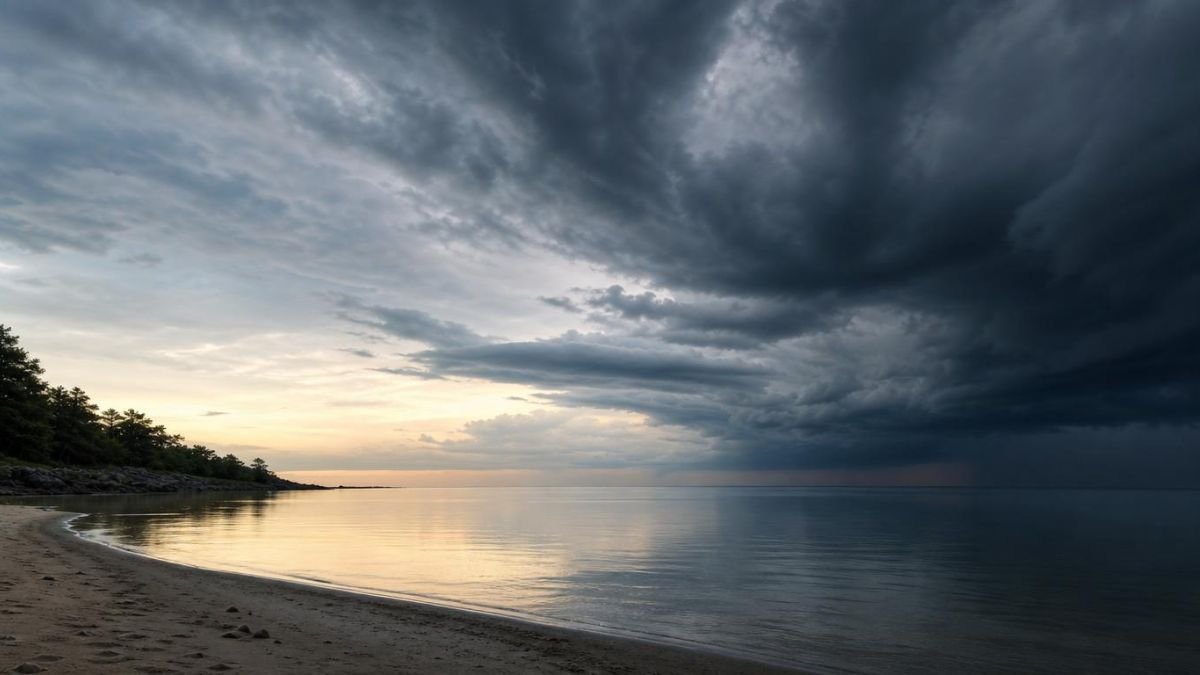
Is a peaceful hour still peaceful, once you’ve decided it’s the calm before something?
Because I don’t think it is. And I think that’s the most consequential thing about this phrase — not whether the storm arrives, but what naming does to the stillness.
Start with the weather, because the phrase is meteorologically real. Ahead of a large storm system, the air can go strangely quiet. Wind drops. Birds stop. The sky takes on a color that’s difficult to describe and impossible to mistake. Sailors have described it for centuries, and it isn’t superstition — a big system draws air in toward itself, and there are moments in that process where everything settles into an unnatural stillness.
So the calm is real, and it is genuinely related to the storm. It isn’t a coincidence and it isn’t irony. It’s part of the same system.
Which is worth holding onto, because the phrase is honest about something we’d rather not think about: that peace and disruption are not separate weather. They’re the same system at different moments.
But here’s what the phrase does to us.
The instant you name the quiet as before the storm, you’ve converted it into a waiting room. It stops being an afternoon and becomes a countdown. You’re still sitting in the same chair, in the same light, with the same tea going cold — but you’re no longer in it. You’re in the storm early.
And that’s the cost I want to put in front of you, because it’s the one we almost never count. There are two calms available in any life: the one you’re in, and the one you’ve labeled. And labeling is not free. It converts rest into vigilance, which is one of the most expensive exchanges a person can make.
So we end up doing something genuinely strange. We spend the calm bracing for the storm, and then we spend the storm inside the storm. Which means we never get the calm at all. It was there. It was fully available. We handed it over in advance.
Now, I want to be fair to the impulse, because the impulse isn’t stupid. It’s protective, and it comes from something real.
Most of us have been ambushed at some point. There was a Tuesday that was completely ordinary until the phone rang. And afterwards a lesson gets installed, below the level of argument: I wasn’t watching, and it came anyway. And from that, a conclusion that feels like wisdom — that being surprised is a kind of failure, and that the way to prevent the next ambush is to never be entirely at ease again.
So the naming of every calm as pre-storm is really a superstition about vigilance. The belief that if you’re already braced, it can’t get you the same way.
And I have to say plainly: it doesn’t work. Bracing does not reduce the impact of anything. What it reduces is the number of hours in your life where you weren’t braced. That’s the entire yield. You can spend twenty years watching the sky and the storm will still be exactly as bad, and you’ll have paid for it twice.
But here’s the part where I want to defend the phrase, because there’s something in it that’s genuinely valuable, and it hinges on one distinction.
There are two completely different ways to spend a calm you believe is temporary. You can prepare, or you can dread. They feel similar from inside — both involve attention on the coming storm — and they could not be more different in what they produce.
Preparation is finite and physical. It has verbs. Secure the shutters. Have the conversation now, while it’s easy, rather than in the middle of the crisis. Get the thing in writing. Rest, actually rest, because rest is preparation. Preparation ends. There comes a point where the shutters are secured and there is nothing further to do.
Dread has no verbs and never ends. It’s rehearsal. It runs the same scene repeatedly, at higher and higher resolution, and produces nothing but a more vivid version of a thing that hasn’t happened.
And the difference between them is the whole meaning of a calm. Used one way, the stillness is the most useful window you’ll get — you can only ever prepare in the calm; nobody has ever secured a shutter mid-hurricane. Used the other way, the same hours are simply the storm, arriving early and lasting longer.
There’s one more thing, and it’s the one people forget.
Sometimes there is no storm.
We’ve all named a quiet stretch as the calm before something and been wrong. The scan came back clear. The meeting was routine. The thing you were certain was coming simply didn’t. And when that happens, notice what the cost was: an entire good week, spent in a weather system that never existed.
That’s not a small loss. Those weeks are not refundable.
So the discipline this phrase asks for is a fairly precise one. Not optimism — optimism isn’t the point, and sometimes the storm is genuinely coming and you’re right to see it. The discipline is to ask what the naming is for. If it produces a list of things to do, then name it and get to work. If it produces nothing but weather in your chest, then you haven’t forecast anything. You’ve just left the calm early.
And there’s a version of this that’s much smaller and closer to home. It’s the good day you can’t quite enjoy because you’re waiting for it to turn. The relationship going well that you’re monitoring for the first crack. The peace you’ve decided must be a prelude.
Some of us have spent so long treating every calm as pre-storm that we’ve forgotten there’s another possibility entirely: that this is simply the weather, today, and it’s fine.
So here’s what I’ll leave you with tonight. Imagine you were told with certainty that a storm arrives in three days.
Almost everyone says they’d prepare. But be honest about what you’d actually do with those seventy-two hours. Would you secure anything? Or would you spend three good days standing at the window, watching a sky that hadn’t changed yet, and call it readiness?
And then the harder question — the one that outlasts the episode: how much of your life so far has been the calm, and how much of it did you actually get to have?




0 Comments