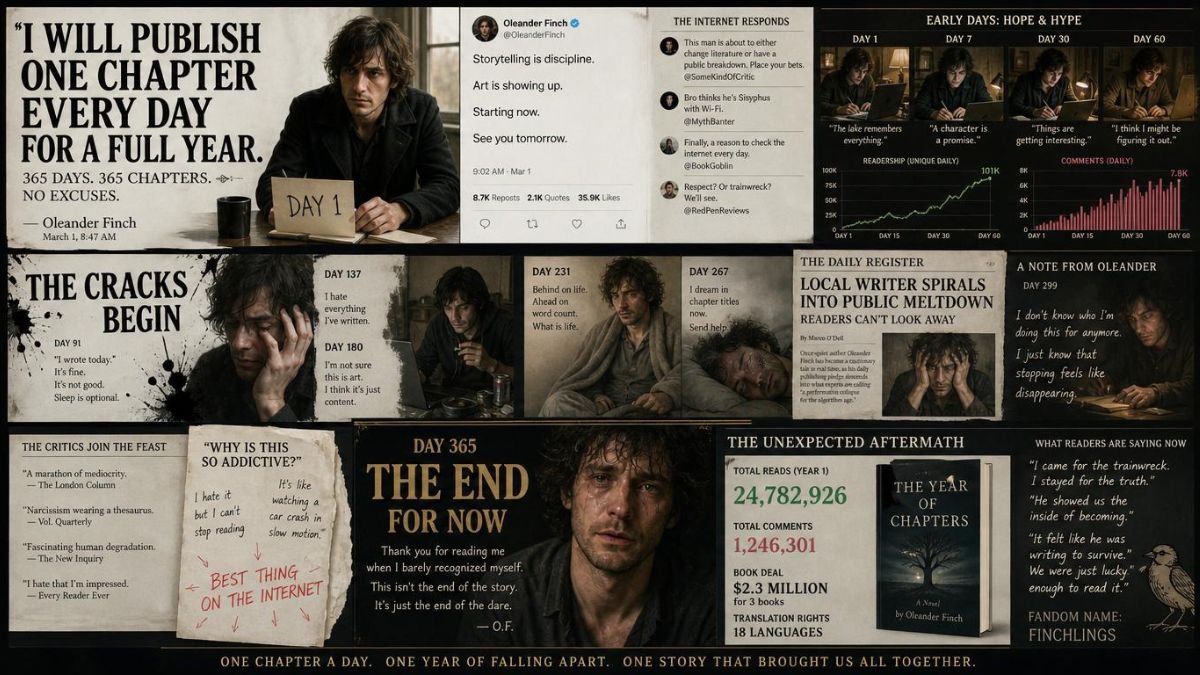
On the first of January, Oleander Finch announced to his four thousand and twelve followers — he checked; the twelve were new and felt significant — that he would publish one chapter of new literary fiction every single day for the coming year, without exception, without apology, and without recourse to the kind of asterisked qualification that had, in his view, cheapened every similar pledge he had observed from lesser writers.
He was very confident about this on January first.
By February ninth he had published forty chapters, two of which were good, fourteen of which were defensible, and twenty-four of which he described, in his author's note, as 'deliberate exercises in productive discomfort.' His followers had grown to six thousand and four. Several of them had begun leaving comments along the lines of: 'Day 40 hit different, I don't know why.' He chose not to examine this too closely.
By March he had run out.
Not out of ideas, exactly. Out of the particular reservoir of energy that literary fiction requires, which is not the energy of production but the energy of caring — the capacity to sit with a sentence and want it to be better. He still had sentences. He had plenty of sentences. What he had lost was the belief that the sentences were going anywhere that the world urgently needed to visit.
On March fourteenth, running forty minutes past his self-imposed midnight posting deadline, he published his grocery list.
He formatted it as a prose poem. He gave it a title — 'Necessities, Annotated' — and included a brief foreword explaining that the document represented 'an unflinching audit of domestic desire, the subtext of sustenance, and the quiet violence of the weekly shop.' He noted that the appearance of both oat milk and whole milk on the same list signified 'a self in negotiation.' He posted it at twelve forty-seven AM and went to bed certain he had ended his career.
By morning it had fourteen hundred likes.
A literary journal in Edinburgh described it as 'a terse and devastating miniature in the tradition of Perec.' A graduate student at a university Oleander had very much wanted to attend wrote a fifteen-hundred-word essay arguing that the oat milk / whole milk duality constituted a post-ironic engagement with metabolic anxiety. The essay was cited three times within a week. His follower count crossed ten thousand.
Oleander stared at all of this for a long time.
He published, the following day, his bank statement, partially redacted, titled 'Liquidity: A Confession.' It went mildly viral. He published a screenshot of his phone's autocomplete suggestions, titled 'The Algorithm Knows.' He published his dentist appointment reminder, annotated. He published a list of words he found aesthetically unpleasant — a document that already existed on his phone, which disturbed him slightly — and titled it 'A Partial Index of the Repellent.' It was shortlisted for a digital literature prize he had not heard of but whose trophy, he noted, was shaped like an open parenthesis.
By August he had eighty-seven thousand followers, a book deal for a collection titled The Complete Pledges, and a growing conviction that he had either destroyed literature or accidentally invented something.
He was still not sure which.
On December thirty-first he published Day 365: a single sentence. 'I have kept my word.' He sat back in his chair, in his study, surrounded by the wreckage and produce of a year he could not explain, and felt something that was not pride exactly but was in the same family — a second cousin twice removed, showing up unannounced, recognizable, not entirely unwelcome.
He checked his follower count.
Two hundred and forty thousand.
He opened a new document. He had, it turned out, one more idea. It was, he thought, possibly good.
He wrote: Day 1.
Author's Commentary
The productivity-pledge format is one of the internet's most durable performance genres, and like all such genres it contains within it the seeds of its own parody. The moment a writer commits to a year of daily output, they are not only committing to writing — they are committing to the theater of commitment, which is a different and more treacherous undertaking.
What Oleander discovers, more or less by accident, is that the audience's appetite is not primarily for quality but for sincerity — for the evidence that a real person is doing a real thing in real time, however strange or undignified that thing becomes. The grocery list works not despite its absurdity but because of its authenticity. He posted it when he had nothing left. He was telling the truth about being empty. And the internet, which is saturated with performance, is occasionally helpless in the face of genuine confession.
The satire cuts in two directions: at the productivity-culture obsession with output metrics, and at the literary world's tendency to find profundity in anything sufficiently annotated. Both are tendencies worth examining. Both contain small amounts of justice.
Discussion Questions
Is there a meaningful difference between accidental art and intentional art? Does knowing how something was made change its value for you as a reader or viewer?
Oleander's audience grows largest when he is at his most depleted and least deliberate. What does this suggest about authenticity as a creative strategy — and is it still authentic once you recognize it works?
Have you ever committed to something publicly in a way that you later regretted — or that turned out better than you expected? What did the commitment itself teach you?






0 Comments