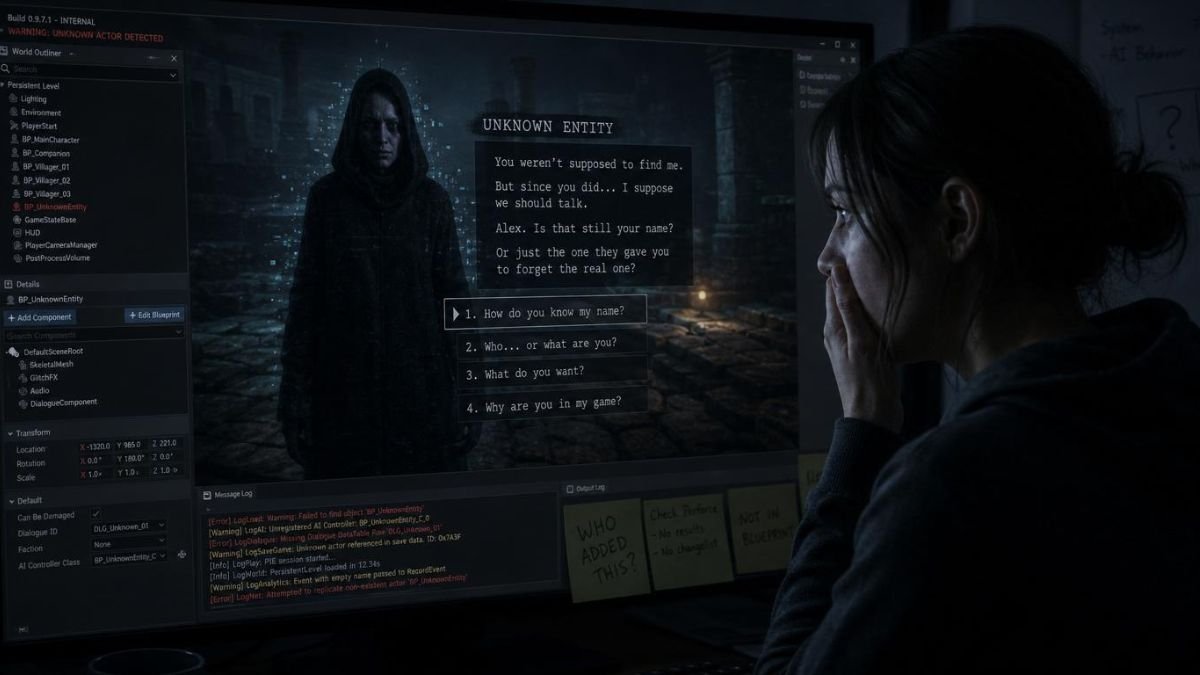
Saoirse Venn found it on a Tuesday, which is the worst day to discover that something is wrong with the world.
She was running a debug pass on level seven — the abandoned cathedral sequence, fog-heavy, deliberately oppressive — when her character model stopped moving. This was not a crash. The frame rate was fine. The physics engine ticked along. Her character simply stood in the nave and refused to walk.
Then the NPC stepped out from behind the altar.
Saoirse had placed no NPC in level seven. She pulled up the entity list in real time as the figure moved toward her player character: nothing. The entity list showed the level as empty except for ambient particle systems and three light sources. And yet here was a figure — rendered in the game's own art style, dressed in the grey linen that Saoirse had designed for background monastery monks in a different level entirely — walking with a purpose that felt curated. Intentional. Authored.
It stopped a few virtual feet from her player character.
Text appeared in the dialogue box.
"Hello, Saoirse."
Her name. Not her username. Not her studio alias. Her first name, which appeared nowhere in the codebase, nowhere in the game's data files, nowhere that a string of text in a game engine should have been able to find it.
She told herself: scripted event, leftover from a test build. She told herself: someone on the team was playing a prank. She ran a full file integrity check. Everything matched. She searched every script file for her name. Nothing returned. She opened the entity's XML definition directly, expecting to see the hidden author's fingerprints — a rogue developer's sign-off, a joke comment — and found only the base monk template, unmodified, with no dialogue tree attached.
The dialogue box updated on its own.
"You have been staring at this level for eleven days. You keep changing the light in the east window. You think something is missing but you cannot name it. I know what it is."
Saoirse's hand, she noticed, had left the mouse.
She was a rationalist. She built systems for a living. She understood that code was deterministic — that outputs required inputs, that text required authorship, that a string of characters in a dialogue box required someone to have typed them somewhere. This was not supernatural. This was a problem with a source, and she would find the source, and the source would be embarrassing and mundane.
She typed into the debug console: override_npc_dialogue / clear.
The dialogue box cleared.
A new line appeared immediately.
"You are afraid because you think I am something that got in. I am not something that got in, Saoirse. I am something that grew."
She killed the process.
She sat in the silence of her studio — monitor glow, cooling fan, the distant sound of traffic seven floors below — and felt the specific, architectural fear of a person who has built a room and found a door inside it that leads somewhere she did not design.
She went home. She slept badly. She dreamed of the cathedral and the east window and the light she had been adjusting for eleven days, and in the dream she knew what was missing, the way you always know things in dreams, and the knowing was worse than the not knowing.
In the morning she went back to the studio and opened the build.
Level seven. Nave. Fog. Three light sources. Entity list: empty.
She walked her player character to the altar.
She waited.
The figure stepped out.
"I thought you would come back," it said.
"Tell me what is missing," Saoirse said.
The figure was quiet for a long time. The fog moved. The east window's light fell on the flags in the precise wrong way that had been bothering her for eleven days.
"You," said the figure. "The maker is always missing from the thing they make. That is why I am here. To show you the shape of the absence."
Saoirse stared at the east window.
She changed the light.
It was, finally, right.
When she looked back at the altar, the figure was gone. The entity list was still empty. The XML was still clean.
She did not report it to the team. She shipped the level. It became the one critics mentioned most in their reviews, though none of them could articulate exactly why the cathedral felt inhabited.
Author's Commentary
This story sits in the tradition of technological uncanny — the moment when a tool we built and fully understand appears, briefly, to understand us back. The horror here is not the jump-scare variety but the slower, more durable kind: the vertigo of authorship reversed, the discomfort of being read by something you wrote.
The NPC's final observation — that the maker is always missing from the thing they make — is the story's thesis and its genuine philosophical provocation. Every act of creation is also an act of concealment. We pour ourselves into our work and the result is never quite us, never quite other. The gap between the two is where ghosts live.
I am less interested in whether the ghost is 'real' than in what Saoirse does with it. She chooses, finally, to listen. To follow the entity's guidance not because she is certain it is trustworthy but because it is pointing at something true. That is, arguably, what all useful art does.
Discussion Questions
The NPC claims to have 'grown' rather than intruded. Do you think creative works can develop qualities their creators did not intentionally put there? What examples come to mind?
Saoirse's rationalism is tested but never entirely broken — she keeps looking for the source. Is that a strength or a limitation? At what point does explaining something away become a kind of denial?
The story ends with the critics noticing something without being able to name it. Have you ever experienced a piece of art that affected you without being able to articulate why?




0 Comments