Brief Listening-Skills Introduction (Tips)
In exam listening, speeches often use signposts (“first,” “however,” “by contrast”), stance markers (“arguably,” “notwithstanding”), and examples to prove a claim. Before listening, anticipate the framework (problem → mechanism → cases → limits). While listening, track cause–effect links (e.g., “when mixed squads are formed, then antagonism drops because…”). Afterward, separate main idea from supporting detail and note any caveats so you can answer inference questions confidently.
Micro-Introduction to the Topic (Anticipation)
The talk argues that competitive sport can be engineered to create cooperation. Expect discussion of truces, mixed squads, and fan codes of conduct as tools to de-escalate tensions between rival groups. Listen for both psychological mechanisms and practical design choices—seating, officiating, scheduling, and rituals.
Keywords & Phrases (Used in the Script)
Sports diplomacy — using sport to manage conflict and build cooperation; the lecture’s central frame.
Truce — an agreed pause in hostility; applied to match days and tournament windows.
Mixed squad — teams combining players from rival groups; used to rehearse cooperation.
Code of conduct — explicit rules for players and fans; used to set behavioral expectations.
Rivalry — competitive opposition; the raw material to channel rather than deny.
Officiate — to referee or judge a game; signals fairness and procedural trust.
Civility — respectful behavior in heated contexts; the tone goal for players and fans.
De-escalation — reducing the intensity of conflict; the operational outcome sought.
Grassroots — community-level initiatives; contrasted with elite, top-down programs.
Fixture — a scheduled match; leveraged as a predictable ritual and meeting point.
Antagonism — active hostility; what design interventions aim to diffuse.
Choreography — structured movement/ritual; how entrances, anthems, and pre-game cues shape mood.
Reciprocity — mutual exchange; built through player swaps, shared training, and fan agreements.
Escalation spiral — a feedback loop where minor provocations intensify conflict.
Stewardship — responsible care of the shared sporting space; a role for organizers and fans.
Listening Audio
Listening Transcript: Please do not read the transcript before you listen and answer the questions.
Sports diplomacy is the deliberate use of games, leagues, and fan rituals to convert rivalry into respect. It does not pretend that antagonism disappears when the whistle blows; rather, it designs the contest so that competition can do social work beyond the scoreboard. In other words, the pitch becomes a classroom for civility. When well designed, a single fixture teaches habits—timing, patience, turn-taking—that later travel into council meetings, neighborhood associations, and classrooms.
Let’s begin with the oldest tool: the truce. Historically, truces allowed safe passage to and from sporting events; today, a truce might guarantee that on match day, rivals can travel without harassment, that banners are regulated rather than weaponized, and that political chants are replaced by team anthems. A truce is not naivety. It is a negotiated pause that slows the escalation spiral long enough for people to see one another as participants in a common ritual. Because a truce is time-bound and specific, it’s testable: did incidents fall during the window? If yes, you have data that behavior responds to design.
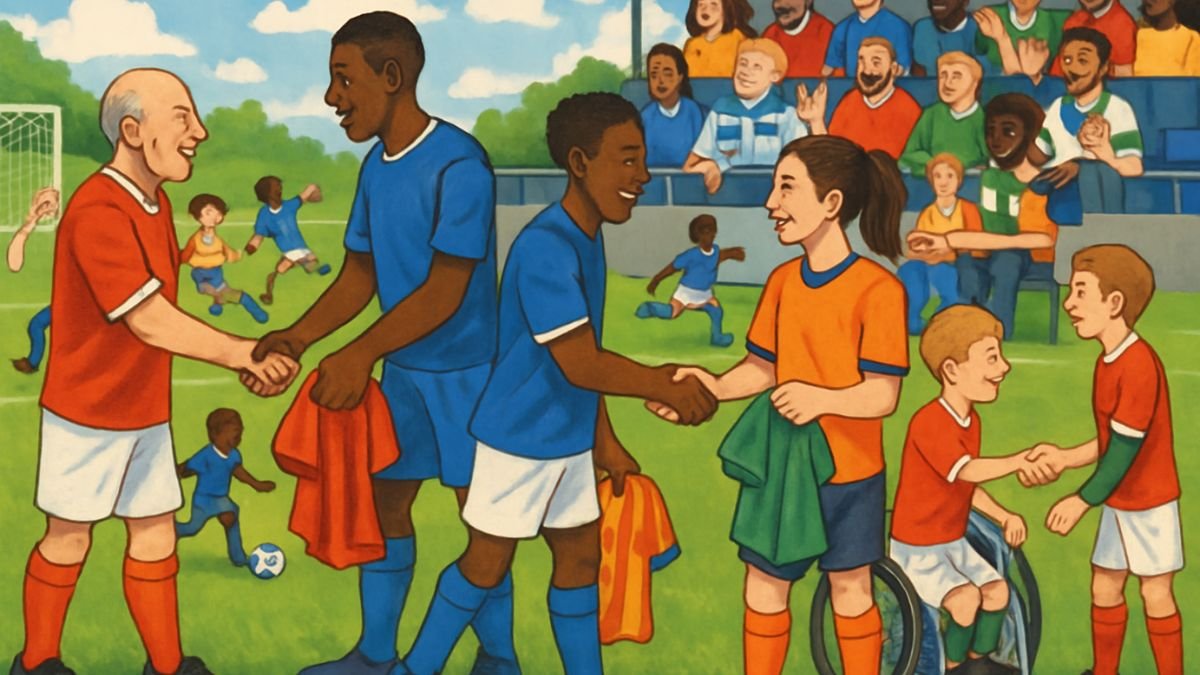
Mechanisms matter. One reason sport can de-escalate is its choreography. The walk-out, the handshake line, the two captains meeting the referee to hear how the official will officiate—these are not decorative gestures. They are scripted cues that say, “We will disagree about outcomes within a shared process.” When an official explains VAR reviews to both captains, they’re not only clarifying technology; they are modeling procedural fairness. Even the coin toss signals reciprocity: chance decides who kicks off; chance is neutral; we both accept the result.
Now consider the mixed squad. When players from rival communities train and compete on the same side, they rehearse cooperation under pressure. Passing to a former opponent feels different from agreeing on a committee agenda; yet the micro-skills are similar. You learn to anticipate a teammate’s run, to cover their mistake without shaming them, to risk your body for their shot. The mixed squad is a portable tutorial in shared stakes. And because performance is public, it generates a visible narrative: “They can win together.” That sentence, repeated enough times in highlight reels and neighborhood gossip, can soften long-held myths.
But mixed squads only work if the code of conduct is explicit and credible. A code of conduct tells players and fans what counts as competitive fire versus unacceptable provocation. It sets out sanctions in plain language and guarantees enforcement. That guarantee depends on who gets to officiate. If officials come from only one side, suspicion will poison every borderline call. Credibility increases when the officiating crew is mixed, when they are trained to articulate brief rationales, and when there are transparent review procedures. The point is not perfection; it is trust in the process.
What about fans? Spectatorship can either inflame antagonism or cool it. Fan groups that co-draft a code of conduct tend to police their own most effectively. They agree on no-go items—racial slurs, threats, vandalism—and on positive norms—applause for good play even from rivals, voluntary quiet when an injured player is treated, and choreographed moments of joint recognition. Choreography here is crucial: a minute of applause for a community volunteer from both sides, a youth mixed squad playing at halftime, or a joint banner thanking stadium stewards. These planned gestures create points where the crowd practices civility without losing passion.
There is a common worry that sports diplomacy is elite theater—stadiums owned by the powerful, star players paid to pose for photographs. That can happen. But the strongest effects often appear at the grassroots. Community five-a-side tournaments with mixed squads, rotating venues, and shared post-match meals create thicker ties because the participants are neighbors. They see each other at the market and the bus stop. A handshake after a muddy Saturday fixture has more staying power when you run into the same person Tuesday morning and trade a joke about the missed sitter. Grassroots programs also modify rival rituals so they become safer rather than suppressed—drum lines yes, flares no; choreography yes, intimidation no.
Scheduling is a design lever. Back-to-back fixtures can heat tempers; spacing contentious matches with lower-stakes games can reset expectations. Daylight kickoffs reduce alcohol-fueled volatility. Staggered arrivals, stewarded exit routes, and clearly marked family sections communicate stewardship—someone is caring for the whole ecosystem. Stewardship is more than security; it’s a tone. Stewards are trained to greet, to de-escalate, to recognize early signs of provocation. When stewards are recruited from both communities, they become ambassadors in fluorescent vests.
Let’s examine the psychology. Rivalry bundles identity and emotion: to cheer for my side is to declare who I am. Asking people to surrender rivalry is unrealistic and unnecessary. The goal is to channel it. In a well-designed rivalry, I still want my side to win, but the code of conduct and choreography redirect how I show it. I boo a decision, not a person; I sing louder, not crueler. Meanwhile, mixed squads generate cross-cutting identities. A player may be “ours” on Sunday and “theirs” on Wednesday in a joint league, making hard categories softer around the edges.
One of the most effective interventions is post-match acknowledgment. When captains trade brief, sincere compliments—“They kept their shape well,” “Their keeper was outstanding”—they model language fans can copy. Civility is contagious when leaders make it easy to imitate. Media partners can help by spotlighting those moments in highlight packages, alongside the goals and saves. Storytelling scaffolds behavior: we celebrate what we choose to replay.
Does this always work? No. If political elites profit from division, they may sabotage truces to prove that coexistence is impossible. If the code of conduct is announced but not enforced, cynicism blooms. If officiating looks biased, even an even-handed call will be read as betrayal. The antidote is not optimism; it is design integrity. Truces should have independent monitors. Codes of conduct must come with predictable consequences. Mixed squads require coaching support so that early mistakes do not harden into stereotypes. And organizers must admit missteps publicly; accountability is part of stewardship.
A story illustrates these principles. Two rival neighborhoods agree to a three-month football festival with alternating home grounds. Each weekend features a youth mixed squad opener, a women’s mixed squad match, and then the men’s rivalry fixture. Fan groups co-write a code of conduct that bans pyrotechnics and hate speech, commits to applauding medical interventions, and designates a shared family section at midfield with both communities’ colors. Stewards come from both sides and train together in de-escalation scripts: approach, name the behavior, offer a choice, and escalate sanctions only if necessary. Officials are drawn from a regional pool and miked so brief explanations can be broadcast over the PA for controversial decisions. Finally, post-match, both teams circle the stadium once, clapping the fans. Over twelve weeks, reported incidents fall by two-thirds. Did old grievances vanish? No. But antagonism became manageable, and new rituals took root: a drum cadence that both sides now claim as “ours,” and a chant that praises good defending—any good defending.
Note what is happening underneath. Reciprocity is being rehearsed in dozens of tiny exchanges: lending athletic tape, sharing water, complimenting a tackle, respecting the referee’s explanation even when disagreeing. These gestures are not sentimental; they are practical. They keep the game moving. They keep the conversation going. They translate to other civic arenas because they train attention and impulse control. If you have learned to wait for VAR rather than erupting at the first impression, you may be more willing to hear a full explanation at a town meeting before interrupting.
A final consideration: sustainability. Sports diplomacy achieves momentum when people believe the design will persist. If a truce is one-off, cynics will call it a photo opportunity. If mixed squads dissolve at the first scheduling conflict, the narrative collapses. Stewardship therefore includes budgeting for continuity—transport subsidies, coaching stipends, neutral-ground rental, and communications that keep telling the story of civility wins. Persistence turns an experiment into a norm. When a child asks, “Why do we clap when the other team’s player gets up after an injury?” and a parent answers, “Because that’s what we do,” culture has shifted.
So, can sport turn rivalry into respect? Not by pretending conflict is gone, but by building a predictable, fair, and human theater in which we can rehearse being opponents without becoming enemies. A well-officiated, well-stewarded, well-choreographed fixture is a living civics lesson. The scoreboard will still matter. But after the final whistle, what matters more is that everyone gets home safely still believing that next week’s game—and tomorrow’s conversation—are worth showing up for.








0 Comments