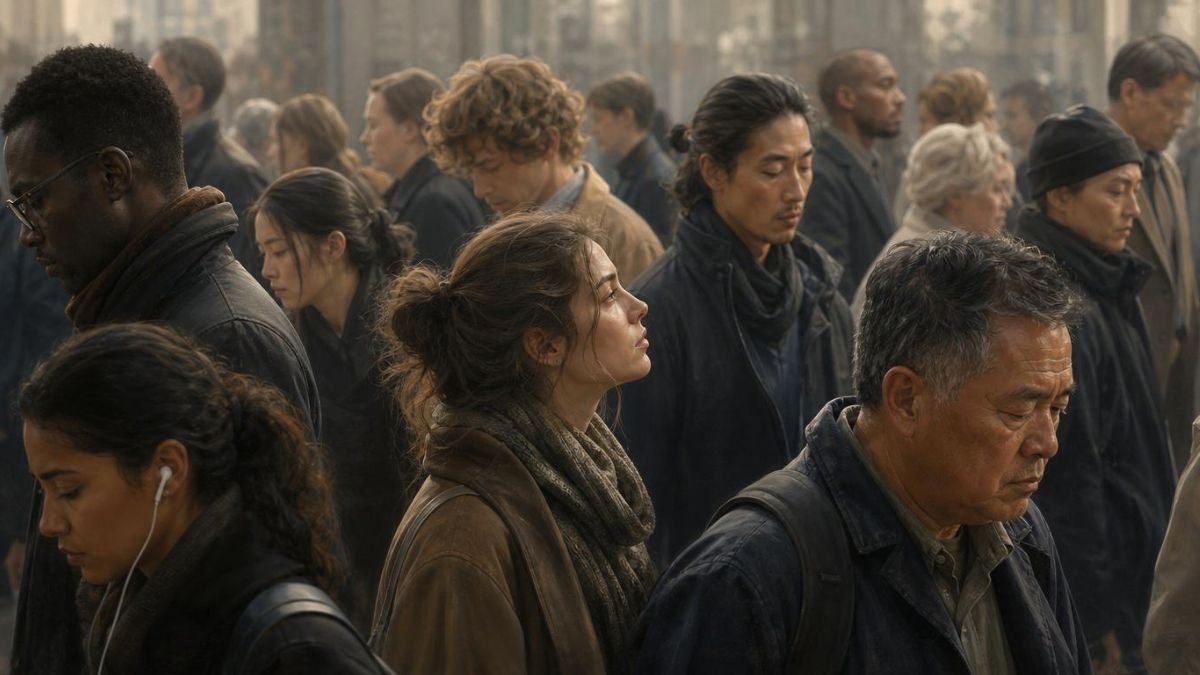
Have you ever passed a stranger on the street and, just for a second, been struck by the fact that their life is every bit as deep and complicated and full as your own?
You're driving down the highway at night, and you notice the lit windows of a passing car — a face, a hand on the wheel, someone singing along to a song you'll never hear — and it hits you, unexpectedly, that this person is the main character of their own entire life. That they have a childhood, and a fear, and someone they miss, and a reason they're on this road tonight, and a whole ocean of a life that has been going on, in full color, this whole time, completely without you. There's a word for that feeling now. It's new — barely more than a decade old — and it's one of the most quietly profound words I know. The word is sonder.
It was coined by a writer named John Koenig, in a project where he invented words for feelings that didn't have names yet — the obscure sorrows we all carry but can't quite point to. And sonder is his word for this exact experience: the realization that each random passerby is living a life as vivid and complex as your own. That everyone — the stranger asleep on the train, the cashier, the person in the window across the street, the crowd flowing over the bridge at rush hour — every single one of them is the center of a world as real and as full as the one you carry around behind your eyes.
Now, on some level, you already know this. Of course other people are real. Of course they have inner lives. If I asked you outright, you'd say yes, obviously. But there's a vast difference between knowing something as a fact and feeling it as a truth. And most of the time — be honest — we don't feel it at all. Most of the time, other people are scenery. They're extras in the movie of our life. The traffic that's in our way. The line that's too long. The face that's simply not us. We walk through a world of billions of people and quietly experience almost all of them as background — as furniture in the story that's really about us.
Sonder is what happens when that background suddenly comes alive. When, for one dizzying moment, an extra steps forward and becomes a whole person, and you realize with a kind of vertigo that you have been walking through a world absolutely crowded with protagonists. That every one of those strangers goes home to a life you'll never see. That they've cried in rooms you'll never enter, loved people you'll never meet, carried griefs as heavy as yours that you'll never know a single thing about. And that to them — this is the part that really turns you inside out — to them, you are the stranger. You're the extra. You're the face in the passing window that they'll forget by the next mile.
Think about what that means. Every person who has ever brushed past you on a crowded street was, in that instant, at the center of a story just as important to them as yours is to you. The old man you didn't look at was once a boy who was somebody's whole world. The tired woman at the next table is carrying a secret joy or a private catastrophe you'll never suspect. And all of these lives are unfolding at once, right now, simultaneously, each one as rich as yours, most of them never to intersect with yours at all. The scale of it is almost unbearable. There are billions of these full and vivid lives running in parallel, this very second, and you'll only ever know the inside of one of them — your own.
I think sonder is one of the most important feelings a person can have, precisely because it's so hard to hold onto. It's the antidote to the quiet selfishness we all fall into just by being trapped inside a single point of view. It's difficult to be cruel to someone the moment you truly feel their sonder — the moment they stop being an obstacle and become a person with a mother and a fear and a favorite song. Every failure of kindness, if you trace it back, is a small failure of sonder. It's the moment we let someone stay scenery instead of letting them become real.
And there's something oddly comforting in it, too, tucked in beside the vertigo. Because if everyone is the center of their own vast and complicated life, then everyone is also just as small and just as lost as you sometimes feel. Everyone is improvising. Everyone is carrying more than they show. That person who seems to have it all figured out is, from the inside of their own head, just as uncertain, just as human, just as much a work in progress as you are. You're not uniquely fragile. You're just a person, in a world of persons, all of you equally real and equally struggling to make sense of the one life you were handed.
So maybe the invitation of this new word is simply this: to practice sonder on purpose. To look, just occasionally, at a stranger — really look — and let yourself feel the whole invisible life behind their face. Not to know it. You never can. Just to remember it's there. To let the background come alive, even for a second, and to walk through the world a little more aware that you are surrounded, at every moment, by people every bit as real as you.
Here's what I'll leave you with. If every stranger you pass is the hero of a story as deep as your own — and if to all of them, you are just a face in the crowd — then how would you move through the world differently, if you could feel the full weight of everyone else's realness all the time?






0 Comments