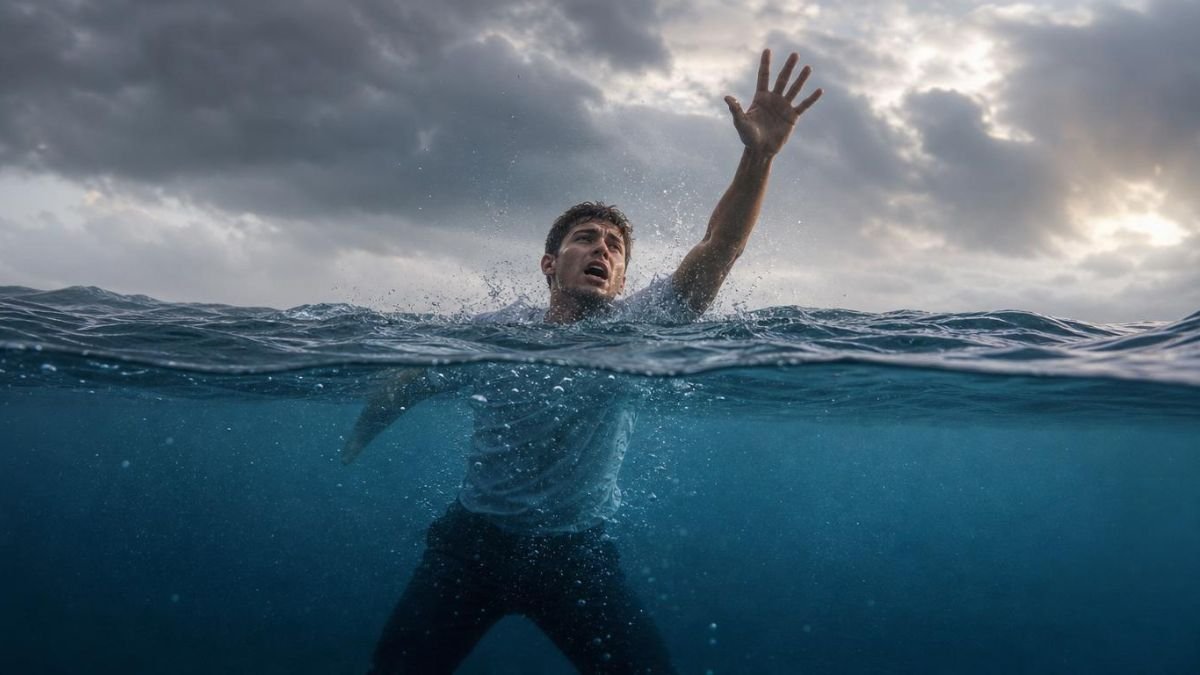
Have you ever been thrown in — and did it actually teach you to swim, or did it just teach you to be afraid of water?
Because that's the question inside this phrase, and we almost never ask it. Sink or swim. We say it about a new job with no training. About a child sent somewhere alone. About a language, a country, a role we were handed with no instruction and a cheerful shrug. It's said briskly, often admiringly, always by the person standing on the bank.
And the image is stark, and I want you to actually picture it. Someone in water that's over their head. Two possible outcomes. There's no third option in this phrase — no float, no cling to the side, no someone reaches in. Just up, or down. It is the most binary sentence we own.
Now, where it comes from is darker than most people realize. Historians link it to the old trials by water — the ordeals used in witch accusations across Europe. The accused was bound and thrown into a pond or a river, and the logic was theological and completely airtight in the worst way. Water was pure; it would reject the guilty. So if you floated, the water had refused you, and you were guilty and would be executed. If you sank, you were innocent — and you had drowned.
That's the origin. A test in which passing kills you and failing kills you, and either way the crowd goes home satisfied. And the phrase drifted down through the centuries, lost the horror, and turned into workplace advice.
But I think a residue of the original survives in how we use it, and it's worth naming. Because sink or swim is always said by someone with authority who has decided not to help. It's not a description of a natural situation. Water doesn't say sink or swim. People do. It's a policy, chosen by a person who could have offered instruction, or a hand, or a shallow end — and elected instead to make it a test. The phrase presents itself as a fact about the world. It's almost always a decision about a person.
And here's where I'd push back on it, gently but seriously.
The phrase assumes that ability is revealed rather than built. That inside each person there's either a swimmer or a sinker, and the water simply exposes which. That's why it feels so morally comfortable to the one doing the throwing — they're not causing the outcome, they're just finding out. But that isn't how any skill has ever worked. Nobody has ever discovered they could swim. People learn to swim, and they learn it in shallow water, slowly, with someone's hand under their back and the ground still available.
So when someone sinks under this policy, we conclude they weren't a swimmer. What actually happened is that we never taught them. And we'll never know what they could have been, because we ran a test instead of a lesson.
There's a real cost to this, and it isn't only the ones who sink. The ones who swim carry something too. Ask anyone who was genuinely thrown in — who survived the first job with no support, the sudden responsibility at nineteen, the family that required them to be an adult before they were one. Yes, they can swim. They'll tell you so. And then, if the conversation goes on long enough and it's late, they'll tell you something else: that they've never once felt safe in water. That competence and terror arrived together and never fully separated. That they perform brilliantly and cannot rest.
That's the thing the phrase doesn't account for. You can learn to swim in a way that also teaches you the water is trying to kill you — and that lesson lasts longer than the stroke does.
But I don't want to leave it there, because the phrase isn't only cruelty, and there's something true in it that I'd be dishonest to skip.
There is a point in every skill where instruction stops working, and only depth teaches. You can be shown the technique on the poolside for a year and learn nothing that matters, because the actual lesson — how to be calm when there's nothing under your feet — is only available where there's nothing under your feet. That's the real content of deep water. Not stroke mechanics. Panic management. And panic cannot be taught dry.
So there's a difference between two things that look identical from a distance. There's being thrown in, which is someone else's abdication. And there's going in, which is you deciding you've stood on the edge long enough. Same water. Utterly different act. One is a verdict passed on you; the other is a choice you made — and the difference shows up years later in whether you're proud of it or still a little angry about it.
And if you're ever the one on the bank — and most of us are, eventually, for someone — I'd offer this. You can give someone deep water without giving them the ordeal. Deep water plus a visible edge. Deep water plus someone in it with them. Deep water plus the certainty that if they go under, a hand arrives. That's not softness; they still have to swim. It just removes the part where they're also negotiating with death.
Because here's the thing about the old trial: the crowd never went in the water. They stood on the bank and watched the outcome and called it justice. And whenever you hear this phrase used approvingly, it's worth noticing who's standing where.
So here's what I'll leave you with. Somewhere in your history is water you were thrown into, and you're still here, so presumably you swam. So think about that particular water honestly. Did it teach you to swim — or did it just teach you never to relax? And if there's someone standing on the edge of their own deep water right now, waiting to see what you'll do: are you going to be the crowd, or are you going to get in?







0 Comments