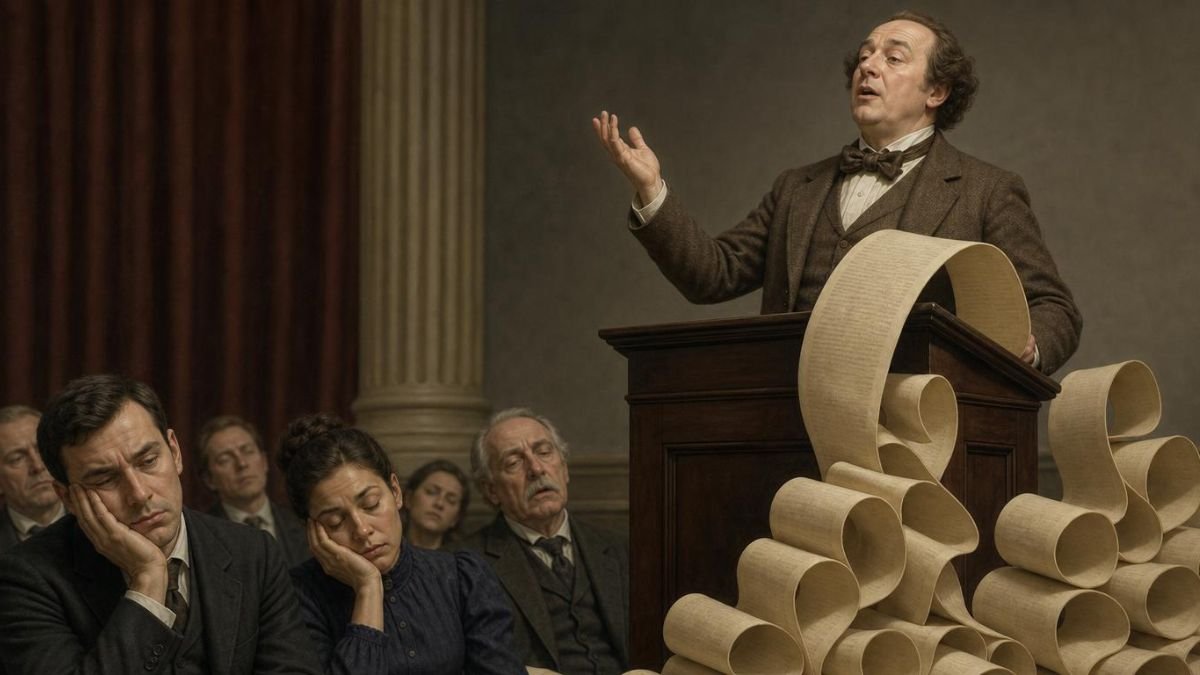
Why is it that the less certain we are of what we mean, the more words we use to say it?
There’s a word for the result, and I love it partly because it’s so compact. Prolix. Five letters and two syllables, describing a fault it refuses to commit. A word about excessive length that gets in and out in half a second.
It comes from the Latin prolixus, and the picture inside it is liquid. Pro — forth, forward — and a root connected to flowing, to being fluid, the same family that gives us liquid. Prolix means, quite literally, poured forth. Spilled out. Extended, stretched, running on.
The Romans used it for things that had simply gone on too far — long hair, a long stretch of time, a speech that wouldn’t end.
And that image of pouring is exactly right, because the defining property of a liquid is that it has no shape of its own. It takes the shape of whatever holds it. And if nothing holds it, it just spreads — thinner and thinner and wider and wider, covering an enormous area, deep nowhere.
That’s prolix speech precisely. Not too much substance. Too little vessel.
Because here’s what I’ve come to believe about wordiness, and it’s not what we usually say about it. We tend to assume the prolix person has too much to say. Usually the opposite is true. Usually they haven’t yet decided what they mean.
Think about what happens when you know exactly what you think. It comes out short. You say the thing, and it’s over, and you feel slightly exposed because there’s nothing else in your mouth to hide behind.
Now think about writing an email when you’re unsure. You approach the point, then back off. You add a qualification. You restate it from a second angle in case the first one was wrong. You add a paragraph of context nobody asked for. You hedge the hedge. And what you produce is nine hundred words that mean roughly I don’t know how to say this.
Prolixity is thinking out loud in public, and then leaving all the thinking in.
Which is why compression is such hard work — and why it’s a gift. There’s a famous line, usually attributed to Pascal, apologizing for the length of a letter on the grounds that he hadn’t had time to make it shorter. And that’s not a joke about laziness. It’s a genuine description of labor. The long version is the raw material. The short version required somebody to go through it and decide.
So every time you write something short and clear, you are doing work on behalf of your reader. You’re absorbing the effort of deciding what matters, so they don’t have to. And every time you send the sprawling version, you’re transferring that labor to them — asking them to wade through your process and locate the point themselves.
That’s what makes prolixity a quiet discourtesy. It isn’t that it wastes time, though it does. It’s that it hands somebody a puddle and asks them to find the deep part.
Now, I want to defend length, because I don’t want this to become an argument for brevity as a virtue in itself. It isn’t.
Not all length is prolix. A long letter to someone you love is not prolix. A conversation that meanders for three hours on a balcony is not prolix. A novel is not prolix. Because the word doesn’t mean long — it means poured out without a channel. It’s about shapelessness, not size.
The test isn’t the word count. The test is whether the thing is going anywhere. Long writing with a current in it is a river, and you can happily float on a river for hours. Prolix writing is a flood plain: the same water, spread out, going nowhere, and you have to walk through all of it.
And clipped speech can be just as empty. There’s a whole style of terse, punchy, confident-sounding communication that says nothing at all — the executive summary with no summary in it. Short and vacant is not an improvement on long and vacant. It’s just faster.
There’s one more root of prolixity worth naming, and it’s the tender one. Fear.
We pad when we’re frightened. The apology that goes on too long is frightened of not being forgiven. The proposal buried in context is frightened of being rejected. The person explaining themselves for the fifth time is frightened they haven’t been believed. Every extra sentence is a small insurance policy.
And the cruel irony is that it doesn’t work. Padding reads as uncertainty, and uncertainty invites doubt. The over-explained apology often sounds less sincere than four honest words. The heavily qualified request sounds like something you don’t really believe in. We add words to feel safer and they make us sound less trustworthy — which makes us add more.
So the cure isn’t a rule about length. It’s the harder thing underneath: decide what you actually mean, then say that, and tolerate the exposure of having said it plainly.
That last part is the real work. A short true sentence has nowhere to hide. That’s why we avoid them.
So here’s what I’ll leave you with. Think of something you’ve been explaining at length recently — to a colleague, to someone you love, to yourself at two in the morning. All that circling, all that context, all that restating.
Now try this: what is the one sentence underneath it? Not the diplomatic version. The one you’d say if you were only allowed twelve words.
You already know it. You knew it before I finished asking. So the real question is this: why have you been pouring, when what you actually needed was to hand someone the cup?






0 Comments