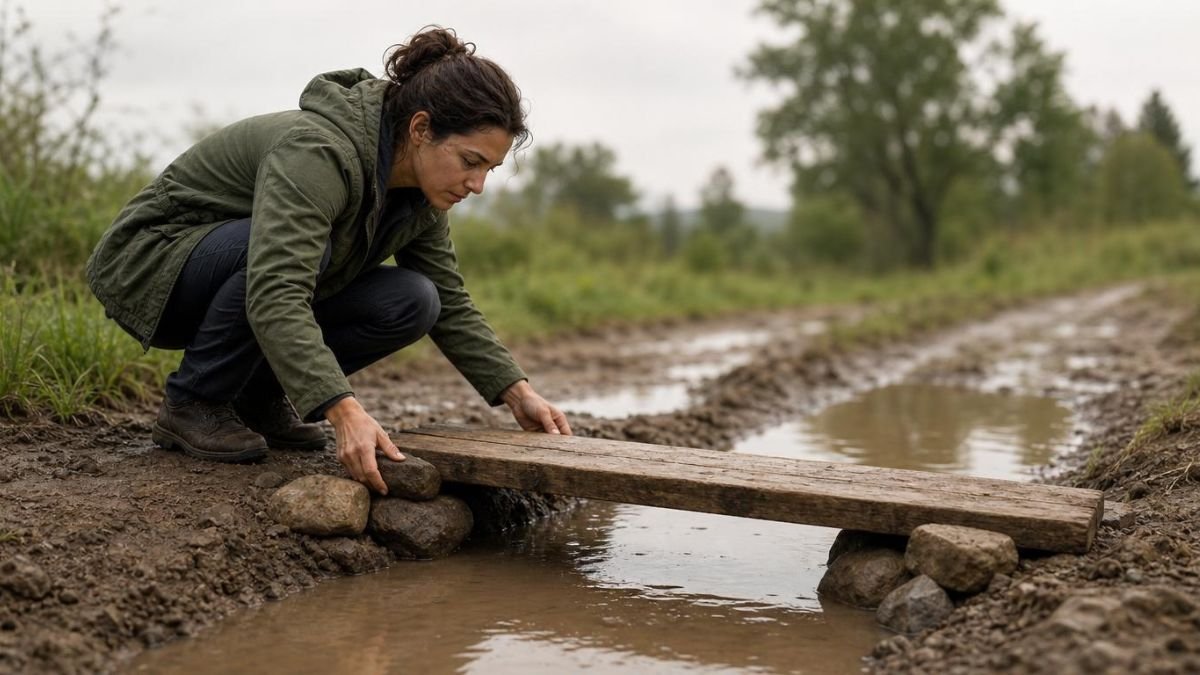
When someone says "let's be pragmatic," what do you brace for?
Be honest. Because for most of us, that sentence has a shape, and the shape is a downgrade. It's the sentence that arrives in the meeting right before the ambitious version of the plan gets quietly cut in half. It's what the sensible relative says about the career you wanted. I'm just being pragmatic. It means: bring your expectations down to the size of the room. It means: the beautiful version is off the table, here's the achievable one.
We've made this word into a synonym for compromise. And I want to show you that it isn't, and that the original meaning is not a lowering at all — it's one of the most demanding standards a person can be held to.
The word is Greek. Pragma, meaning a deed, a thing done, an act — from prassein, to do, to accomplish. It's the same family that gives us practice and practical. So at its root, pragmatic doesn't mean modest. It means concerned with what is actually done. Judge by deeds.
That's a much sharper blade than we've been using it as. Because the pragmatic question isn't what's realistic? — that's a question about fear, mostly, dressed up as arithmetic. The pragmatic question is: what does this actually do in the world? What happens when it meets reality? Not what does it claim, not what does it feel like, not how does it sound when described at a dinner table. What are its deeds?
And once you hold the word that way, it stops being the enemy of idealism and becomes something much more uncomfortable: a test that both idealism and cynicism can fail.
Take the idealist first, since they're the ones this word usually gets used against. There's a kind of high-minded person whose beliefs are gorgeous and produce nothing. They hold the correct positions with real passion, and the world outside their window is unchanged, has been unchanged for years, and will remain unchanged. By the measure of pragma, they have done nothing. The deeds are absent. And that's not a small criticism — it's the whole criticism. A conviction that never becomes an act is not a conviction; it's a preference, and it's cheap.
But now turn the same blade on the person who called themselves pragmatic in the first place, because they usually escape unexamined. The one who says be realistic, who trims every plan, who has never once attempted something whose success wasn't guaranteed. Ask them the pragmatic question: what have your deeds accomplished? Very often, the answer is also nothing — just a safer, more respectable nothing. They've avoided failure by avoiding attempt. And the person who never tried anything difficult has no better claim on results than the dreamer who tried nothing at all. Both of them have empty hands. One just has a better excuse.
Which is why I'd separate this word carefully from the thing it gets confused with. A pragmatist says: let's find out what works. A cynic says: nothing works. Those two sentences sound like relatives at a distance, and they are complete opposites. One is a commitment to testing. The other is a refusal to test, wearing the costume of experience. Cynicism is the laziest position available, because it can never be disproved by anything except effort, and it has already ruled effort out.
There's a whole philosophy built on this word — the American pragmatists, William James and the others, who proposed something that still unsettles people: that the meaning and the truth of an idea lie in its practical consequences. That if two beliefs would make no difference whatsoever to anyone's actual experience, the argument between them is empty. Look at what it does. That's the test.
And here's where it gets genuinely beautiful, because that test cuts in a direction nobody expects. We assume the pragmatic lens is hostile to the tender things — to love, to forgiveness, to faith, to generosity, to hope. That when you apply the hard question, the soft things fall away first.
They don't. Ask the pragmatic question of forgiveness — what does it do? It ends a war that was consuming one person entirely. It hands you back years. There is no more practical act available to a human being. Ask it of kindness: it changes the actual behavior of actual people, measurably, for a long time afterward. Ask it of hope — not the vague sort, the working sort — and you find it's the thing that determines whether a person gets up and makes another attempt, which determines everything downstream. These aren't decorations on a serious life. By the strictest test of deeds, they're some of the highest-functioning things we have. The tender things work. They just don't look like tools, so we file them under sentiment and then wonder why our sensible plans keep failing on the human parts.
But the word carries a warning too, and I won't leave it out. Pragma tells you to judge by deeds — but it doesn't tell you what to aim at. Pragmatism with no destination becomes a very efficient machine going nowhere, or somewhere terrible. It works is a fine answer to how, and no answer at all to toward what. Some of the most catastrophic things ever done were done by people who were entirely focused on what was effective. So the word needs a companion. Effectiveness is a servant. It should never be the master, and whenever you hear someone justify a thing purely on the grounds that it works, ask them the second question, and watch what happens.
So here's what I'll leave you with. Take the thing you've been calling impractical — the plan, the reconciliation, the letter, the change you've told yourself the world doesn't allow. Ask the real pragmatic question about it, not the fearful one. Not is it realistic, but what would it actually do, and have I ever once tested it? And then the harder half: how much of what you call being pragmatic has ever been measured by its deeds at all — or have you been calling it practical simply because it was safe?






0 Comments