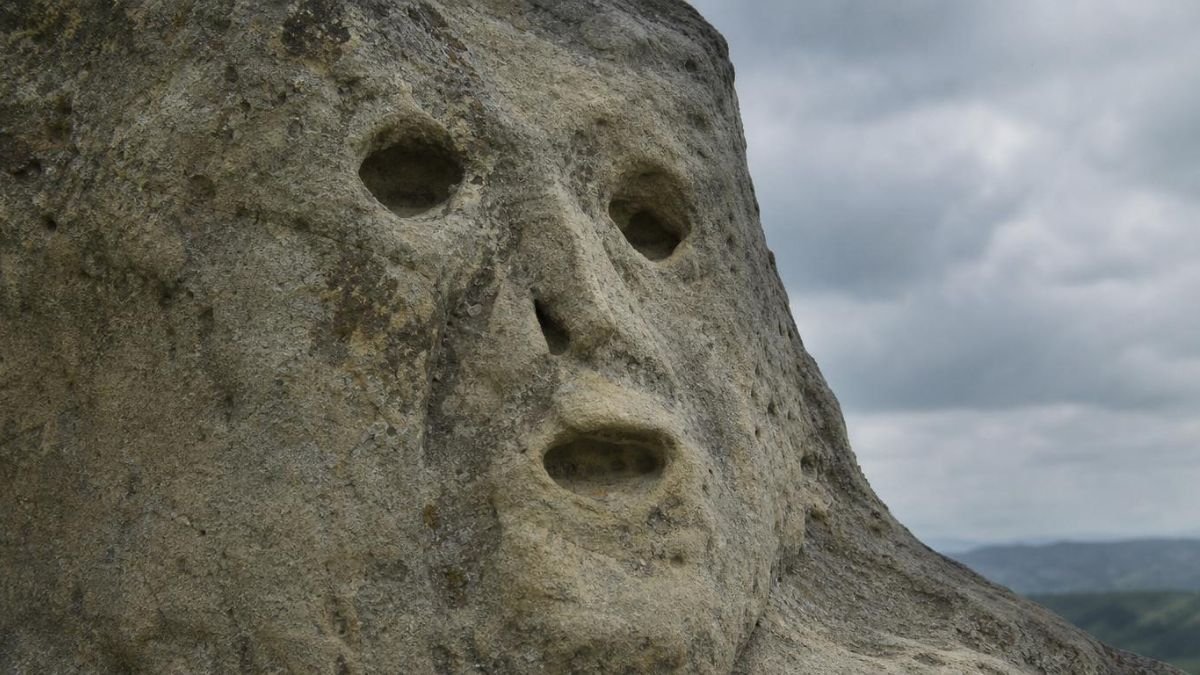
Why does your brain insist on finding a face in a wall socket?
Because it does. You've seen it — two round holes, a slot beneath, and something in you says surprised little face before you've had a single conscious thought about it. It happens with car headlights and grilles, which always seem to have an expression, usually smug. It happens with the moon. With clouds. With the grain in a wooden door at the end of a dark hallway, which is why so many childhoods contain a specific piece of furniture that was watching.
There's a word for this, and it's one of my favorites in the language. Pareidolia.
It's Greek. Para, meaning beside, alongside, or slightly off from — the same para that gives us parallel and paranormal, always suggesting something adjacent to the real thing. And eidolon, meaning image, form, or phantom — from eidos, shape, the same root that eventually gives us idol and idea. So pareidolia means, roughly, an image beside the image. A form standing next to the actual form. Something you see that is next to what is there.
And I love that construction, because it doesn't say false image. It says beside. You aren't hallucinating; the socket is genuinely there, the clouds are genuinely there. You've simply seen a second thing standing alongside the first, and your brain served it to you with total confidence, before consultation.
Now here's the biology, and it's remarkable. We are extraordinarily tuned to faces. There's a region of the brain that appears to do little else — a dedicated face-detection system, running constantly, in the background, with a hair trigger. And it is deliberately, evolutionarily biased toward false positives. It would rather be wrong a hundred times than miss once.
Which makes complete sense when you think about the stakes involved. For most of human history, failing to notice a face in the undergrowth was fatal, and mistakenly seeing a face in the undergrowth cost you nothing but a moment of embarrassment. So the system was tuned toward yes. Toward there's someone there. And because it's not smart — it's fast, which is different — it will fire on any arrangement of two things above one thing. Two windows and a door. Two knots and a crack. Two coat hooks and a light switch. The threshold for person is astonishingly low.
So pareidolia is not a flaw in your perception. It's the cost of a feature, and the feature kept your ancestors alive. Every time you see a face in a piece of toast, you're watching a survival system succeed at doing what it was built to do, slightly too enthusiastically.
But now let me take you somewhere else with this, because it isn't only faces.
We do the same thing with meaning.
The mind that cannot look at three dots without assembling a face also cannot look at three events without assembling a story. This is the same instinct, running on a different input. Something bad happens, then something else bad happens, and before you've decided anything, a shape appears: this is a pattern, this is what my life is doing, this is happening to me. You didn't reason your way there. It arrived complete, with the same confidence as the face in the socket.
And sometimes the pattern is real. Sometimes there genuinely is a face in the undergrowth, and the person who saw it early was right. That's the whole point of the system — it's not useless, it's overactive. But the overactivity means we are all, constantly, seeing meanings standing beside the events. Not in them. Beside them.
The coincidence that felt like a sign. The stranger's expression you read as judgment, which was actually indigestion. The silence from a friend that you filled in with a whole narrative, and the truth turned out to be a broken phone. The story you tell about your twenties, which is a genuine pattern you drew through a scatter of accidents that could have supported six other stories equally well.
That's meaning-pareidolia. And I don't say this to make you distrust yourself into paralysis. I say it because there's an enormous freedom in knowing that the pattern arrived automatically and can therefore be looked at again. If the shape came from your face-detector rather than from the world, you're allowed to check. You're allowed to ask: what else could these same dots make?
And here's the tender part, the part I actually want to leave you with.
Notice what we look for. Out of every possible shape the mind could impose on random noise, the one it reaches for first is a face. Not a landscape. Not a machine. A face — which is to say, another person. Someone looking back.
We are so profoundly wired for company that we manufacture it from oil stains and rock formations and the arrangement of holes in a wall. We look at the moon — a lifeless rock — and for thousands of years, across every culture, we have insisted there's someone in it. A man, a rabbit, a woman weaving. We could not leave it as a rock. We stared at the most distant, silent, unreachable object in the sky and said: there's a face up there.
That's not a malfunction. That's loneliness, in its most beautiful engineering. That's a species that would rather populate an empty universe with imaginary neighbors than accept an empty room.
And it shows up as tenderness in small ways all the time. You feel briefly guilty about throwing away a cracked mug because it looked like it had eyes. You can't quite bring yourself to be rough with an object that seems to have a face. Children name their toys and grieve them. Adults do too, quietly, about cars and houses. All of it downstream of the same reflex: something in you sees a person, and the moment it does, you start to care.
So the next time you catch yourself seeing a face where there isn't one — in a socket, in a shadow, in the folds of a curtain at night — I'd like you to notice what's really happening. Your mind went looking for someone. It went looking for someone in a piece of plastic. That's how badly we want not to be alone in the room.
So here's what I'll leave you with. If your mind will invent a face out of two holes and a slot rather than accept an empty wall — then what stories has it invented out of the loose events of your life, standing beside the facts rather than inside them? And what would you actually see, if you looked at the same scattered dots and refused, just once, to let them make a face?



0 Comments