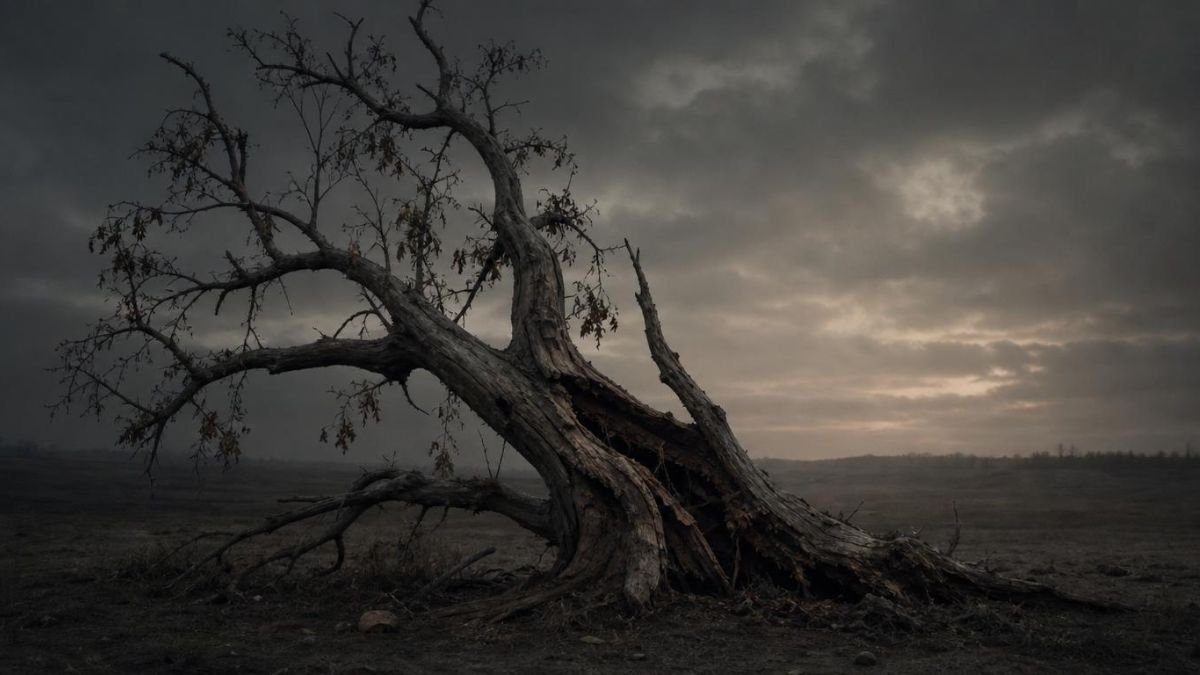
What’s the difference between something that’s dying and something nobody has been watering?
Because from the outside, they look identical. That’s the difficulty I want to sit with tonight, and there’s a word that carries the whole of it inside.
Moribund. It comes straight from the Latin moribundus, from mori, to die. And it means, precisely, at the point of death, in the process of dying.
Not dead. Dying.
The family around it is enormous once you start looking. Mortal. Immortal. Morbid. Mortify, which literally means to make dead — so when something mortifies you, the old sense is that a part of you has just died of it. Even mortgage, which is a piece of grim medieval accounting: a dead pledge, so called because the pledge dies the moment the debt is finally paid.
But moribund is the one that interests me, because of what it insists on.
Latin bothered to have a word for the state of dying. Not the event, not the outcome — the condition of being on the way. And I think that’s a recognition we’ve largely lost. We treat death as a moment, a line crossed, an instant recorded on a certificate. But dying is very often a room people live in for a while. Sometimes a long while.
There’s a dignity in a language having a word for that. It says: this is a real place, and you can be in it, and while you are, you are still here.
Now — watch what we’ve done with the word.
We almost never use it about people anymore. We use it about things. A moribund industry. A moribund institution. A moribund party, a moribund town, a moribund project, a moribund marriage.
And when we use it that way, notice that it functions as a verdict. Nobody says this industry is moribund as a call to action. They say it as an explanation for why they’re not investing. It’s a word that closes a file.
Which is odd, isn’t it? Because the word means dying, and dying means not yet dead. Everything called moribund is, by the strict meaning of the term, still alive. Still, in principle, savable.
But we don’t treat it that way. The moment the label lands, the tending stops.
And here’s where this word gets genuinely dangerous, and genuinely interesting.
Calling something moribund is not an observation. It’s a prediction — and predictions in human systems have a habit of manufacturing their own evidence. Call an industry moribund and the investment leaves. Call a town moribund and the young people go. Call a department moribund and the good people transfer out and the budget gets cut, and eighteen months later everyone agrees the diagnosis was correct.
The word didn’t describe the death. It participated in it.
Which brings me to the question I actually care about, which isn’t about industries at all.
There are things in your life you have quietly filed as moribund.
You know the ones. The friendship that’s been on life support for three years — you never fell out, nothing happened, you both simply stopped. The ambition you had at twenty-six that you now describe in the past tense, with a small self-deprecating laugh. The instrument. The language you were learning. Something between you and a family member that used to be warm and is now merely polite.
And here’s what I’d gently put to you: in most of those cases, the filing came first.
Not always. Some things really are ending, and some endings are right, and I’m not going to tell you every dying thing should be revived. Some should be allowed to finish. That’s an honest position and I’d defend it.
But there’s a specific error I want to name, because it’s so common and so quiet. It’s the moment where a diagnosis becomes a reason to stop tending — and then the not-tending becomes the cause of the decline — and then the decline gets read as confirmation of the diagnosis.
You decided the friendship was over, so you stopped calling. Now it’s over. And you get to feel you were right.
Which brings us to the thing this word can’t tell you and never could.
From the outside, dying and dormant look the same.
Winter looks moribund. Every deciduous tree in a cold country looks, in January, exactly like a dead tree. Bare, brittle, grey, no sign of life anywhere on it. And if you had never seen a spring, you’d bury it. You’d be certain. All the evidence would be on your side.
The only way to tell a dead tree from a sleeping one is time, or a cut into the wood — and the second is only available if you’re close enough to touch it.
So the honest position on most moribund things in a life is: I don’t actually know. Not because it’s unknowable in principle, but because you stopped standing close enough to check.
Which suggests a better question than is this over. Because is this over is a question about the thing, and you can’t answer it from where you’re standing.
The better question is about you. It’s: am I still tending this, or did I stop? And that one you can answer immediately, with total accuracy, tonight.
Because if you’re still tending it and it’s still declining, then you have real information — and you can let go with a clear conscience. Letting go, done properly, is not a failure. Some things should be allowed to reach their end while someone is still holding them.
But if you stopped tending it two years ago and have been reading the results as evidence, then what you’ve got isn’t a diagnosis. It’s a self-portrait.
So here’s what I’ll leave you with tonight. Think of something in your life you’d describe as moribund. A relationship, an ambition, a version of yourself you speak about in the past tense.
Now ask, as honestly as you can manage: is that thing dying — or is it simply that nobody has watered it, and I have been the nobody?
And if it’s the second: what would it actually cost you to find out which one it was?







0 Comments