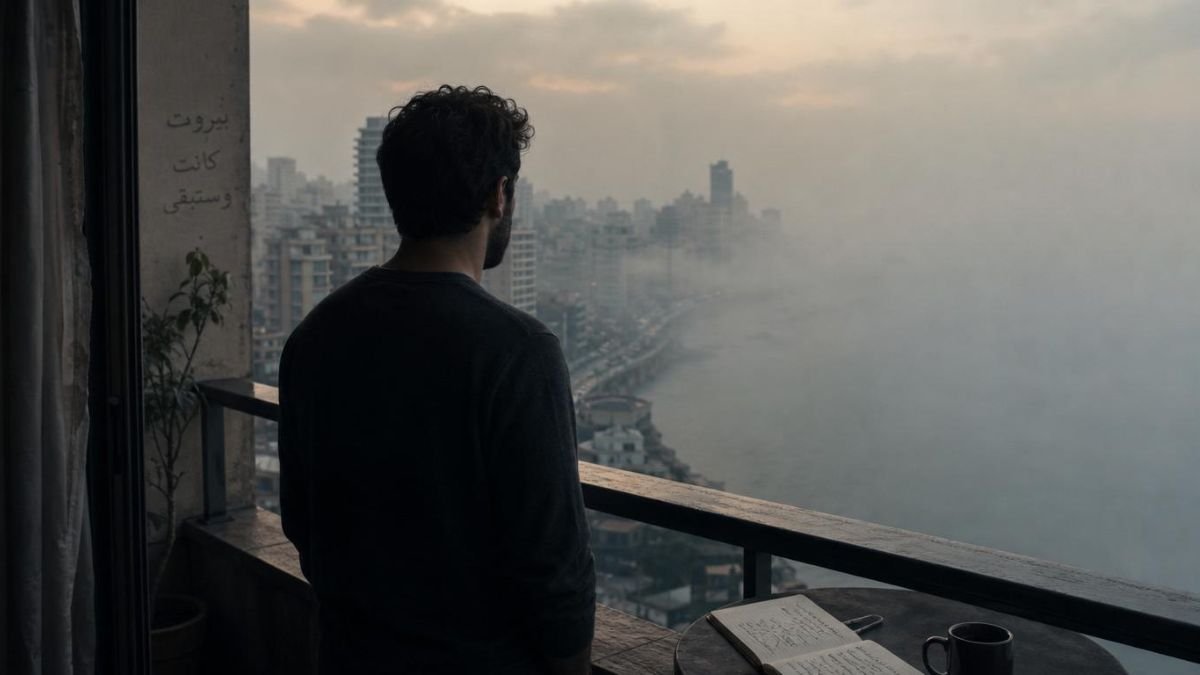
The fog arrived at five-forty in the morning, while Samir was still in his kitchen measuring coffee.
He measured it precisely — three level tablespoons per two cups, a ritual he had maintained for nine years, ever since the period of his life he did not name aloud but thought of privately as the dissolution — and by the time he carried his cup to the balcony the sea had vanished. Not dramatically. Not all at once. The fog had simply moved in from the water with the quiet authority of something that had every right to be there, and now the balcony railing ended in white, and beyond the white there was only suggestion.
Samir stood and drank his coffee.
He was forty-one. He had, over the preceding two decades, constructed a life of intentional legibility. The apartment: chosen for its view of the Corniche, its distance from the noise of the Hamra intersection, its south-facing windows that admitted the kind of light that made mornings feel earned rather than suffered. The career: law, then arbitration, then a consulting practice that allowed him to solve other people's intractable problems at a rate that suggested his own life contained none. The future: a second apartment in the mountains, a tentative plan to write something he had been not-writing for seven years, a vague but present intention to find again, someday, the particular quality of connection he had lost during the dissolution.
All of this was visible to him at normal hours. He could see it arrayed before him the way he could see the coastline on clear days — the arc of the bay, the green headland to the north, the Pigeon Rocks standing improbable and permanent in the shallows. He knew the shape of his life. He had made the shape himself, deliberately, with both hands, as a corrective to all the years when shape had been imposed on him by forces that did not ask his preference.
But the fog did not consult the coastline before it arrived.
He had been thinking, lately, about Nour.
He had not thought about Nour in four years, which was itself a kind of achievement — a monument to the particular discipline of forgetting — and then three weeks ago she had appeared in the background of a mutual acquaintance's photograph, laughing at something outside the frame, and the forgetting had undone itself overnight with the completeness of a knot coming loose. She was not in his plan. She had never been in his plan; she had arrived, years ago, before he understood that he needed one, and then she had left, or he had left, or they had collectively, incrementally failed to stay, which was a different thing from leaving but arrived at the same destination.
He finished his coffee. The fog remained.
There was, he understood, a specific quality to this particular morning — the particular whiteness of the erasure, the fact that he could hear the sea below him but not see it, the way the sound was somehow more present for the absence of the visual confirmation. He had spent twenty years learning to see ahead. He had not spent any time learning what to do when the view was taken from him.
Below, hidden in the white, the Mediterranean moved with a patience that preceded him by millions of years and would succeed him by the same measure. It did not accommodate schedules. It did not negotiate with planners. It came when it came and withdrew when it withdrew and the coastline was beautiful precisely because it was always, on some timescale, temporary.
Samir set his cup on the railing.
He was not, he thought, afraid of the fog. He was afraid of what it revealed about his relationship to clarity. He had confused knowing the shape of the future with controlling it. He had confused preparation with the thing preparation was supposed to make possible, which was — he was only now naming it — a life that felt lived rather than administered.
Somewhere in the white, a horn sounded. A boat he could not see, navigating by instruments, by memory, by whatever a captain uses when the horizon disappears.
He went inside. He picked up his phone. He looked at the number for a long time. He put the phone down. He picked it up again.
The fog was still there when he stepped back onto the balcony. It would be there for hours yet. He had lived in this city long enough to know that.
He dialed.
It rang.
The Mediterranean moved below him, unseen, enormous, going about its business.
Author's Commentary
Beirut is a city that has been forced, repeatedly, to rebuild its relationship with the future. Its residents understand in a bone-level way that plans are provisional — not because they are pessimists, but because the city has taught them to hold ambition and uncertainty in the same hand simultaneously. Samir is a product of this education, even as he has tried to insulate himself from it.
The dissolution he refers to but does not name is left deliberately vague. It could be a war, a collapse, a personal loss, or all three — because in Beirut these things have a tendency to arrive together. What matters is not the specific event but its legacy: a man who responded to chaos by becoming a very precise planner, and who is now learning that precision is not the same as wisdom.
The fog is not a symbol of doom. It is a symbol of the gap between what we can see and what is still there. The sea is still below him. Nour is still in the world. The future is still arriving. The question the story asks — and does not answer — is whether Samir can learn to navigate by instruments rather than by sight.
Discussion Questions
Samir equates knowing the shape of the future with controlling it. Is this a common confusion? How do you personally navigate the difference between planning and controlling?
The city of Beirut functions almost as a character here — a place that has learned to live with uncertainty. Does your own environment shape how you relate to the future?
The story ends on a ring tone, not an answer. What do you hope happens next? What does your hope reveal about what you most want for Samir?








0 Comments