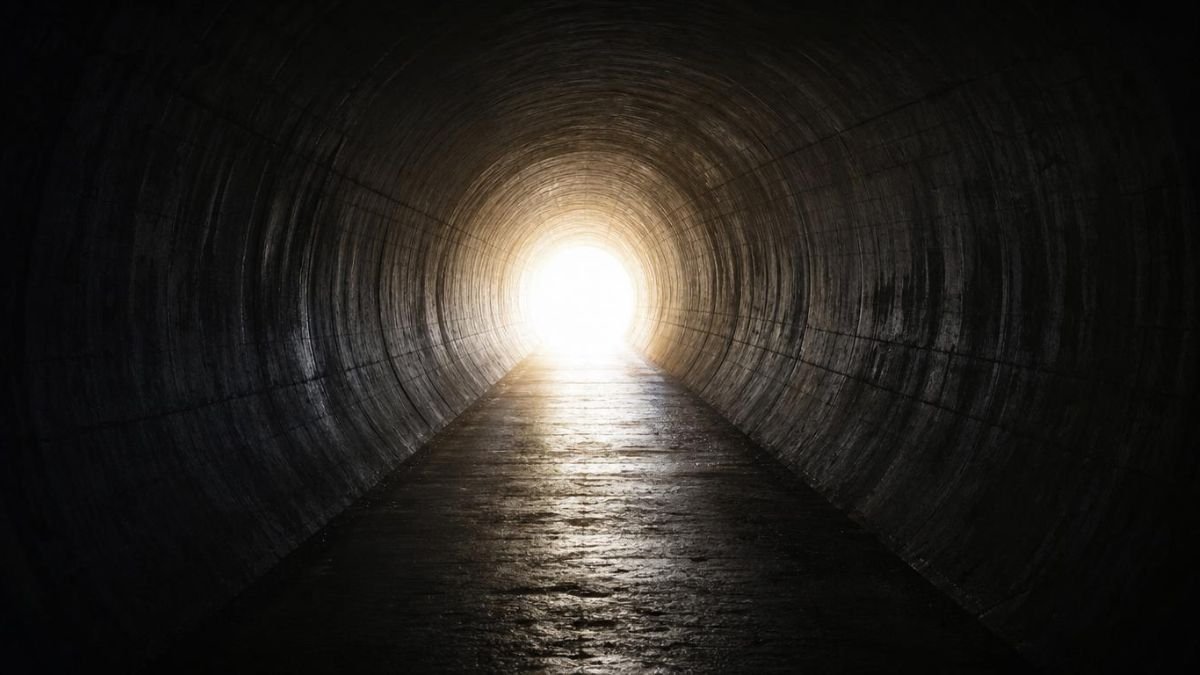
What exactly is the difference between a cave and a tunnel?
It’s not the darkness. Both are dark. It’s not the walls, or the cold, or the strange way sound behaves inside them. Stand blindfolded in either one and you could not tell them apart.
The difference is a single fact, and it is entirely invisible from the inside: a cave has one entrance. A tunnel has two.
That’s it. That’s the whole distinction. And I think it might be the most important distinction there is in any hard season of a life, because everything about how you should behave depends on which one you’re standing in — and you usually cannot tell.
Let’s stay with the tunnel, since that’s the phrase. There is light at the end of the tunnel. We say it to each other in the long stretches: the illness, the debt, the grief, the years of study, the season where nothing is working and nothing has worked for a while. And it’s such a familiar phrase that I want to slow down and actually look at what it’s claiming, because it’s more precise than we give it credit for.
First: it’s a tunnel, which means walls. And walls are usually the complaint. You can’t go sideways, you can’t wander off, you can’t take the interesting detour, you can’t quit and go do something more pleasant. But notice what walls also do. In an open field, lost, in the dark, every direction is equally plausible and equally useless. In a tunnel, there are only two options — forward or back. The walls are what make the choice simple. They’ve stolen your freedom and handed you clarity in exchange, and on the worst days that is not the worst trade.
Second: the light does not come to you. This matters more than anything else in the phrase. The light at the end of the tunnel has never once, in the history of tunnels, walked down and collected anybody. It is simply information. It says: there is an opening, and it is that way. The walking is entirely yours.
Third — and this is the part I most want you to have — is the geometry of it. If you’ve ever driven a long tunnel or walked one, you know that the exit appears very early as a tiny point of light, and then it stays tiny for an absurdly long time. You walk and walk and the light does not seem to grow. It’s maddening. You start to suspect you aren’t moving at all. And then, in the last stretch, it swells — suddenly, enormously, all at once — and you’re out.
That is exactly how progress works in the long seasons, and almost nobody warns us. The recovery, the rebuilding, the slow work of becoming solvent or well or whole again — for most of its length it produces no visible change in the size of the exit. You are moving. The distance is genuinely closing. It just doesn’t look like anything for a very long time, and then it looks like everything.
So if you’re in something now and you feel like nothing is changing — you might be in the middle stretch, where the light is real and stubbornly the same size. The stillness of that light is not evidence that you’re standing still.
Now, I have to deal with the cynic’s version, because you’ve heard it and it’s genuinely funny: the light at the end of the tunnel is an oncoming train. And I’ll grant it a point. Sometimes what looked like the way out is another problem arriving at speed. That happens. Hope can be wrong.
But notice the odd thing about that joke — it doesn’t dispute the tunnel. A train is coming from somewhere. It came in through the other end. Even the cynic has accidentally confirmed that the passage goes through.
Which brings me back to the thing I find most moving about this whole image, and it’s the fact that we never say it. Somebody made the tunnel.
A cave is a natural accident — water and time working on stone with nobody’s intention behind it. But a tunnel is an act of will. It exists because human beings looked at a mountain and decided it should be crossable, and then spent years in the dark making it so, mostly for the benefit of people they would never meet.
So if you’re in a tunnel, you are not lost. You are on a route. Someone was here before you, in worse conditions, with less light, and they came through, and the fact that there’s a passage at all is their doing. The grief you’re moving through has been moved through. The illness, the divorce, the year after the loss, the impossible stretch of raising a small child alone — none of it is unmapped. It is one of the most heavily traveled tunnels on earth. Every single person who tells you it does get better is not making a prediction. They’re reporting a fact about a passage they personally walked.
And what about the cave? Because sometimes it really is one. Sometimes the thing you’re in has no far end — the loss that will not resolve, the condition that won’t be cured, the situation with no exit at all.
Here’s what I’ve come to believe. Even in a cave, the direction is out — but out is back the way you came, toward the entrance, toward the light you already know exists. There’s no shame in that. Turning around is not defeat when the passage genuinely doesn’t go through. The skill, and it’s a hard-won one, is telling the two apart honestly instead of hopefully — and being willing to ask someone who’s been in this particular dark before which kind it is.
So here’s what I’ll leave you with. Think about the dark stretch you’re in now, or the one you’re closest to. And ask yourself, as plainly as you can: is this a cave, or a tunnel? Do I actually know, or have I just assumed?
And then the question underneath it — the one that changes what you do tomorrow: if it is a tunnel, then somebody dug it. So who came through this one before you, and why haven’t you asked them how long the middle part takes?






0 Comments