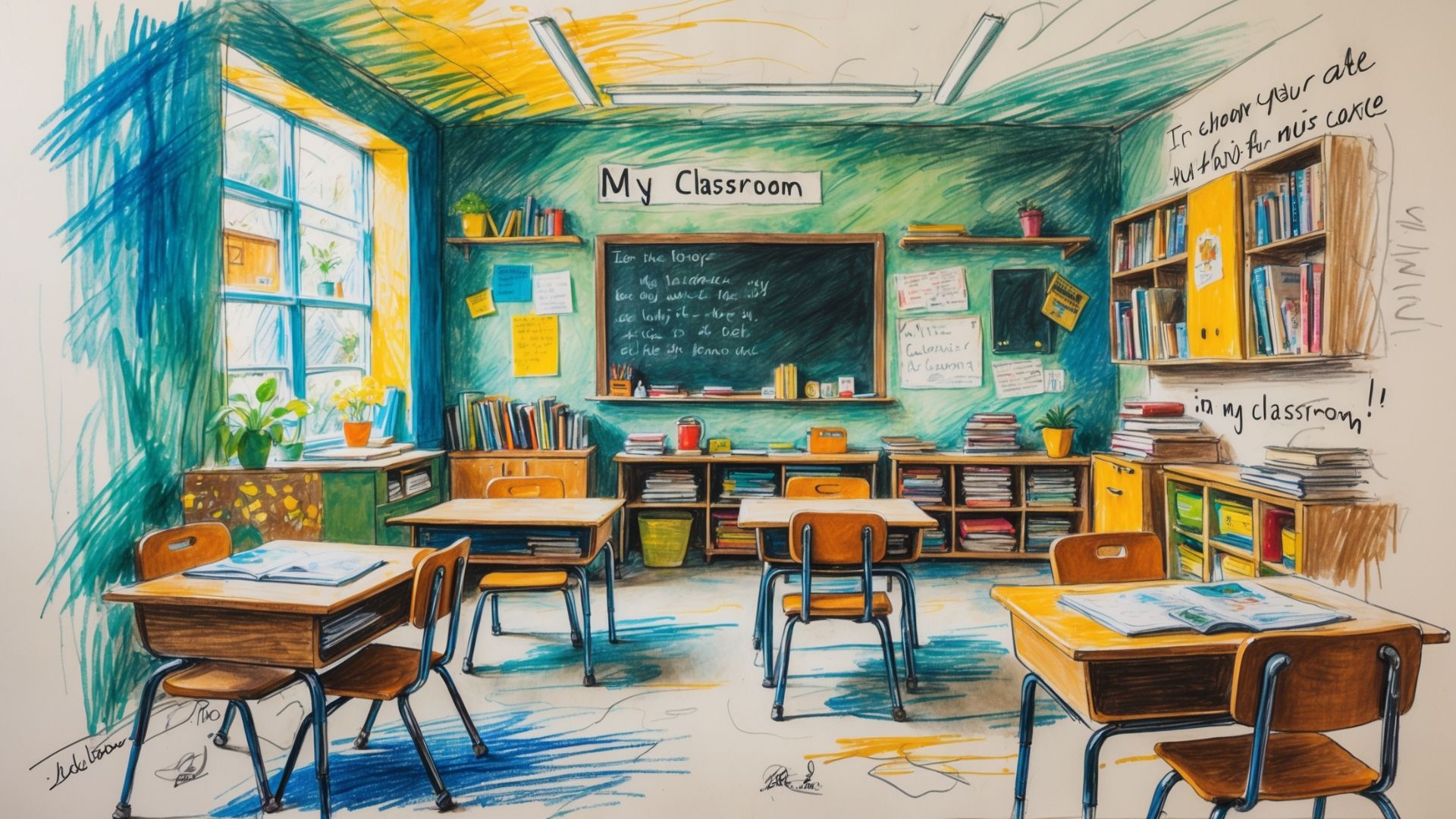
Let's Learn English: Inside the Classroom!
Hello! Are you ready to learn some English words? That's great! Learning a new language is an adventure, and starting with things you see often can make it easier. Today, we will talk about the classroom. Maybe you are in an English class right now, or perhaps you remember your school days. We will learn the names of common things in a classroom and some easy phrases to use. Don't worry, we will go slowly, and you can practice along the way. You can do this!
What's in a Classroom? Let's Look Around!
Imagine you are sitting in a classroom. What do you see? Let's learn some words together.
- Desk: This is where you sit to study. It's a small table.
- Example: "My book is on the desk."
- Real life: You put your notebook and pen on your desk to write.
- Practice: Look around you. Do you see a desk? Try saying: "This is a desk." Good job!
- Chair: This is what you sit on. Usually, it's behind the desk.
- Example: "Please sit on the chair."
- Real life: When the teacher says "Sit down," you sit on your chair.
- Practice: Can you point to a chair? Say: "That is a chair." Excellent!
- Book: You read this. It has pages with words and pictures.
- Example: "Open your book to page 5."
- Real life: Your teacher might ask you to read from your English book.
- Practice: Do you have a book near you? Hold it and say: "This is my book." Very good!
- Notebook: This is a book with empty pages. You write in it.
- Example: "Write the new words in your notebook."
- Real life: You use a notebook to take notes during the lesson.
- Practice: Let's pretend you are writing. Say: "I am writing in my notebook." Keep going!
- Pen: You use this to write. It uses ink.
- Example: "Can I borrow a pen?"
- Real life: You need a pen to fill out a form or sign your name.
- Practice: Find a pen. Say: "I have a pen." You're learning fast!
- Pencil: This is also for writing or drawing. You can erase it.
- Example: "Use a pencil for the test."
- Real life: Many students use pencils because they can fix mistakes easily with an eraser.
- Practice: Do you like using a pen or a pencil more? Try saying: "I use a pencil." or "I use a pen." Great!
- Whiteboard (or Blackboard): The teacher writes on this big board at the front of the class. Whiteboards use markers, and blackboards use chalk.
- Example: "The teacher writes on the whiteboard."
- Real life: Important information or new words often go on the whiteboard.
- Practice: Imagine the teacher is writing. Say: "Look at the whiteboard." Wonderful!
- Teacher: This is the person who helps you learn.
- Example: "The teacher explains the lesson."
- Real life: You listen to the teacher and ask questions if you don't understand.
- Practice: Think about your teacher. Say: "My teacher is nice."
- Student: This is a person who is learning. That's you!
- Example: "I am a student."
- Real life: Students go to school or classes to learn new things.
- Practice: Point to yourself and say: "I am a student." Yes, you are!
Wow, look at all the words you know now! Desk, chair, book, notebook, pen, pencil, whiteboard, teacher, student. That's fantastic!
Simple Phrases for the Classroom
Knowing the words is great. Now, let's learn some simple phrases (groups of words) you can use in the classroom.
- Asking for something:
- "May I borrow a pen, please?" (Use this if you need a pen.
- "Can I have a piece of paper, please?" (If you need paper.
- Practice: Try asking for a pencil. Say: "May I borrow a pencil, please?" Very polite!
- Asking where something is:
- "Where is the book?"
- "Where is my notebook?"
- Practice: Ask where the teacher is. Say: "Where is the teacher?" Good question!
- Saying what you need:
- "I need a pen."
- "I need my book."
- Practice: Say you need a chair. "I need a chair." Perfect!
- Understanding instructions:
- "Open your book." (Means to look inside your book.
- "Close your book." (Means to shut your book.
- "Listen to the teacher." (Means to pay attention.
- "Look at the whiteboard." (Means to turn your eyes to the board.
- Practice: Let's pretend. "Open your book." Now, "Close your book." You did it!
Let's Practice More!
Talking is the best way to learn. Let's try using the words and phrases.
Imagine you are in class:
- You need a pen. What do you say?
- (Think: "May I borrow a pen, please?" or "I need a pen."
- The teacher tells you to look at the board. What do you do?
- (Think: You look at the whiteboard.
- You see your friend's notebook. What can you say?
- (Think: "That is your notebook."
You can practice these words every day. When you sit at a table, think "desk." When you sit down, think "chair." When you read, think "book." When you write, think "pen" or "pencil" and "notebook."
Learning English takes time, but you are doing a wonderful job. Every new word and phrase you learn is a big step. Keep practicing talking about the classroom objects. Maybe you can name 5 things in a classroom right now! Try it!
You learned a lot today! Keep up the amazing work!



0 Comments