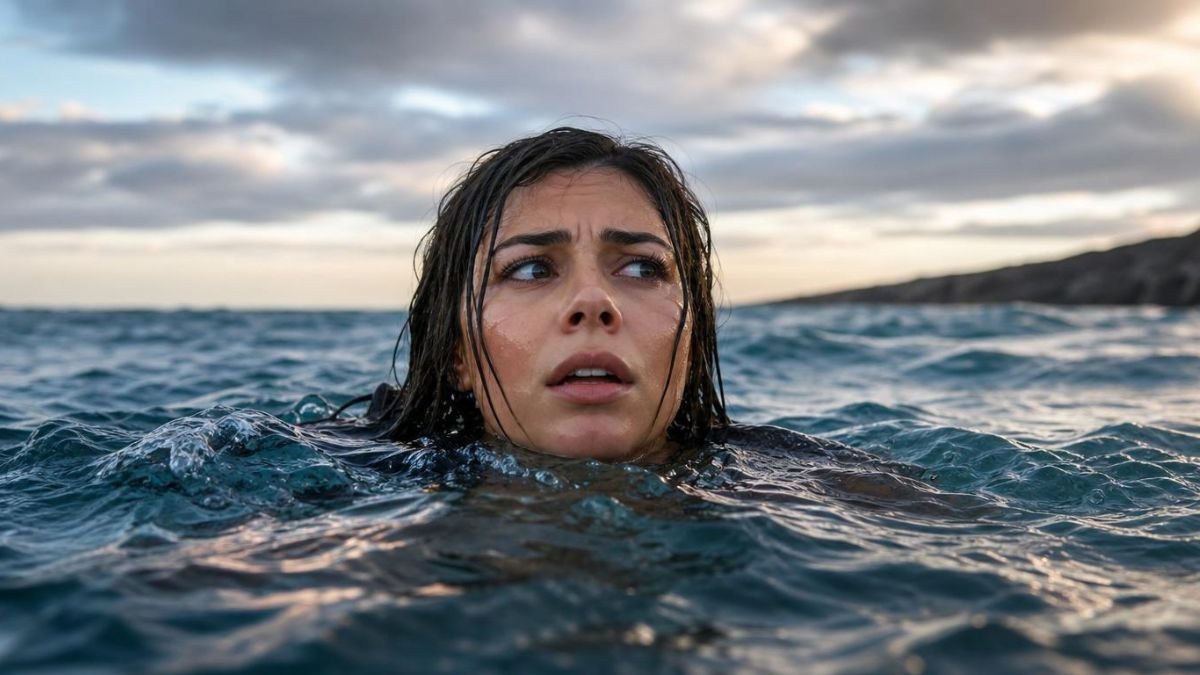
On the hardest days, are you allowed to count I’m still here as a good day?
Because there’s a phrase we reach for in those seasons, and I want you to notice how astonishingly modest it is. Keep your head above water. That’s it. That’s the whole instruction.
Listen to everything it doesn’t say. It doesn’t say swim. It doesn’t say make progress. It doesn’t say reach the shore, or beat the current, or get out of the water at all. It asks for a few inches. The distance between your mouth and the surface. It’s the smallest goal in the entire language, and I think it might also be the most merciful.
We don’t talk this way about anything else. Everywhere else we’re told to excel, exceed, optimize, grow. And then someone we love goes under, and every one of those words becomes obscene, and we quietly reach for the one phrase that lowers the bar all the way to the waterline. Just keep breathing. Just be here tomorrow.
I want to stay in the water for a moment, though, because the physical facts of this phrase are strangely instructive.
The first is this: a human body wants to float. Lungs full of air, muscles loose, you rise. The water is not, in itself, trying to kill you. What drowns people, more often than not, is panic. The thrashing. The desperate, exhausting, entirely understandable fight — arms flailing, breath shallow, every muscle rigid — that burns through energy at an incredible rate and drives you down instead of up. The counterintuitive truth taught in every survival course is that what saves you is not effort. It’s calm. Fill the lungs. Stop fighting. Let the water hold what it’s perfectly capable of holding.
And I think we know exactly what that means outside the water. There are seasons where the harder you struggle, the further under you go — where the frantic problem-solving at three in the morning, the endless rearranging, the sheer exhausting effort of trying to fix everything at once, is not keeping you up. It’s the flailing. Sometimes the thing that keeps your head above water is doing dramatically less, and breathing on purpose, and trusting that you are more buoyant than your panic believes.
The second fact is harder, and I want to say it carefully, because it’s the one that might change how you look at someone tomorrow.
Real drowning is almost silent.
Lifeguards will tell you this. The image we carry — the splashing, the shouting, the arm waving in the air — is mostly from films. An actual person in trouble usually can’t call out, because the mouth is barely clearing the surface and every bit of breath is going to breathing rather than to sound. From the shore, they can look almost calm. Someone treading water. Someone quietly bobbing. People have drowned within a few feet of others who genuinely didn’t know.
Sit with that for a second, because it’s the whole reason this phrase matters.
The people around you who are barely keeping their heads above water are not, generally, waving. They’re at their desk. They’re answering fine, thanks. They’re the reliable one, the funny one, the one who always shows up. Not because they’re hiding it from you exactly, but because everything they have is going into the small, silent, invisible work of staying at the surface. There is nothing left over for signaling.
So if you take one practical thing from this episode, let it be that. The quiet ones deserve a second look. Ask twice. Ask the way you’d ask if you actually wanted the answer.
And then there’s treading water, which we use as an insult. I’m just treading water right now, people say, apologetically, like it’s a confession of failure. But treading water is precisely the correct thing to do when you are far from shore and out of strength. It is not nothing. It is the specific, deliberate, tiring skill of remaining alive in deep water until conditions change — until the current shifts, until your strength returns, until the boat comes.
There are whole years of a life that are correctly spent treading water. The year of the illness. The year of the grief. The year of the newborn. The year everything came at once. Nobody grows in those years, and nobody should be expected to. The task is not growth. The task is presence. And the fact that you’re still here, still breathing, still surfacing — that’s not a stalled life. That’s the hardest work you may ever do, done well, by a person nobody applauded.
I’ll add one more thing, gently. Everything above assumes a season, not a permanent condition. Water is survivable and boats do come — but nobody is meant to tread indefinitely, alone, in a sea with no edge. If your season has stopped feeling like a season, that’s not weakness to admit. That’s you doing the smartest thing a swimmer can do, which is to raise one arm and be seen. There is no version of courage that requires you to go under quietly.
But for the ordinary hard weeks, the ones we all get, I want to give you permission that I suspect you’ve been withholding from yourself. You do not have to make progress today. You do not have to be impressive, or productive, or on top of it. Some days the entire assignment is your next breath, and completing that assignment is not a small thing. It’s the thing everything else will eventually be built on.
So here’s what I’ll leave you with. Two questions, and I’d like you to answer both.
The first is for you. If today’s only goal were the next breath, and you met it — could you let that count? Could you go to sleep tonight calling it enough?
And the second is for everyone else. Somewhere near you, someone is quietly at the surface, not waving, using everything they have to stay there. So who have you assumed is fine, simply because they were silent in the water?





0 Comments