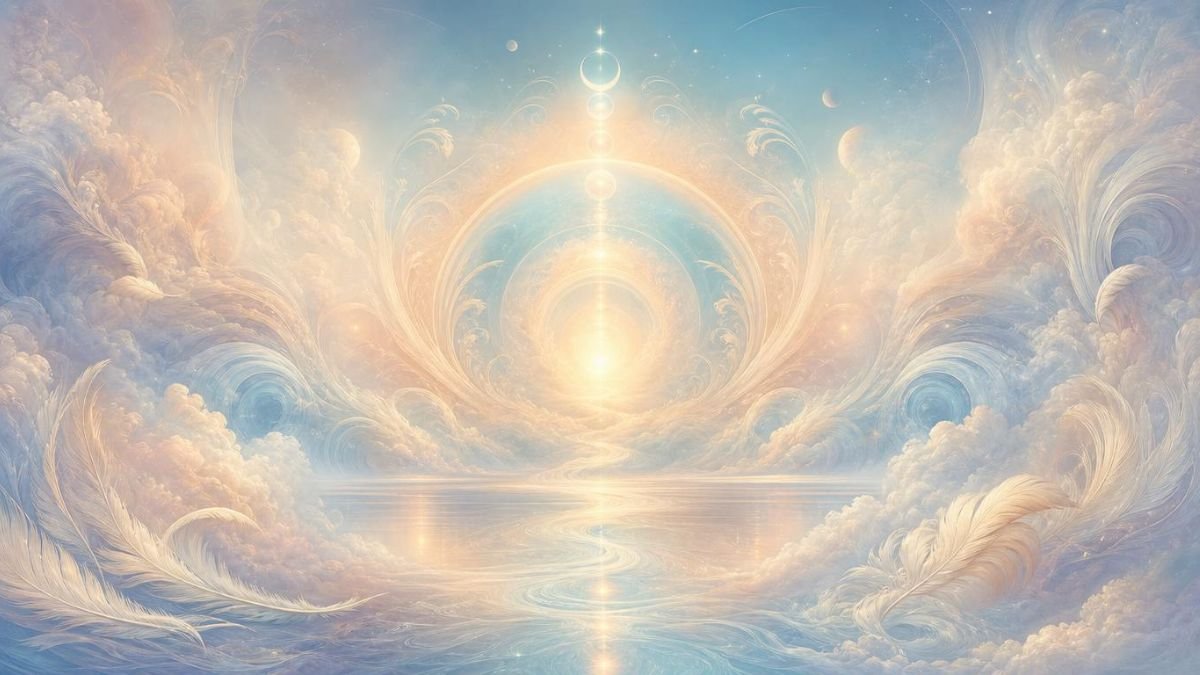
Have you ever felt something so large that every word you reached for felt like a thimble held up to the ocean?
Maybe it was grief. Maybe it was love. Maybe it was standing under a sky so full of stars that something in your chest ached and you turned to the person beside you and could only manage — "wow" — and knew, even as you said it, that the word had failed completely. That whatever had just happened inside you was too big, too deep, too whole to be broken into words at all. There's a word for that experience. And it's a strange and wonderful and slightly paradoxical word, because it's a word whose entire job is to admit that words aren't enough. The word is ineffable.
It means, quite simply, unspeakable — but not in the sense of something too terrible to say. In the sense of something too great to say. Something that cannot be expressed, cannot be captured, cannot be forced into the small containers we call sentences. It comes from Latin — effabilis, able to be spoken, from a root meaning to speak, to utter — with that little in- on the front that means not. Not able to be spoken. The ineffable is the thing that lives on the far side of language, in the country words can point toward but never enter.
And here we are, on a show about the love of words, spending an entire episode on the one word that admits words have a limit. I find that almost unbearably beautiful. Because it means language is honest enough — humble enough — to have coined a term for its own edge. To say: here, right here, is where I end. Beyond this line, you're on your own. I can gesture at what's out there, but I cannot bring it back for you.
Think about how much of what matters most to you lives out there, in the ineffable. Try, right now, to describe the exact taste of your favorite food to someone who's never had it. You can't. You can circle it, compare it, gesture — but the actual experience won't cross the gap. Try to explain the specific quality of your love for one particular person — not love in general, but this love, the exact shape of it. Words scatter like startled birds. Try to say what music does to you, why a certain chord progression opens a door in your chest that has no name. You'll fail. Everyone fails. The most important experiences of a human life are, at their core, ineffable. They can be lived. They cannot be transmitted.
And I think that's why we have art. Stay with me here. If everything could be said plainly, we wouldn't need poetry, or music, or painting, or dance. We'd just say the thing and be done. But the ineffable can't be said plainly — so we invented ways of gesturing at it instead. A poem doesn't tell you the feeling; it builds a shape that makes the feeling happen in you. A song doesn't explain longing; it becomes longing, in sound. Every art form is a different technology for pointing at the ineffable — for getting as close to the unspeakable as a human being can get, and then trusting you to make the final leap across the gap yourself. Art is language reaching past its own edge. It's the effort to say the unsayable, knowing it can't be done, and doing it anyway, because the reaching itself is holy.
This is also, I think, why the great mystics of every tradition end up sounding so oddly alike, and so oddly frustrated. Whatever they touched — whatever vastness they met in their deepest moments — was ineffable, and they knew it, and they kept trying to say it anyway, and they kept failing in the same beautiful way. They pile up images, contradict themselves, reach for metaphor after metaphor, and finally throw up their hands and say some version of: it is not this, it is not that, I cannot tell you, you would have to see. They weren't bad writers. They were honest ones, standing at the edge of language, describing accurately the fact that they'd run out of road. The stammering is the report. The failure to say it is the most truthful thing they could say.
There's a humility in the word that I think we badly need. We live in a time that acts as if everything can be captured, measured, explained, posted, and summed up in a caption. And ineffable stands quietly against all of that. It insists that the deepest things resist capture. That there are experiences you can only have, never hold. That some truths can be pointed to but never possessed. And rather than making me sad, that fills me with a kind of relief. It means there will always be mystery. It means the world can never be fully flattened into words and thereby used up. There will always be a vastness left over — beyond the reach of every sentence ever written — waiting on the other side of language.
And maybe that's what awe is. Awe is the emotion you feel when you brush up against the ineffable — when you meet something so much larger than your capacity to name it that language simply falls silent, and you're left standing there, wordless, full. The wordlessness isn't a failure in those moments. It's the appropriate response. Some things deserve your silence more than your description. Some experiences are honored best by the fact that you couldn't speak.
So the next time you're struck dumb — the next time something moves through you that's too big for any word you own — I don't want you to feel that you've failed to find the right expression. I want you to recognize where you are. You've arrived at the edge. You're standing at the exact border of what language can do, looking out over the country beyond it. And that borderland, that wordless vastness, is where the most real things in your life have always lived.
Here's the question I'll leave you with, and notice that I can only point toward it — I can't say it for you. If the things that matter most to you are precisely the things you can never fully put into words — then what have you been trying to explain that you might be meant, instead, to simply stand before in silence and let remain ineffable?


0 Comments