Before You Listen: Building Your Academic Listening Skills
History and anthropology lectures present a particular challenge for international exam candidates, and it is not the one most students expect. The difficulty is rarely the vocabulary. It is the density of proper nouns. A single minute of audio can contain place names, culture names, and dates, and many candidates freeze when they hear a word they cannot spell.
The solution is to stop trying to capture names accurately. Write the first two letters and move on. If you hear a name you have never encountered, note it as "C-" or "H-" and keep listening, because the question will almost never require you to reproduce the spelling. What the question will require is that you know what was said about that place, and you cannot know that if you spent four seconds trying to transcribe it.
Second, listen for the argument hiding inside the information. Academic lectures on history are not lists of facts; they are arguments about how to interpret facts. Very often the argument takes the form of an old view being corrected by new evidence. When you hear phrases like "for a long time it was assumed," "the traditional picture," or "what the evidence now suggests," you have found the backbone of the entire talk. Everything else hangs from it, and main idea questions are usually written from it directly.
Third, pay attention to hedging. Serious academic speakers distinguish carefully between what is established and what is debated, using words like "estimates suggest," "probably," "remains contested," and "we may never know." Exams test this distinction constantly, because it separates listeners who understood the content from listeners who understood the speaker. If the audio says a claim is disputed and an answer option states it as fact, that option is wrong no matter how reasonable it sounds.
Finally, be careful with numbers that come with qualifying language. In today's lecture you will hear population figures, and they arrive attached to words like "estimates" and "range." Write the qualifier down beside the number. A question is very likely to depend on it.
For this particular recording, one more piece of advice. The speaker corrects several ideas that many people learned at school. If an answer option matches what you were taught rather than what you just heard, choose the audio every time.
About This Talk
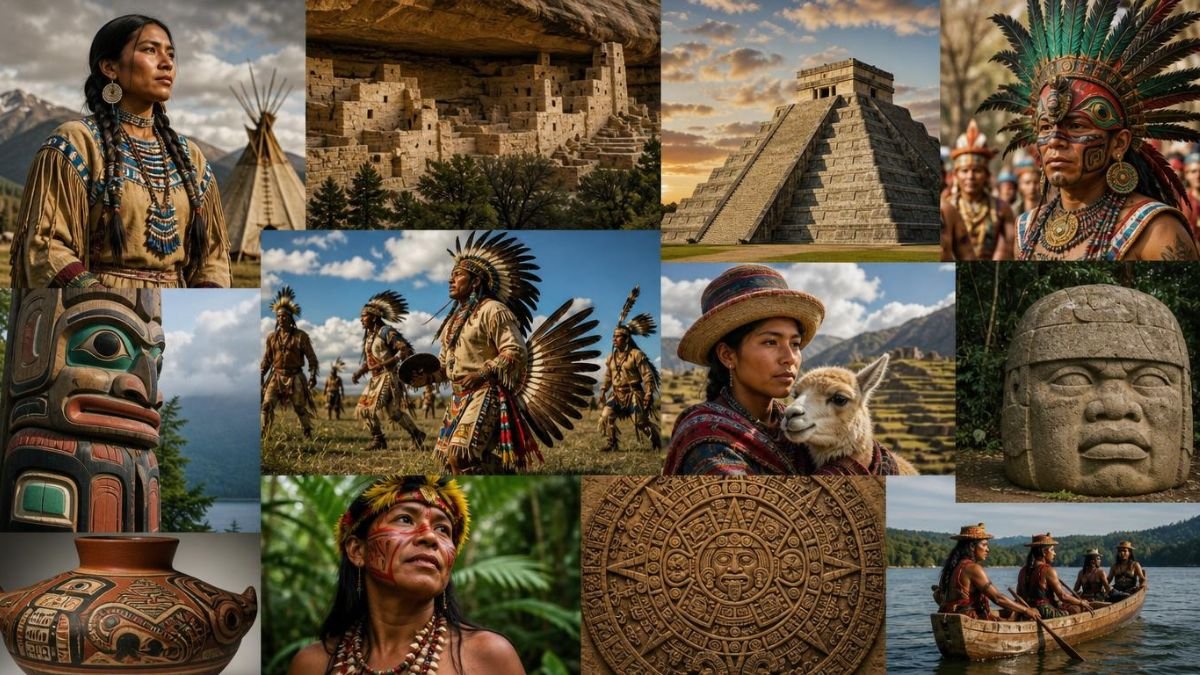
You are about to hear part of a university lecture in an anthropology course. The speaker examines what archaeological evidence reveals about the Indigenous societies of the Americas before European contact, and why the picture presented in older textbooks was so badly mistaken. Before you listen, consider this question: if a landscape looks wild and untouched, how would you know whether it had been shaped by people? The speaker's answer to that question runs through the entire lecture.
Key Vocabulary and Phrases
pristine: Completely pure and untouched by human activity. The speaker uses it to describe how early European observers imagined the American landscape, and then spends much of the lecture explaining why that impression was mistaken.
an earthwork: A large structure built from soil and earth rather than stone. In the talk it refers to the enormous mounds constructed at Cahokia, and the word is worth knowing because it appears in archaeology texts constantly.
anthropogenic: Created or caused by human beings. The speaker applies it to certain Amazonian soils, which is a striking use, since we usually think of soil as something nature produces on its own.
subsistence: The activity of producing just enough food to survive. The speaker uses it while challenging the assumption that Indigenous peoples lived at a bare subsistence level, so notice the context in which the word appears.
a staple: A basic food that forms the foundation of a diet. Maize is described this way, and the speaker explains how it was developed over thousands of years.
a yield: The amount of food a piece of land produces. The word appears in the discussion of raised-field agriculture, where the yields were remarkably high.
a confederacy: A political union of separate groups that keep their own authority while cooperating. The term is used for the alliance of nations in the northeast of the continent.
depopulation: A dramatic fall in the number of people living somewhere. In the lecture, it refers to the catastrophic losses that followed contact with Europeans, and it is central to the speaker's main argument.
contested: Disputed among experts, with no settled agreement. The speaker uses it about one specific historical claim, and the word signals caution rather than doubt about everything.
ingenuity: Cleverness at solving practical problems through invention. The speaker uses it repeatedly, and it carries the respectful tone of the whole lecture.
to reframe: To change the way something is understood by presenting it from a different angle. This is essentially what the entire lecture is doing.
a testament to: Clear evidence of something impressive. Used about the scale of construction achieved without certain technologies.
sustained: Continued over a long period without stopping. The speaker uses it for agricultural systems that maintained their productivity across centuries.
a legacy: Something inherited from the past that continues to have effects today. It appears in the closing section, where the speaker emphasizes that these are living cultures.
Listening Audio
Listening Script
Good morning. Today we begin our unit on the Americas before European contact, and I want to start by dismantling an image that many of you will have absorbed without ever examining it.
The image is of a vast, empty, pristine continent. Endless forest, uncounted herds, a few small groups of people moving lightly across a landscape they had barely touched. This picture appears in early colonial accounts, in nineteenth century painting, and in a surprising number of textbooks still in circulation. It is also, according to the evidence we now have, close to being the opposite of the truth.
Let's begin with scale. Around the year one thousand and fifty, on the floodplain near what is now the city of Saint Louis, there stood a city we call Cahokia. At its height it covered several square miles and contained more than a hundred earthworks, the largest of which, Monks Mound, rises about thirty meters and covers a base area larger than the footprint of the Great Pyramid at Giza. It was built entirely by hand, basket of soil by basket of soil, without draft animals and without the wheel. That is a testament to organization as much as to labor. Population estimates for Cahokia vary considerably, and I want you to note that word, estimates, but most fall somewhere between ten and twenty thousand people, which would have made it larger than London at the same date.
Now move south. The Mexica, whom many of you will know as the Aztecs, built their capital on an island in a shallow lake, and faced an obvious problem: not enough farmland. Their solution was the chinampa, a system of raised fields constructed by piling mud and vegetation onto woven frameworks anchored in the lakebed. The result was farmland that was permanently moist, continuously fertilized by the sediment around it, and productive enough to support multiple harvests each year. The yields were extraordinary by the standards of any agricultural system of the period, and the ingenuity involved was not accidental. It was engineering.
And this brings me to my central point, which concerns the Amazon.
For most of the twentieth century, the standard view held that the Amazon basin could not support large populations. The soils were poor, the argument went, and so the people living there must have been small mobile groups practicing simple subsistence agriculture. Then researchers began looking closely at patches of unusually dark, fertile soil scattered throughout the basin, known locally as terra preta, meaning black earth. These soils are rich in charcoal, in pottery fragments, in organic waste. They are not natural. They are anthropogenic, created deliberately over generations by people adding charred material and refuse to the ground, and they remain fertile centuries after they were made. In some regions they cover areas measured in square kilometers.
Consider what that requires: large settled populations, sustained over long periods, actively improving their land rather than exhausting it. The forest that early explorers described as untouched wilderness was in many places an inhabited landscape, managed through controlled burning, through the planting and encouragement of useful tree species, and through soil creation. What looked pristine was in fact the product of thousands of years of human work.
I should add that the same principle applies to the great grasslands and open woodlands of North America. Regular controlled burning by Indigenous nations maintained those environments, and when the burning stopped, the landscapes changed.
Let me turn briefly to social and political organization, because material achievement is only part of the story. In the northeast, five nations, later six, formed the Haudenosaunee Confederacy, governed by an oral constitution known as the Great Law of Peace. It established a council, defined procedures for reaching decisions, granted particular authority to clan mothers in selecting and removing leaders, and set out how member nations retained internal independence within a common structure. Whether this system directly influenced the framers of the United States Constitution is a question that remains genuinely contested among historians, and I would rather you understood the debate than memorized a conclusion. What is not contested is that the confederacy functioned as a sophisticated political system for centuries before Europeans arrived to observe it.
So why has the empty continent picture persisted so long? Part of the answer is uncomfortable. Many early European accounts of an underpopulated landscape were written decades after first contact, and by that point epidemic diseases had already swept through populations with no prior exposure to them. Estimates of the resulting depopulation vary widely, but many researchers place the losses across the hemisphere at somewhere in the region of ninety percent within roughly a century and a half. Diseases traveled faster than colonists did. So a great many settlers genuinely believed they were entering an empty land. They were, in a real sense, walking through the aftermath of a catastrophe they had arrived too late to witness, and they mistook it for the natural condition of the place.
I want to close on one point, and I want to be direct about it. Everything I have described this morning tends to be discussed in the past tense, and that framing carries a danger. These are not vanished civilizations. The Haudenosaunee Confederacy still exists. Millions of people across the hemisphere speak Indigenous languages, maintain their nations, and hold to agricultural and ecological knowledge developed over millennia. The legacy under discussion is not an inheritance we observe from outside. It belongs to living communities, and it is worth studying for what it can still teach us about managing land over the long term.
Next week we'll examine the Andes, and I'll be asking you to reframe another assumption: that record-keeping requires writing.
Comprehension Quiz
Choose the best answer for each question. After each question, write one or two sentences explaining why you chose that answer. Working out why an answer is right is what makes the skill stick, so treat the justification as part of the exercise.
1. What is the main purpose of the lecture?
A) To compare the achievements of North and South American societies
B) To describe the causes of population decline after European contact
C) To correct a widespread misunderstanding about the pre-contact Americas
D) To argue that ancient agricultural methods should be adopted today
Justification: _________________________________________________________________
2. What does the speaker emphasize about the construction of Monks Mound?
A) It was achieved without draft animals or the wheel
B) It took longer to complete than the Great Pyramid at Giza
C) It was built from stone transported over long distances
D) It required cooperation between several distant cities
Justification: _________________________________________________________________
3. What is the speaker's attitude toward early European accounts of an empty landscape?
A) They were deliberate falsifications intended to justify settlement
B) They remain the most reliable source we have for the period
C) They were accurate for coastal regions but not for the interior
D) They were sincere but described a landscape already transformed by disease
Justification: _________________________________________________________________
4. What is significant about terra preta soils?
A) They formed naturally in areas where forests were regularly burned
B) They were created by people and stayed fertile for centuries afterward
C) They were discovered only in a small area near the Amazon river mouth
D) They lose their fertility quickly once cultivation stops
Justification: _________________________________________________________________
5. Why does the speaker describe the chinampa system?
A) To explain why the Mexica capital was eventually abandoned
B) To show that farming methods spread between distant regions
C) To argue that lake environments were the most productive farmland
D) To illustrate deliberate engineering in response to a practical problem
Justification: _________________________________________________________________
6. Which of the following is NOT mentioned as evidence that Indigenous peoples shaped their environments?
A) The creation of fertile soils from charcoal and organic waste
B) The construction of raised fields in a shallow lake
C) The breeding of large animals to plow agricultural land
D) The use of controlled burning to maintain open landscapes
Justification: _________________________________________________________________
7. What does the speaker mean by describing the continent as "pristine"?
A) Unusually fertile and capable of supporting large populations
B) Untouched by human activity and left in a natural state
C) Unfamiliar to Europeans and therefore poorly documented
D) Unspoiled by the epidemics that arrived later
Justification: _________________________________________________________________
8. What can be inferred about the influence of the Great Law of Peace on the United States Constitution?
A) Historians have not reached agreement about whether it occurred
B) The speaker considers the connection to be firmly established
C) Recent evidence has disproved the idea entirely
D) The question has received almost no scholarly attention
Justification: _________________________________________________________________
9. What does the speaker say about population figures for Cahokia?
A) They have been confirmed by recent excavation at the site
B) They are lower than earlier researchers had assumed
C) They show the city was smaller than London at the same date
D) They vary, with most falling between ten and twenty thousand
Justification: _________________________________________________________________
10. Why does the speaker raise the issue of the past tense at the end of the lecture?
A) To explain why archaeological evidence is often difficult to date
B) To stress that the cultures discussed continue to exist today
C) To introduce the topic of the following week's lecture
D) To acknowledge that some of the evidence presented is uncertain
Justification: _________________________________________________________________
1. Correct answer: C
C is right, and the opening tells you so. The speaker announces an intention to dismantle an image many students absorbed without examining, describes that image, and then says it is close to being the opposite of the truth. Everything that follows is evidence against it. When a lecture opens by naming a false belief, the purpose is nearly always correction.
A notices that examples come from different regions, but the examples all serve the same argument. They are not being weighed against each other.
B is the subject of one section near the end. It explains why the misunderstanding survived, which makes it supporting material rather than the point.
D adds a recommendation about modern agriculture. The speaker does say the knowledge is worth studying for managing land over the long term, but that is a closing remark, not the purpose of the talk. Watch for options built from a lecture's final sentence.
2. Correct answer: A
A is stated directly: the mound was built entirely by hand, basket of soil by basket of soil, without draft animals and without the wheel, which the speaker calls a testament to organization as much as to labor.
B introduces a comparison of construction time. Giza is mentioned only as a size comparison for the base area, not for duration.
C contradicts the audio. The word "earthwork" is defined earlier in the vocabulary list for exactly this reason: it means built from soil rather than stone.
D invents cooperation between cities, which is never described.
If you chose B, the lesson is a useful one. Hearing two things named in the same sentence does not tell you what is being compared. Listen for the specific quality under comparison, which here was size.
3. Correct answer: D
D captures the position precisely. The speaker says many settlers genuinely believed they were entering an empty land, and describes them as walking through the aftermath of a catastrophe they arrived too late to witness.
A turns the point into an accusation of dishonesty. The word "genuinely" rules this out, and it was chosen carefully by the speaker.
B contradicts the argument entirely.
C invents a geographic split between coast and interior that never appears.
This question rewards close attention to a single adverb. Attitude questions frequently do. When a speaker inserts a word like "genuinely," "sincerely," or "understandably," they are telling you how to judge the people being discussed.
4. Correct answer: B
B matches the description: the soils are anthropogenic, created deliberately over generations by people adding charred material and refuse, and they remain fertile centuries after they were made.
A is the trap, because it takes a real element, burning, and uses it to argue the soils were natural. The speaker explicitly says they are not natural. Options that reverse a stated claim while keeping its vocabulary are extremely common, so listen for the negation.
C shrinks the scale. The speaker says these soils are scattered throughout the basin and in some regions cover areas measured in square kilometers.
D reverses the finding about durability, which was the most remarkable part of it.
5. Correct answer: D
D reflects how the example is framed. The speaker sets up a problem, not enough farmland on an island, then presents the chinampa as the solution, and closes by saying the ingenuity involved was not accidental but engineering.
A introduces the abandonment of the capital, which is never discussed.
B suggests diffusion between regions, and no such claim is made. The chinampa and terra preta are presented as separate solutions developed independently.
C overstates the case into a general ranking of farmland types. The speaker praises the yields as extraordinary for the period without declaring lake farming best overall. Be cautious with options that convert a specific compliment into a universal claim.
6. Correct answer: C
C is correct because animal breeding for plowing is never mentioned as evidence of anything. In fact, the speaker notes the absence of draft animals when describing how Cahokia was built, which points in the opposite direction.
A is terra preta, B is the chinampa system, and D is the controlled burning that maintained grasslands and open woodlands in North America. All three appear as evidence of environmental management.
Here is the transferable point. On NOT questions, the correct answer is sometimes a detail the lecture contradicts rather than one it never raises. Since the phrase "draft animals" did appear, a hurried listener may half-recognize it and reject this option. Recognition is not the same as confirmation, and the difference costs marks.
7. Correct answer: B
B is the meaning in use. The speaker builds the picture explicitly: endless forest, uncounted herds, a landscape people had barely touched. That is what pristine means here, untouched by human activity.
A confuses pristine with fertile. Fertility is discussed at length, but as a result of human work rather than as part of this word's meaning.
C shifts the word toward European knowledge of the continent, which is a different idea.
D links pristine to disease, and while epidemics matter enormously to the lecture, they belong to the explanation of why the false image survived, not to the definition of the word.
Vocabulary questions are always answered from context, and the context here is generous. The speaker defines the term through three descriptive phrases before ever using it in argument.
8. Correct answer: A
A is right, and the speaker practically hands it to you: whether the system directly influenced the framers of the United States Constitution remains genuinely contested among historians, and the speaker adds a preference that students understand the debate rather than memorize a conclusion.
B claims the speaker endorses the connection, which is exactly what the hedging language rules out.
C claims disproof, which is a different thing from disagreement. Contested means unresolved, not refuted.
D says the question has been neglected, but a contested question is one that has attracted plenty of attention, just not agreement.
This question tests whether you were listening to the speaker's certainty level rather than only to the content. Options B, C, and D each represent a different way of mishearing a hedge, and international exams use all three.
9. Correct answer: D
D matches the audio, where the speaker says estimates vary considerably, asks you to note the word "estimates," and gives a range of roughly ten to twenty thousand people.
A claims confirmation by excavation, which converts an estimate into an established fact. That conversion is the single most common numbers trap in academic listening.
B invents a comparison with earlier researchers' assumptions.
C reverses the comparison. The speaker says such a population would have made Cahokia larger than London at the same date, not smaller. Comparative directions are easy to flip when you are writing quickly, so it is worth using an arrow rather than a word in your notes.
10. Correct answer: B
B is the point of the closing section. The speaker warns that discussing everything in the past tense carries a danger, states that these are not vanished civilizations, notes that the Haudenosaunee Confederacy still exists, and refers to living communities.
A raises dating problems, which never come up.
C is tempting because the lecture does end with a preview of next week's topic on the Andes. But the past tense passage comes before that preview and serves a different purpose. When two things happen close together at the end of a talk, check the order carefully.
D suggests the speaker is qualifying the evidence. The hedging in this lecture appears earlier, around population estimates and the constitutional debate, and the closing section is not hedged at all. It is the most direct passage in the whole talk, introduced with the words "I want to be direct about it."
After the Quiz
Look back at your justifications and mark every question where you wrote something vague like "it sounded right." Those are the questions to revisit, whether or not you scored them correctly.
If you found this listening difficult, try it once more with a specific task rather than general comprehension: write down every phrase the speaker uses to signal uncertainty, and every phrase used to signal confidence. There are examples of both in this lecture, and learning to hear the difference will improve your score on attitude and inference questions across every exam format.









0 Comments