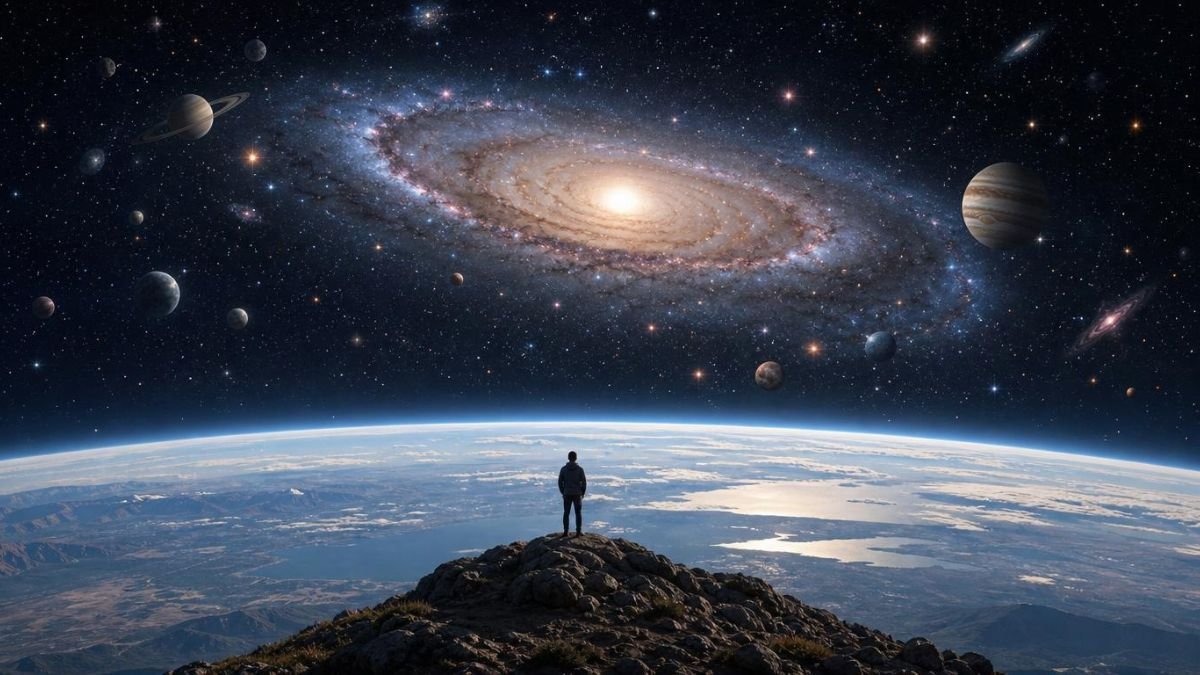
If size were really the measure of what matters, could anything you feel ever count?
That’s the question hiding inside this phrase, and I want to sneak up on it slowly, because I actually love this expression and I want to defend it before I complain about it.
In the grand scheme of things. We say it as an act of mercy toward ourselves. You spill the coffee on the good shirt, you miss the train, you replay the mildly humiliating thing you said in a meeting — and then somebody, or some better part of you, says: in the grand scheme of things, this is nothing. And the tightness in your chest lets go a little.
What’s happening in that moment is genuinely one of the great mental technologies available to a human being. It’s a zoom-out. You take the thing that’s filling your entire field of vision and you set it against a much larger frame — the year, the life, the century, the galaxy — and it shrinks to its actual size. The relief is real, and it’s not a trick. The proportion really was distorted. The zoom just corrected it.
Anyone who’s ever lain on their back under a genuinely dark sky knows this feeling. The stars do something to a worry. They don’t answer it. They just re-scale it, and somehow that’s enough.
So: a good tool. A real one. Now here’s the trouble.
The trouble is that the zoom doesn’t know where to stop.
Once you’ve pulled far enough back to make your embarrassment look small, you have also, by the identical operation, made everything else look small. Your work. The person you love. The thing you spent nine years building. Your grief, your child’s first sentence, the friendship of twenty years. From far enough away, all of it is the same size, and that size is zero. There is no telescope in existence that will shrink your anxieties and leave your loves untouched.
And when someone lives up there permanently — when the zoom-out stops being a tool and becomes an address — you get a particular kind of person we all recognize. Nothing quite reaches them. Everything is fine because nothing counts. They’ve mistaken numbness for wisdom, and they’ll tell you, gently, from a very great height, that in a hundred years none of this will matter.
Which is true. And useless. And also true of everything they’ve ever cared about, including that observation.
Then there’s the cruel version, and this is where I really want to plant a flag. Because this phrase is at its very worst when it’s aimed at somebody else.
Someone tells you their pain and you say: well, in the grand scheme of things. What you’ve done there is not offer perspective. You’ve refused to be present. You have taken the enormous, specific, immediate thing in front of them and used astronomy to decline to look at it. It’s dismissal wearing philosophy’s coat, and the person on the receiving end always feels the difference, even when they can’t name it.
So here’s the rule I’d offer, and it’s simple. This phrase is a telescope you’re allowed to pick up and point at your own anxieties. You are not allowed to point it at another person’s grief. Zoom out on yourself. Never on someone who’s hurting in front of you.
But I want to go further than a usage rule, because there’s a deeper problem with the phrase, and it’s sitting in the word grand.
Grand means big. And when we say the grand scheme, we almost always mean the large scheme — the wide frame, the long view, the cosmic scale. We’re using size as the standard. And once size is the standard, you have already lost, permanently, because there is always something bigger. Your country against the world. The world against the sun. The sun against a galaxy that contains hundreds of billions of them. On that measure nothing a human being feels has ever mattered or ever could, including the feeling of awe you get from contemplating it.
So size is the wrong measure. It has to be. A standard that cancels everything, including itself, isn’t a standard. It’s a solvent.
But notice the other word. Scheme. A scheme isn’t a size — it’s a plan. A design. An arrangement in which parts relate to a whole. And in any real scheme, the importance of a part has nothing to do with how big it is. A single misplaced note ruins a symphony. A small hinge decides whether the door opens. A sentence someone said to you at fifteen is still, quietly, steering decisions you’re making this year.
So if there’s a grand scheme, it isn’t grand because it’s big. It’s grand because it’s intricate — because it’s made of an unimaginable number of small things whose whole significance comes from where they sit and what they touch.
Which flips the phrase completely. Instead of in the grand scheme of things, this is nothing, you get something much more interesting and much more demanding: in the grand scheme of things, this small thing you’re about to do is connected to more than you can see.
I don’t think we have to choose between the two readings. Keep the telescope for your own three-in-the-morning spirals. But don’t move in. Come back down, every time, to the scale where things actually happen — which is the scale of one person, one room, one day, one conversation. That’s the only scale at which anyone has ever done anything.
So here’s what I’ll leave you with. The next time that sentence arrives in your mouth, catch it and ask it one question before you let it out: whose scheme, and what am I using it for?
Because there are two ways to say it. One of them frees you from a worry that had gotten too large. The other excuses you from caring about something you’d rather not deal with. They sound identical. Only you can tell which one you meant — so which one has it usually been?




0 Comments