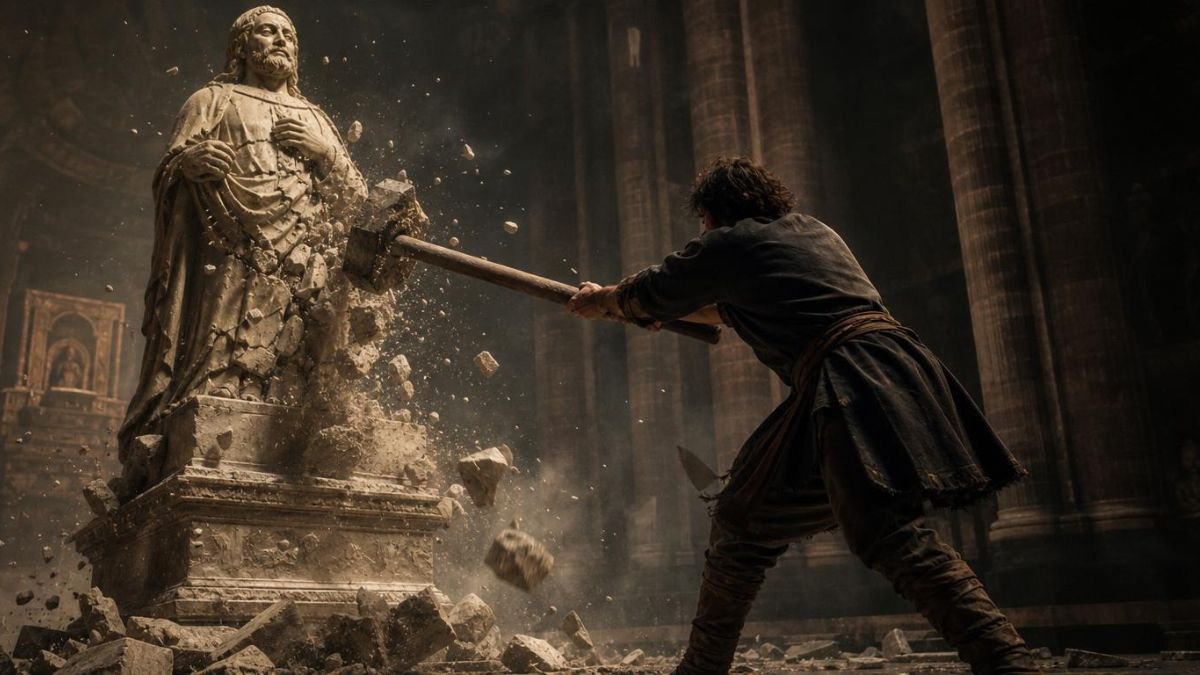
What if the person taking a hammer to the statue loves the god more than the people kneeling in front of it?
That's the question hiding inside tonight's word, and it's older and sharper than the way we use it. Iconoclast. We reach for it now to describe a certain kind of person — the founder who ignored the rulebook, the artist who broke the form, the thinker who said the thing everyone was thinking and nobody would say. It's become a compliment with a bit of leather jacket in it. A word for people who don't fit.
But the word remembers something much more literal. It's Greek. Eikon, meaning image, and klastes, meaning breaker. Image-breaker. And it comes from an actual period of history, in the Byzantine world of the eighth and ninth centuries, when Christians took hammers and knives to Christian art. Icons were pulled down from churches and destroyed — painted panels, mosaics, faces of saints that had been prayed to for generations, smashed and scraped away by people who believed they were doing something holy. Not vandals from outside. Believers from within.
Because the argument was theological, and it was this: that painted board is not God. It's wood and pigment. And when you kneel to it, when you kiss it, when you carry it through the streets — are you reaching through the image toward the divine, or have you started worshipping the image itself? Have you fallen in love with the picture?
That's the accusation buried in the word, and it has never really changed. Every iconoclast, in every century, is saying the same sentence in a different costume: you have mistaken the representation for the reality. You are serving a picture of the thing instead of the thing.
And once you hear it that way, the word stops being about rebels and starts being about all of us, because making icons is one of the most human things we do. We take something we love — something living and messy and hard to hold — and we make an image of it, because the image is easier to keep. We make an image of what a marriage looks like, and then serve the image while the actual marriage starves in the next room. We make an image of what success looks like, complete with the title and the address and the photograph, and pursue the image long after we've stopped wanting anything it was supposed to represent. We make an image of faith, and defend the image ferociously while the thing it pointed to quietly leaves. We even make an image of ourselves — a version we present, a story we tell about who we are — and then spend years protecting the portrait at the expense of the person.
That's the moment an iconoclast is needed. Not to destroy what you love, but to break the thing that has been standing in front of what you love, taking its offerings.
Which brings me to the distinction that matters most in this word, and it's the difference between an iconoclast and a vandal.
The vandal breaks because breaking feels like power. Anything will do. Anything cherished by anyone is a target, because the pleasure is in the smashing and in the faces of the people watching. It requires nothing — no belief, no love, no risk. It is the cheapest posture available, and our age produces it at industrial volume. Whole careers are built on ridiculing whatever people hold dear, and mistaken for courage.
The iconoclast breaks for the opposite reason. They break the image because they can still see the thing behind it, and they cannot bear watching a substitute receive the devotion. The test is simple and it never fails: does this person love anything? Is there something they're protecting on the far side of what they're destroying? Every real iconoclast is, underneath, a devotee. They're often the most serious person in the room about the very tradition they seem to be attacking. They're not tearing down the church because they think it's meaningless. They're tearing down the church because they think it's meant something, and it's stopped.
And here's the twist the word carries at the end, which nobody escapes. Every iconoclast becomes an icon.
It happens without fail. The one who broke the images becomes an image. The rebel's face ends up on a poster. The heretic becomes the founder of a new orthodoxy, with its own untouchable objects and its own people saying we don't question that here. The one who told everyone to stop worshipping pictures is now a picture on a wall, and a new generation is kneeling. Which means iconoclasm was never a personality type you could simply be. It's a practice, and it doesn't stay done. Any image can become an idol given enough time — including the image of the person who warned you about idols.
So the only honest way to hold this word is to point it at yourself. Not at the beliefs of people you already disagree with — that's the easy direction, and it costs nothing. The hard direction is inward, toward the pictures you've been maintaining for years without inspection. The idea of yourself you defend automatically. The version of your life you've been protecting in front of people. The belief you inherited so early that you've never once turned it over to see if there's anything on the back.
Break the picture. Not because you love the thing less, but because you finally want to look at it directly.
So here's what I'll leave you with. There's an icon somewhere in your life you haven't looked behind in years — a picture of a person, a plan, a faith, a self — polished, defended, and quietly receiving everything you had meant to give to the real thing. What would it take to lift it down off the wall? And what are you afraid you'd find standing there — or not standing there — once the image was out of the way?





0 Comments