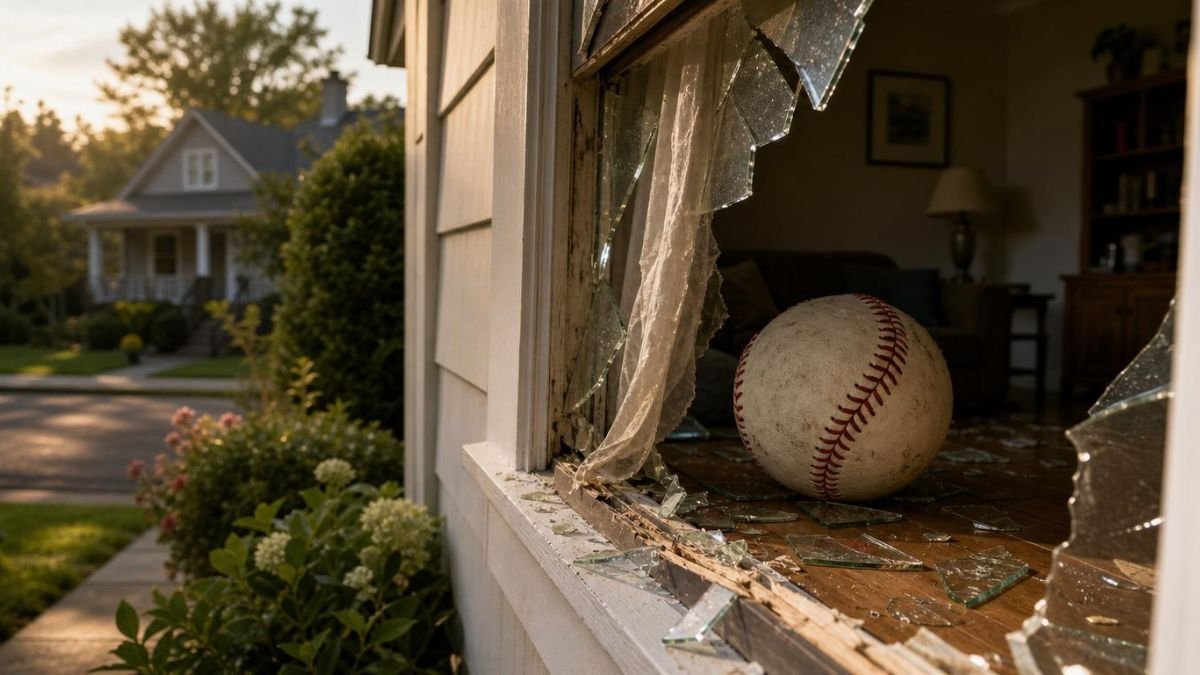
What if the things that make you flinch are the most reliable map you have of what you actually care about?
Start with the words themselves, because this phrase is more precise than we give it credit for. We don’t say something hit home. We say it hit close to home. It’s a measurement. It’s the language of range and distance — the vocabulary of a shot that landed nearby.
And a near miss does something strange to a person. It’s not the same as being struck. A direct hit produces pain and you deal with the pain. A near miss produces something else: an awareness. The shell landed in the next street and now you know two things you didn’t know a minute ago. You know that this is within range. And you know exactly where you were standing when it happened.
That’s what this phrase is describing. Something didn’t hurt you, exactly. It landed close to a structure you’d rather not have anyone aiming at.
But the part I really want to look at is the word home.
Because a phrase like this only makes sense if there’s a center. You can’t measure closeness to nothing. To say something hit close to home is to admit that you carry an interior map, and on that map there is a place marked as the middle, and everything else in your life gets its distance measured out from there.
And most of us have never actually drawn that map. We don’t know, in any explicit way, what’s at the center. We’d struggle to write it down.
Which is why the flinches matter so much. Because a flinch is a data point. It’s a marker dropped on the map, saying: something valuable is buried near this spot.
Think about the times it’s happened to you. A joke lands at a dinner table and everyone laughs and something in your chest goes tight, and you laugh too, and you spend the drive home wondering why it bothered you. A film ends and your friends are talking about the cinematography and you’re sitting in the dark unable to move. A criticism from someone whose opinion you don’t even respect goes in like a nail and stays there for a week.
In every one of those cases, the reaction is out of proportion to the event. And we’re embarrassed by that. We say, sorry, that’s silly, I don’t know why that got to me.
But disproportion is exactly the signal. A reaction that’s too big for its cause is telling you the cause landed near something else — something buried, something you built a while ago and haven’t looked at since. The flinch isn’t the response to the joke. It’s the response to what’s under the ground where the joke landed.
So the embarrassment is misplaced. What you’re calling oversensitivity is actually a survey. Your nervous system is quietly triangulating and handing you coordinates, and the only appropriate response is curiosity: what is stored there?
And here’s what makes this genuinely useful rather than just interesting. Most of us can’t answer the question what do you care about most honestly, because we answer it aspirationally. We name the things we’d like to be at the center. But you cannot fake a flinch. The flinch tells the truth about the map whether or not you approve of it.
Sometimes what you find is beautiful. You discover you care enormously about being useful to your family, or about a kind of work you’d stopped admitting mattered.
And sometimes it’s less flattering. Sometimes the thing near the impact site is a fear about status, or a wound about being left, or a very old sentence somebody said to you when you were nine and which has been sitting at the center of your map ever since, quietly determining the distance to everything.
That’s worth knowing too. Arguably more.
Now, there’s a second half to this phrase, and it’s about other people.
Because when something hits close to home for someone else, you’ve just been shown the location of their center — usually by accident, usually without their consent. You made a remark, or told a story, or repeated an opinion you don’t hold strongly, and watched something go very still in their face.
And I think there’s a whole ethics contained in what you do next.
The wrong move is to press. To find it interesting. To poke at the spot now that you know where it is, because we’re all a little curious about the buried things in other people. Or the equally common move: to get defensive, to explain that you didn’t mean anything by it, which turns their flinch into a problem they have to manage on top of everything else.
The better move is smaller. You note the coordinates. You don’t say anything. And you remember, later, that this is near their house.
Because that’s what the phrase is really admitting: everybody is living somewhere. Every person you speak to has a center they’ve never told you about, and a set of buried structures around it, and you are talking in a landscape you cannot see. Most of us are firing constantly without a map, and mostly nothing happens, and occasionally something lands in the next street and we don’t even hear it.
That’s not a reason for paralysis — you can’t hold a conversation while worrying about ordnance. But it is a reason for a particular kind of attention. When you see the flinch, believe it. Don’t argue with the size of someone’s reaction. The size is not about you.
And one last thing, which I find quietly hopeful. The phrase says close to home, not home. A near miss means it didn’t hit. The structure is still standing. Whatever is at the center of your map has not been destroyed by the joke at the dinner table or the film or the offhand comment. It’s been located. That’s all.
And a thing you can locate is a thing you can finally go and look at, in daylight, on purpose.
So here’s what I’ll leave you with tonight. Think back over the last few months and gather your flinches — the reactions that were too big, the moments you laughed a half-second late, the comment that stayed. Put them on a map like impact sites.
Now stand back and look at where they cluster. Because if you drew lines from all of them, they’d meet somewhere.
So the question is this: what’s standing at that point? And how long has it been since you went and looked at it — the thing your whole life has been quietly measuring its distances from?





0 Comments