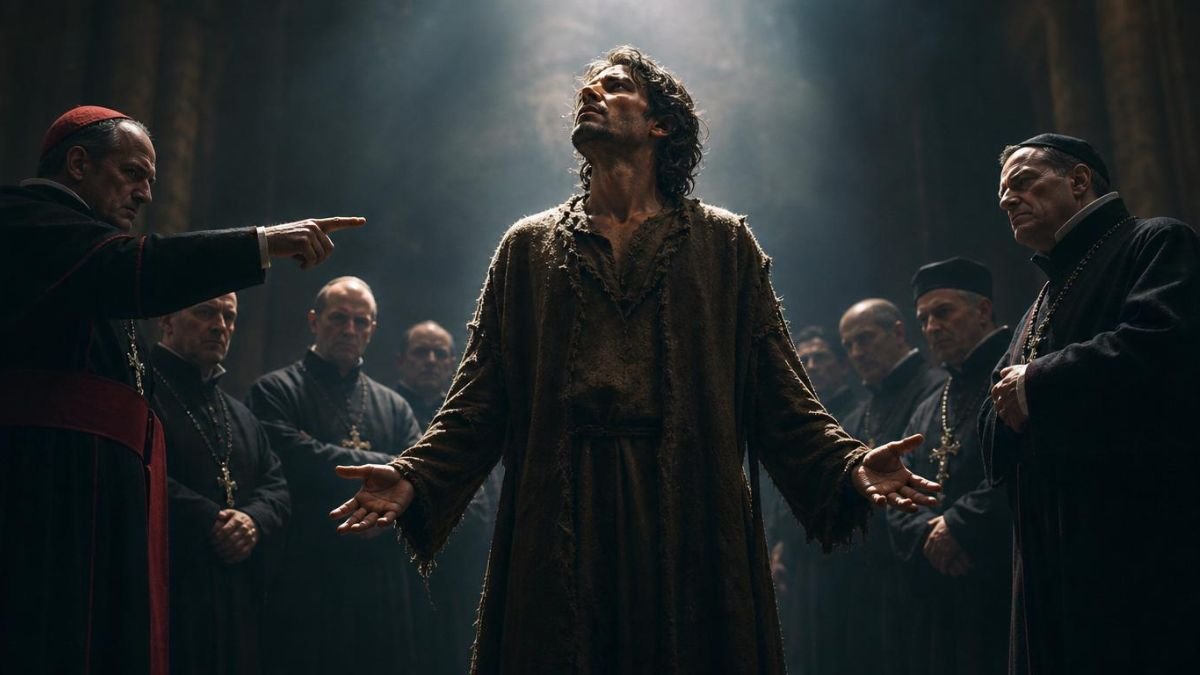
What if the original sin of the heretic was nothing more than choosing?
Because that's what the word actually says, and I don't think most people know it. Heretical. It's a heavy word, historically drenched — it carries trials, fire, exile, careers ended and lives ended. It sounds like the darkest possible thing to be accused of.
And it comes from the Greek hairesis, which means: a choice. A taking. A selection made for oneself. From hairein, to take, to pick up. In the older Greek world it was almost neutral — it referred to a school of thought, a philosophical faction, a set of ideas one had chosen to follow.
So the root crime in heresy is not believing something monstrous. It's the act of selection. It's the moment a person stops receiving a belief and starts picking one.
And once you see that, you understand why the accusation has always been so ferocious — because what's threatened isn't the content of the belief, it's the procedure. The heretic demonstrates, in public, that belief is something a person can hold up, examine, and decide about. And once a room has watched somebody do that, everyone else's belief changes character. It stops being the water they swim in and becomes one option among several, which it may never have been before. That's the danger. Not the wrong answer — the visible existence of a choice.
Which is why heresy has always been treated as more dangerous than outright unbelief. The stranger who believes something entirely different is easy; they're outside, they're foreign, they don't disturb anything. The heretic is inside. They share almost everything with you — the same texts, the same vocabulary, the same community — and they differ on one point, and that one point is unbearable precisely because everything else is shared. You can't dismiss them as ignorant. They know exactly what they're departing from. Families know this too: the deepest fractures are almost never with strangers.
And notice how the word has traveled. We now use it far outside religion, and we use it lightly. A heretical view of the economy. Heresy in the physics department. She has some heretical opinions about how to cook rice. It's become our word for any belief that a particular group treats as unsayable.
That drift is telling, because it means we've quietly understood something: every community has doctrine. Not just religious ones. Every workplace, profession, political tribe, family, and friendship group has a small set of propositions that are not really open, and everyone can feel where the edges are, and nobody ever wrote them down. You can usually locate them by noticing where a conversation goes strangely quiet, or where the response to a question is emotional rather than factual. That's a doctrinal boundary, and you've just touched it.
And here's the honest complication, because I don't want to hand you a romantic picture of the heretic as automatic hero.
Most heresies are wrong. That's the unglamorous statistical truth. If a community has spent a century thinking about something and one person disagrees, the odds are simply not in that person's favor. Orthodoxy isn't merely oppression — a lot of it is accumulated, tested knowledge, and there's a reason we don't reopen every settled question every morning. A world where everyone chooses everything from scratch isn't free; it's amnesiac, and it repeats every mistake at full speed.
So the heretic is usually mistaken, and occasionally right, and — this is the cruel part — you cannot tell which in advance. Not from the inside, and not from the outside. The person burned for a lunatic idea and the person burned for the idea we now teach in schools looked exactly the same to their contemporaries. Same confidence, same defiance, same insufferable certainty.
Which means the real question isn't should we tolerate heretics because they might be right. It's something more practical: what does a community lose when it makes heresy too expensive?
And the answer is: it loses the ability to find out it was wrong. Because if the cost of saying the forbidden thing is high enough, the forbidden thing simply stops being said — including on the occasions when it's true. And nobody in that community will notice the loss, because the absence of dissent looks exactly like consensus. That's the trap. A group with no heretics cannot distinguish between we are correct and we have made disagreement unaffordable.
But I want to bring this closer to home, because there's a private version of this word that matters more to most of us than the public one.
You have doctrines too. Beliefs you received early — about what you're capable of, what you're allowed to want, what kind of person you are, what your family is like, what your limits are — and which you have never once selected. They were installed, not chosen. And they operate with full authority, and they are almost never examined, because examining them feels vaguely like betrayal.
So the most useful act of heresy available to most people isn't public at all. It's the private one: taking a single belief you've held about yourself since you were twelve and doing what the Greek word says — hairein, taking it up, holding it, and actually choosing whether to keep it. Some you'll keep. That's fine; a chosen belief is worth ten inherited ones even when it's identical in content.
Because that's the real inheritance in this word. Not danger. Agency. The heretic's crime was believing that a person could pick.
So here's what I'll leave you with. Somewhere in you is a proposition you have never once questioned — not because you tested it and it held, but because it arrived before you were old enough to have an opinion about it, and has simply been true ever since. So think about what it might be. And ask yourself the question the word actually asks: if you took that belief in your hands today and were free to choose it or set it down, which would you honestly do?







0 Comments