What if the most peaceful word we have was born out of a shipwreck?
Halcyon. It’s a word that seems to glow. We reach for it when we’re describing something golden and gone — the halcyon days of a friendship, of a city, of a summer when we were young and nothing had gone wrong yet. It’s soft and slightly antique and drenched in nostalgia, and almost everybody who uses it is looking backward when they do.
But the word is not originally about the past at all. And it’s certainly not about summer.
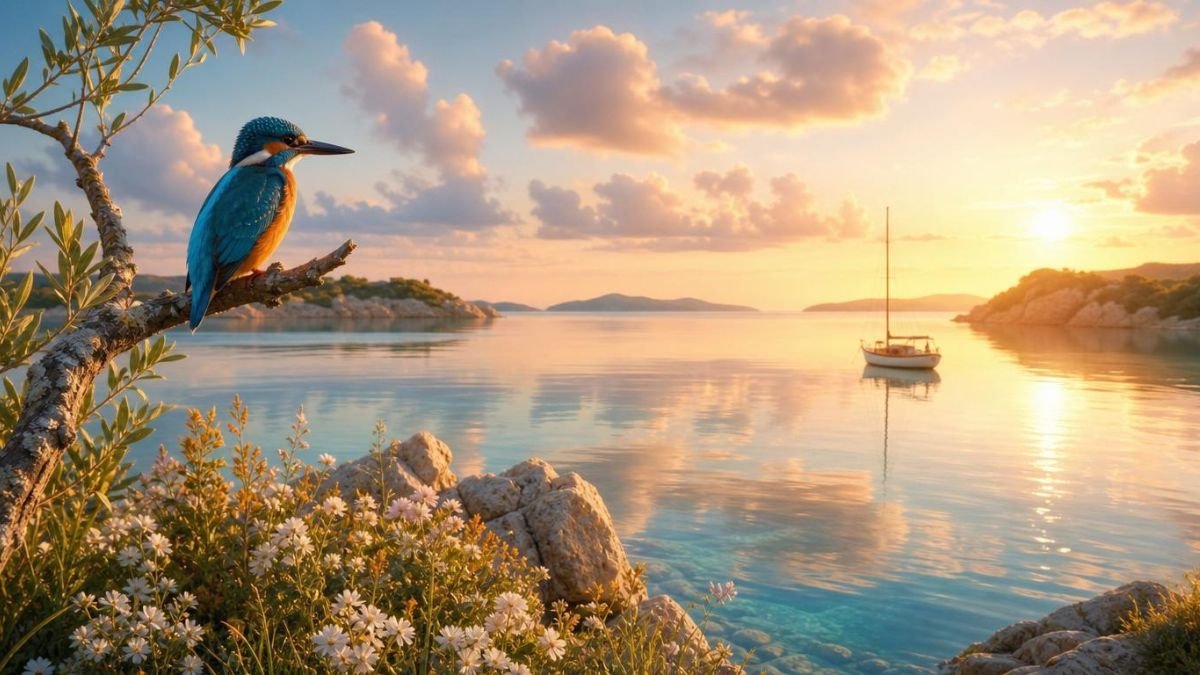
Halcyon comes from the Greek alkyon — a kingfisher. That small, ridiculous, brilliant bird, the flash of blue over the water. And behind the bird is a story.
Alcyone was the daughter of Aeolus, keeper of the winds. She married a man named Ceyx, and by every account they loved each other in that complete, unguarded way that myths tend to punish. Ceyx went to sea. A storm took the ship, and he drowned. And when Alcyone found out — in some versions when his body washed up where she stood — she threw herself into the water after him.
And the gods, moved by something they didn’t often bother to feel, turned them both into kingfishers so they wouldn’t be separated.
But that’s not the part that gives us the word. Here’s the part that does.
The kingfisher, in the old belief, builds her nest on the sea itself — a nest that floats on the open water. Which is, obviously, impossible; the first wave would end it. So Aeolus, her father, keeper of every wind there is, calms them. For about two weeks around the winter solstice, he holds the winds still so his daughter can lay her eggs on a floating nest in the middle of the ocean and have them hatch.
Those two weeks are the halcyon days.
And now look at what that actually means, because it is nothing like how we use the word.
Halcyon is not summer. Halcyon is the dead of winter. It’s a pocket of stillness cut into the worst season, on the most dangerous surface on earth. The storms haven’t been abolished. They’ve been paused. Everybody involved knows exactly how long it lasts, and everybody knows what comes after.
Halcyon days are not a golden age. They’re a granted stillness with a deadline.
And they were granted out of grief. That’s the detail that undoes me every time. The calm exists because a loss was so total that even the winds were stopped in sympathy. The peace is not the absence of the tragedy. It’s the tragedy’s strange, tender aftermath.
And they were granted for a purpose. Not for rest. Not so anyone could relax. The winds were stilled so that something could be born — so a nest could hold, in the middle of the sea, long enough for new life to hatch. The calm is not the point. The calm is the condition.
And stay a moment with the nest itself, because it’s the strangest object in the whole story. A nest on open water. Nothing under it. Nothing holding it. The most fragile structure we know of, containing the most fragile thing there is, placed on the least stable surface on earth — and it works, for exactly as long as the stillness lasts. I can’t think of a better picture of how anything worth having actually gets built. Not on rock. Not on guarantees. On a borrowed calm, over deep water, by someone who decided the eggs were worth the risk of the sea.
So this word, which we use to mean those lovely years before things went wrong, actually says something far more useful and far more urgent. It says: here is a brief window of stillness inside an ongoing storm. It will not last. It was given to you at a cost. Build something in it.
I think most of us are handed halcyon days far more often than we notice, and we spend nearly all of them waiting for a better calm to arrive.
Because we do this thing — we postpone. We say we’ll start the work, have the conversation, make the thing, go and see the person, once life settles down. Once this project ends, once the kids are older, once the money is steadier, once the storm properly stops. And we’re waiting for a permanence that the myth flatly says does not exist. Aeolus never abolished the winds. Nobody was ever offered a calm sea forever. What we’re given is fourteen days, on the water, in winter, and the instruction hidden inside the gift is: lay the eggs now.
And there’s another turn here, about nostalgia specifically. We call the past halcyon almost always from inside a storm — that’s the whole reason we’re looking back. Which raises an uncomfortable possibility: those days probably didn’t feel golden while you were in them. They felt ordinary. They felt like a Tuesday. You were, in all likelihood, worried about something that has since evaporated completely.
Which means the halcyon days you’re currently mourning were, at the time, invisible to you. And by the same logic — and here’s where it gets uncomfortable — you may very well be standing in one right now, on an ordinary evening, unable to see it, mildly irritated about something you won’t remember in a year.
Alcyone knew. That’s what separates her from us. She knew exactly how many days she had and precisely what they were for, and she spent every one of them on the nest.
So maybe the word isn’t nostalgic at all. Maybe it’s the opposite — a warning issued in the softest possible voice. Not remember how beautiful that was, but notice what you’re in, because it’s short and it was given to you for something.
So here’s what I’ll leave you with tonight. Imagine you were told that the calm you’re currently in — whatever calm you have, however partial, however unimpressive — is fourteen days long. That the winds resume after that. And that this stillness was granted to you specifically so that one thing could be born that cannot be born in a storm.
What is that thing? And why, exactly, are you waiting for a better sea?


0 Comments