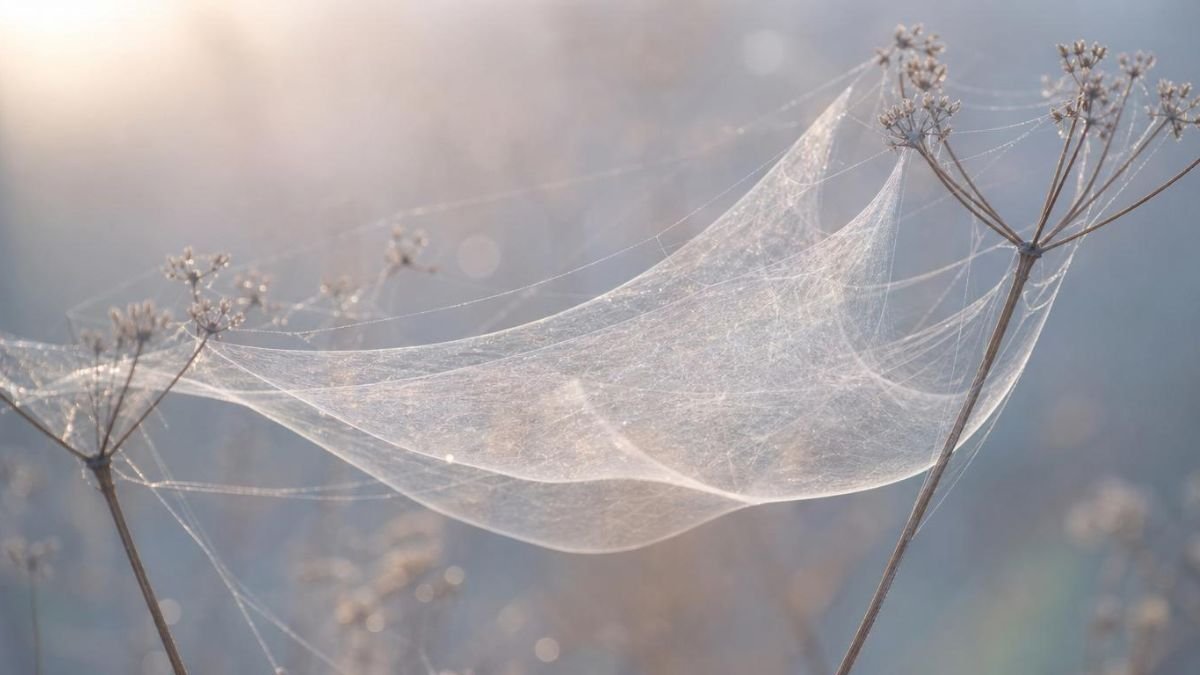
Have you ever seen the air full of threads?
It happens in autumn, on certain still, warm mornings after a cold night. You look across a field and the whole surface of it is silvered — thousands of fine threads laid over the grass, catching the low sun — and if you look up, there are strands drifting past at head height, going somewhere, unattached to anything. It looks like the morning is unraveling.
There's a word for those threads, and it's one of the loveliest in English. Gossamer.
We mostly use it now as an adjective for anything impossibly fine. Gossamer wings. A gossamer veil. A gossamer thread of hope. It's become our word for the barely-there — for things so delicate that describing them feels like touching them too hard.
But the origin is a small, strange story. The most persuasive theory is that it comes from goose summer — the old name for a warm spell in late autumn, around the time geese were traditionally eaten, when these threads appear most abundantly in the fields. Goose summer. A borrowed warmth in November, when the year has already turned but has generously forgotten to be cold. And the shining threads that filled the air in that season took the name of the season itself.
I find that so moving, and it's the kind of thing that happens over and over in English. A word gets named for when it appears, and centuries later we're using it for something ethereal and no one remembers there's a goose in there, and a false summer, and a specific week in November five hundred years ago.
Now — what are the threads actually?
They're spider silk. Not webs; something else. Many spiders, especially the tiny ones, travel by a method called ballooning. The spider climbs to a high point, lifts its abdomen, and releases fine strands into the air. The strands catch the breeze — and are also lifted by the earth's electric field, which is a fact I still find difficult to believe — and the spider lets go, and flies. Actually flies. They've been found miles up. They've landed on ships in the middle of oceans. A creature with no wings, riding a thread it made out of its own body, going wherever the sky decides.
So gossamer isn't debris. It's transport. Every one of those shining threads across the field is a used parachute, or one still in flight with a passenger too small for you to see.
And then there's the material itself, which is where this word turns into something else entirely.
Spider silk is one of the strongest materials known. Weight for weight, tougher than steel. Extraordinarily elastic — it can stretch enormously before breaking, which is what actually matters, because toughness isn't hardness; it's how much energy a thing can absorb before it fails. A web survives a flying insect not by resisting it but by giving, distributing the shock through the whole structure, and holding.
So our supreme word for fragility is made from one of the strongest things on earth.
That contradiction is the whole episode for me. Because I think we make this mistake constantly. We look at a thin thing and assume weakness. We look at something that yields and call it fragile. And gossamer says: no. Fineness is not weakness. Yielding is not failure. The thread survives the wind because it's thin enough to move with it — a rigid line of the same size would snap in an hour.
Think about which things in your life have actually held. It's rarely the rigid ones. The relationships that lasted thirty years weren't the ones defended most fiercely; they were the ones with give in them, that could stretch across a bad decade and come back. The people who endured the most weren't the hardest. Hard things shatter. It's the ones with elasticity — who could bend absurdly far, absorb the shock, and return — who are still standing.
And there's a second lesson in the ballooning, which I keep returning to.
To fly, the spider has to let go. It spins the thread out of itself, and then it releases the surface it's standing on, with absolutely no ability to steer. It cannot choose a destination. It cannot come back. It makes something out of its own body, offers it to the wind, and lets the world take it somewhere.
That's an astonishing amount of trust for an animal the size of a comma. And it works — it's how spiders colonized islands that rose from the sea; it's how they arrived on volcanic ground where nothing had ever lived. The most successful dispersal strategy on the planet is: make a thread, let go, don't steer.
I'm not going to turn that into cheap advice, because letting go with no steering is not a strategy I'd recommend for most Tuesdays. But I'd note that everything you've ever made and released — the message you sent, the work you published, the kindness you offered without follow-up — went out on exactly that principle. You spun something out of yourself, you let it go, and you had no control over where the air took it. Some of it landed on ground you'll never see.
So the next time you're in a field on a bright cold morning and the whole world seems to be strung with light, know what you're looking at. Not decoration. Not decay. A migration. Thousands of small travelers who made a thread from the inside of themselves and trusted the sky. And know that the word you'd use for it carries a goose, and a false summer, and five hundred years of people standing in the same field, looking up.
So here's what I'll leave you with. If the finest thread in nature is also among the strongest — if it survives precisely because it gives — then what have you been calling fragile in yourself that was actually just elastic? And what would you have to spin out of your own body, and then release with no way to steer it, in order to finally get somewhere the wind is going?





0 Comments